WHAT is the Most Deadly Virus?

The virus of relativism was blowing in the wind, along with a virulent secularism determined to propel any remnants of biblical Christianity out of the public square.

virusB

When I originally wrote this book more than twenty-five years ago, the winds of the “me generation” were blowing a strong and deadly virus through the culture.

The cultural revolution that had taken root in the 1960s was beginning to reach full flower, as seen in the abandonment of traditional values and moral standards in almost every sector.

“Do your own thing” became the slogan that guided choices and behaviors, closely aligned with “I gotta be me!” and “I owe it to myself.”

The virus of relativism was blowing in the wind, along with a virulent secularism determined to propel any remnants of biblical Christianity out of the public square.

It was period of time marvelously captured in a biblical statement that serves as a description slogan for a period in Israel’s history known as the time of the judges: “Everyone did what was right in his (or her) own eyes.”

Even at my most pessimistic moments back then, I would not have imaged that things could or would unravel as quickly or as drastically as they have.

We have experienced a cultural “perfect storm,” due to the convergence of forces such as moral relativism, aggressive pluralism, determined secularism, “do it yourself” spirituality, and libertarian individualism, aided by the technological realities of the information age.

The implications for followers of Jesus Christ are obvious.

We cannot hermetically seal ourselves from the spirit of the age so that we live in splendid isolation from it.

In fact, we must not.

First, our sovereign Lord calls us to live in the world for His glory, and monasticism and isolationism are not biblical options.

Our mandate from the risen Christ prohibits retreat.

Besides, the attempt is futile. There is no place to hide. Virtually every segment of modern culture has become a carrier of values alien to those of the kingdom of Christ.

We confront the open expression of these anti-Christian values in academia, the media or the entertainment industry; commonly in the operations of our daily life that bring us into constant contact with lifestyles we are expected not merely to tolerate or accept, but to celebrate; and less directly in spheres of commerce and technology.

Sadly, the spirit of the age often takes its most deadly form when it is absorbed into the professing Christian community.

Much more than I want to admit, many Christians live, act, and choose as if God’s Word had never been written.

How do we live in a society without fixed standards, a society daily becoming more secular and pagan?

God’s call is clear: “Prove yourselves to be blameless and innocent, children of God above reproach in the midst of a crooked and perverse generation, among whom you appear as lights in the world, holding fast the word of life” (Phil. 2:15-17 NASB).

These are important verses.

They remind us that we are not simply to survive the moral confusion and spiritual anarchy that surrounds us, somehow staying unpolluted by the world.

We are also to shine, reflecting the glory of the Lord Jesus to a world that desperately need to see Him.

In other words, we are not just to be good in the midst of evil.

We are not even just to be good for something, serving others.

We are to be agents of our King, pressing His kingdom and its values into our culture and forming communities that are outposts of his kingdom, demonstrating to the world another, and a better, way to live life.  (Gary Inrig, “Hearts of Iron, Feet of Clay,” 7-8)

“God loves you and I love you and that’s the way it’s gonna be!” – Mike

What About those Mutations?

We all ‘read’ messages through our past hurt, our present circumstances and our prejudged expectations…

dna-structure-562597795-5ae77532c06471003681d684

When I preach I am often shocked at the disconnection that occurs between the words and that I speak and the words that are heard.

I have often had a discussion with a member of a congregation after church service who is convinced that I said something that I didn’t say.

When the video, tape or other people are consulted and it becomes clear what was actually said, the individual sometimes becomes intransigent: ‘Well, I know what I heard, and it’s not what you say that you said!’

What we are seeing here is a problem of decoding.

The same communication problem operates in the field of genetics.  Information is passed from one generation to another via a genetic code.  Sometimes, however, in the process of exchange some sort of mutation or change takes place that causes the process to go awry.  The information received is not the same as that passed down.

The principle that we must be aware of if we are to receive the exact messages that are sent is that we all ‘read’ messages through our past hurt, our present circumstances and our prejudged expectations.  In other words, we screen or decode messages through a filter, and occasionally that filter is not always clean (emphasis mine–mb).

For instance, when I teach on the subject of relationships, occasionally I have read out a list of common words and asked the audience to write down their immediate feelings when I mentioned them.  I then compare answers.  If I use the word ‘father’, for example, the feelings swing from ‘love’ and ‘security’ to ‘hatred’ and ‘pain.’  Their recorded emotions reflect their past.

What I am attempting to illustrate to them is the difference between denotation and connotation.  If we look up the word ‘father’ in the dictionary, it has a literal meaning or denotation, yet it may, as we have seen, have a completely different specific meaning or connotation to each of us. So if I use the phrase ‘God is our Father’ without explanation from the pulpit, I am in danger of being misinterpreted since everyone will decode the phrase differently.  On top of the problem of connotation, people tend to add their feelings of rejection, their poisoned perceptions and their ill-informed expectations (Robert Fergusson, “A Plank Across a Stream,” Making Connections That Work, 166-167).

“Therefore do not be unwise, but understand what the will of the Lord is (Eph. 5:17).

“God loves you and I love you and that’s the way it’s gonna be!” – Mike

What is THIS?

bf5c2e990bda8b22c53067042d449d99-colorful-heart-sticker-by-vexels

Finish the following Bible passage:  “By THIS all will know that you are My disciples…” (John 13:35—emphasis mine, mb).

  • “if you sing a cappella (i.e., without instrumental accompaniment) in your worship assemblies.” Col. 3:16; Eph. 5:19
  • “if you observe the Lord’s Supper every first day of the week.” Acts 20:7; 2:42
  • “if your women do not lead in the assembly or usurp authority over a man.” 1 Tim. 2:12-15; 1 Cor. 14:26-35
  • “if you do not tithe, but rather engage in a free-will offering each Lord’s Day as you have been prospered.” 1 Cor. 16:1-2
  • “if you teach and practice that divorce is sanctioned for only one reason—and that is the sexual unfaithfulness of your spouse.” Mat. 19:9
  • “if you baptize penitent believers for the remission of sins.” Acts 2:38; 22:16; 1 Pet. 3:21
  • “if you correctly employ the appropriate biblical term for the brother who proclaims the gospel from the pulpit as a ‘preacher’—and not a ‘pastor’.” 1 Tim. 3:1-7; Titus 1:5-9
  • “if you correctly interpret and teach what the Bible says about the coming of the Son of Man/Christ.” Mat. 16:28; 24:29
  • “IF YOU HAVE LOVE FOR ONE ANOTHER.” Lev. 19:18; John 15:12; Rom. 13:9; 1 Pet. 2:17; 4:8; Heb. 13:1; 1 John 4:12

“Preacher, are you saying that doctrine doesn’t matter?”  Nope—I’ve never said that, I’ve never taught that, nor have I ever even thought that.  Right doctrine is ESSENTIAL.  Period.  Dot.  End of sentence (Acts 2:42–“in the apostles’ doctrine”; 1 Tim. 1:3—“teach no other doctrine”; 4:6—“good doctrine”; 4:12—“doctrine”; 4:16—“the doctrine”; “doctrine”—5:17; 6:1—“God and His doctrine”; 6:3—“the doctrine”; 2 Tim. 3:16—“for doctrine”; Titus 1:9, 2:1—“sound doctrine”; 2:7—“in doctrine”; 2:10—“the doctrine of God”).

But sometimes well-intentioned brethren emphasize the right thinking about doctrine (and they should), but they unfortunately fail to first emphasize the right practice of doctrine—and that is in and with patient LOVE.

Ya’ll ever notice this…?

In Ephesians 4, in that grand chapter about unity, before the apostle Paul talked about one body, one Spirit, one hope, one Lord, one faith, one baptism, and one God, he predicated them all with LOVE.  “I…beseech you to have a walk worthy of the calling with which you were called, with all lowliness and gentleness, with longsuffering, bearing with one another in LOVE” (vv. 1a, 2—emphasis mine, mb).  Question.  Did Paul ever say in this chapter (or anywhere else for that matter) that doctrine was unimportant?  A thousand times no!  But what active heart attitude did he say must first be practiced in order for doctrinal unity to be enjoyed?  Read the latter part of verse two again and then commit it to memory.  “Bearing with one another in LOVE.”

But now watch it again.

In 1 Corinthians 13, the same apostle through divine inspiration said, “If I speak with the tongues of men and of angels, but have not LOVE, I have become as sounding brass or a clanging cymbal.”  In the context of speaking in foreign tongues (cf. Acts 2:4, 6-11), Paul said—now get this—“If I am miraculously endowed with the ability to teach God’s Word in a language which I’ve never studied before, but I don’t possess or either speak the truth in LOVE (Eph. 4:15), then all I’m doing is making a bunch of loud racket” (e.g., sounding brass and a clanging cymbal).1

But keep reading.

“And though I have the gift of prophecy (i.e., the miraculous gift to speak for God—cf. Mat. 7:22), and understand all mysteries and knowledge (i.e., miraculous gifts of comprehension)…but have not LOVE, I am nothing” (v. 2a, c).  Paul said, “Even though the Holy Spirit revealed to me truths, ideas and concepts, which the church as a whole has neither known nor grasped up until this time, if I fail to exhibit Christian love, then his special capacity and discernment is absolutely worthless to either me or the church.”  In other words, his knowing the truth without first practicing truth (i.e., LOVE) would have been meaningless.

Our Lord made this very same point in Matthew.

Jesus told the doctrinally fastidious scribes and Pharisees of His day, “You pay tithe of mint and anise and cumin, and have neglected the weightier matters of the law: justice and mercy and faith.  These you ought to have done, without leaving the others undone” (23:23b).  These guys were so “gun-ho” about keeping every facet of the law that they actually gave ten percent of the seeds (which were used to spice their foods) in their herb gardens.  Now watch, Jesus never condemned them for their religious fervor in terms of sacrifice; He did censure them, however, for their failure to harmonize their efforts with expressions of genuine love.  The Jewish world knew theses religious leaders by their devotion and ardor—even to the point of minutia, but they didn’t know them as a group by their LOVE.   And as important as it was to properly and fully sacrifice, these devotees of the law didn’t keep the, watch it—“weightier” matters of the law—at all.  They got doctrine right, but they missed the heaviest doctrine of all—love.

So many of my good brethren today in their zeal for doctrinal accuracy wholly miss this concept of love.  They “bite and devour” one another (Gal. 5:15) over important, yes—even essential matters, but they overlook THE MOST IMPORTANT, THE MOST ESSENTIAL matter of all—Christ-like LOVE. 

Our Lord said, “By THIS all will know that you are My disciples, if you have LOVE for one another” (John 13:35).

Beloved, are you known by your love?

1/ John MacArthur, “In New Testament times, rites honoring the pagan deities Cybele, Bacchus, and Dionysus included speaking in ecstatic noises that were accompanied by smashing gongs, clanging cymbals, and blaring trumpets.  Paul’s hearers clearly got his point: unless it is done in love, ministering the gift of languages, or speaking in any other human or angelic way, amounts to no more than those pagan rituals.  It is only meaningless gibberish in a Christian guise.”  The MacArthur New Testament Commentary, 1 Corinthians, 331).

“God loves you and I love you and that’s the way it’s gonna be!”–Mike

What is Faithfulness?

31kelley2-mobileMasterAt3x

It was a Sunday morning, October 23, 1983.

A Hezbollah suicide bomber drove his truck packed with over 2,000 pounds of explosives into the U.S. Marine barracks in Beirut, Lebanon.

214 Americans were killed while they slept in their beds; another 128 were wounded in the horrific blast.

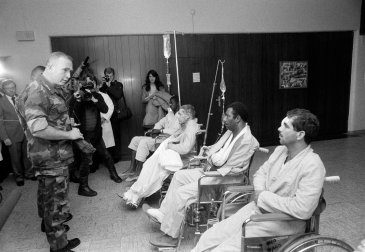
A few days after the tragedy, Marine Corps Commandant, Paul Kelly, visited some of the survivors in a Frankfurt, Germany hospital.

Among them was a Corporal named Jeffrey Nashton, who had been severely wounded in the attack.

Nashton had so many tubes running in and out of his body that someone said he looked more like a machine than a man.

As Kelly neared him, Nashton, struggling to move and racked with pain, motioned for a piece of paper and a pen.

He wrote a brief note and then passed it back to the Commandant.

The slip of paper had only two words – “Semper Fi,” the Latin motto of the Marine Corps, meaning “forever faithful.”

Thought: Christianity in general and marriage in particular aren’t simply about starting journeys – they’re about being forever faithful.

general-pxkelley

INCARNATE:  10 Do not fear any of those things which you are about to suffer. Indeed, the devil is about to throw some of you into prison, that you may be tested, and you will have tribulation ten days. Be faithful until death, and I will give you the crown of life (Rev. 2:10).  

“God loves you and I love you and that’s the way it’s gonna be!” – Mike