THE LORD’S CHURCH at Thessalonica had suffered her share of negative experiences.
You could say she had been “burned.” False prophets had come in with alleged messages from God—especially in the context of the second coming (4:13-5:11). In retrospect, the congregation realized that some of these individuals hadn’t really brought actual, factual revelations (cf. 2 Thess. 2:1-3).1
Unfortunately, as is sometimes the case, the brethren not only stopped listening to the false prophets (a good thing), but they moved to the opposite extreme and evidently rejected ALL prophets and prophecies (not a good thing).
Paul tried to keep the pendulum of reaction from swinging too far and keep the church at center. He said, “Do not despise prophecies…” (1 Thess. 5:20). The Greek word translated “despise” is exoutheneo (pronounced eks-ü-the-ne’-ō). It means “to make of no account.” In Alabama parlance, when a person says something is “of no account,” he’s saying it’s of no or very little importance. In lieu of the fraudulent messages from false prophets, the Thessalonians treated ALL prophets and prophecies as though they were of no account.
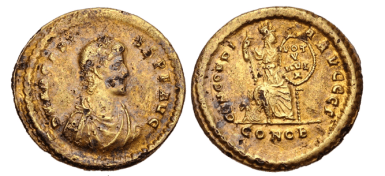
Paul, by contrast, urged them to employ a different methodology. He said, “Test all things…” (v. 21). “Test”—some versions say “prove” (KJV, ASV); the word in the original is dokimazo (pronounced do-kē-mä’-zō). It means “to test, to examine, to prove, or to scrutinize” (to see whether a thing is genuine or not).2 The word was used in reference to the testing of ancient coins.
Somewhere around 650 BC, coinage was invented on the eastern shore of the Aegean Sea (think Asia Minor). Counterfeiters and counterfeit coins appeared soon thereafter.3
There were two ways of counterfeiting an actual coin. The first method was to cover a base metal disk with a very thin veneer of precious metal (like silver) and then strike it between engraved dies. Assuming the plating was smooth and without obvious defects, that the dies were of good quality, and the weight of the finished product was close to the official standard, a spurious coin might pass as genuine. This bogus coin was referred to as a fourrée (from the French word meaning “stuffed”).
The second method was to make a clay mold from a legitimate coin, and then pour molten metal (i.e., leaded copper alloy) into the mold. Since ceramic molds could be produced en masse with a minimum of expense, counterfeiters could make a significant profit from the creation and exchange of their low-value copper forgeries.
To deal with the proliferation of these counterfeit coins, some ancient societies passed laws which provided for official coin-testers (called dokimastes)—who would sit at banking tables in the marketplace and inspect metal currency. These “testers” would inspect a coin, weigh it against an official standard coin, and then cut it with a chisel to reveal what was on the inside. In so doing, they proved whether or not the money was genuine or whether it was a forgery.
Now watch it. Paul told the Thessalonians, “Do not despise prophecies. Test (dokimazo) all things; hold fast what is good.” Test what things, Paul? Prophecies (v. 20). Don’t despise all of them, don’t consider all them of no account—but prove and inspect them.
Beloved, the mandate of the Thessalonian church is ours today. Just because a preacher says something from the pulpit doesn’t necessarily make it true. It is possible he is sincere, but mistaken (e.g., Apollos—Acts 18:24-26); then too, it is possible that he is insincere as well as in error (e.g., Hymenaeus and Alexander—1 Tim. 1:20; Hymenaeus and Philetus—2 Tim. 2:17-18). On the other hand, because he says something that you haven’t heard before doesn’t necessarily make it wrong. The only way of knowing what he says is factual or not is to compare what he teaches with the revealed will of God.4
“Beloved, do not believe every spirit, but test (dokimazo) the spirits, whether they are of God; because many false prophets have gone out into the world” (1 John 4:1).
1 Earl D. Edwards, 1 Thessalonians 5:20-21, Truth For Today Commentary, 188.
3 Counterfeiting has sometimes been referred to as “the second oldest profession.”
4 “Christians must learn to discern truth from error, good from bad. We cannot always trust the source.” Michael Whitworth, 1 Thessalonians 5:19-22, Living & Longing for the Lord, 118.



 INCARNATE