
INCARNATE – THIS WORLD IS NOT MY HOME

I have always enjoyed singing the song, “This World is not my Home.”  Its meaning should have a very special place in the hearts of those who have faith in our Father’s promises.  As the song states, this earthly life full of worldly care is not our home.  We are merely pilgrims on a journey.  We should not dwell on the things of this world, but instead set our minds on our eternal home, which is Heaven.  If our sights are set on heaven, we will do everything necessary to go there and bring others with us. 

            The verse the song writer used in reference with this song is Matthew 6:19-20. “Do not lay up for yourselves treasures on earth… but lay up for yourselves treasures in Heaven.” (NKJV) If we dwell on our treasures here on earth then this is where our thoughts will constantly be.  If we dwell on reaching our eternal home, then our thoughts and actions will be directed toward Heaven and remembering His promise and pleasing our Heavenly Father.  This reminds me of Matthew 6:21: “For where your treasure is, there your heart will be also.” (NKJV) Of course, it is a wonderful thing to be able to enjoy the things we have been blessed with during our life here on earth.  When a Christian’s spiritual attitude and duties suffer, this is an indication that the heart is not in the right place.  Our successes and blessings are given by God.  As we give Him the glory, our hearts will remain humble and our mindset continues to be focused on being with Him.

            Let’s take a look at some of the verses of the song I mentioned above.  In verse 1 it says, “This world is not my home, I’m just a passing thru.”  We are just passing through this life and rather quickly, it seems.  Just like the verse states in James 4:14, “For what is your life?  It is even a vapor that appears for a little time and then vanishes away.” (NKJV)  We have just a short life to live on this world and we need to make every minute we have count towards our heavenly goal.  In the second verse of the song it mentions “my Savior pardoned me and now I onward go.”  Jesus died on the cross for us and gave us a chance to be forgiven of our sinfulness and join him in everlasting life in Heaven.  He did not have to do this and yet he did.  His cruel death pardons us from sin and allows us the opportunity to join with him in Heaven.  Also in the second verse, it says “I know He’ll take me thru tho’ I am weak and poor”.  We are weak and sinful men.  Through God’s grace we have been promised strength and rich blessings in Heaven with our Savior as long as our faith is in him, not of this world.

            We need to have a mindset like the chorus verse of this song “And I can’t feel at home in this world anymore”.  Satan constantly tries to ensnare us with earthly pleasures and troubles.  He wants the faithful to loose sight of God’s promise and those of the world to be consumed with earthly concerns.  Constant prayer and fellowship with other Christians will provide us strength to prevent these temptations.  God’s promise to the faithful of eternity with Him should give us peace that the troubles of this world are only temporary and the weakness of the flesh is of this world, not Heaven.  The many that see this earthly life as their “home” desperately need us to be messengers and to share this “GOOD NEWS” of our Savior and His eternal home promised to those who believe and obey.  May each of us live everyday with the title of this song “this world is not my home” engraved on our hearts and remember God’s promise to those who believe on Him. BY JASON HUDSON

“GOD LOVES YOU AND I LOVE YOU AND THAT’S THE WAY IT’S GONNA BE!” – MIKE

INCARNATE – IF THERE IS A GOD, LET HIM STRIKE ME DEAD RIGHT NOW

Most of us have heard the age-old story about the unbelieving professor. He stands in front of his class and demands that there is no God. “If there is a God,” he challenges, “then let Him strike me dead right here and now.” He pauses for dramatic effect and waits 30 seconds. When nothing happens, he proclaims his atheistic position as the victor and gloats, “Just as I suspected, I’m still alive. There is no God.” Supposedly, just because God does not do exactly as he demands at that particular instant, then that proves there is no God. But let’s critically assess this emotional appeal (because it certainly is not a logical argument) and see how we could rationally respond to it.

Is it true that someone who has the power to do something should always do it when called upon to do it? For instance, suppose a criminal robs a bank and murders several people. A policeman arrives on the scene pointing his pistol at the criminal. The criminal drops his gun and begins to taunt the cop. “You gonna shoot me with that gun? I bet you don’t even have any bullets loaded. You are probably a terrible shot anyway. If you do have a loaded gun, and you think you could hit me, go ahead. Pull the trigger. Shoot me, if you are a cop.” If the policeman has a loaded gun and is a good shot, should he shoot the criminal, just to prove that he can? Of course not. There could be some very good reasons why the policeman, when taunted to show his power, refuses to respond.

Now think about our professor. He demands that God kill him on the spot to “prove” that God exists. He is taunting God just as the criminal did the policeman. Could there be legitimate reasons as to why God does not strike him dead? Certainly. Maybe the professor is going to convert to Christianity in several years and be a strong force for good in the world. Maybe the professor is going to teach one of his students something about medical science that leads that student to find a cure for cancer, and that student ends up being a Christian who gives God the glory for the discovery. Maybe the professor is going to have a child that rebels against his father’s atheism, becomes a Christian and does mission work for many years. Since God is the only being Who knows all the possible ramifications of every thought and action, only He would be in a position to know how to respond in such a situation.

Throughout the course of human history God has worked His will through miraculous and through what we would call natural means (often called providence). In many eras of history He has used both at the same time; but in some instances and epochs, He has worked primarily through providence with very little or no recognizable miraculous activity. It is important to understand this truth, since it is often affirmed that if God has worked miracles in the past to aid His people, then He “should” be doing the same today. For instance, agnostic professor Bart Ehrman demands, “If he [God] could do miracles for his people throughout the Bible, where is he today when your son is killed in a car accident, or your husband gets multiple sclerosis, or civil war is unleashed in Iraq, or the Iranians decide to pursue their nuclear ambitions?”1 This idea is well-illustrated on Marshall Brain’s Web site whywontgodhealamputees.com. According to Brain, the fact that God does not miraculously regrow limbs proves that He is imaginary. He says, “Nothing happens when we pray for amputated limbs. God never regenerates lost limbs through prayer…. Does God answer prayers? If so, then how do we explain this disconnection between God and amputees?”2

Notice that Brain, Ehrman, and the atheistic professor insist that if God is capable of miracles (or striking a person dead), then we should see those things happening today. But why must that be the case? Could it be that an all-knowing God has very good reasons why He is not at work in the same miraculous ways He worked in the past? In addition, the same Bible that tells us about God’s miracles also lays out a very strong case for God working through providential means. To demand that God must operate in the way that we insist He operate is more than slightly presumptuous, especially in light of the fact that He has given us ample information about other ways He works.

Ehrman and other unbelievers challenge Christians to produce modern miracles as evidence that God intervenes in the world today. They do so, however, refusing to recognize two important truths. First, even during the ages of human history when God performed miracles, He did not intervene to stop all suffering. People still got sick, had accidents, broke bones, suffered emotionally, and died. It is as if the skeptic insists that the Bible paints a picture of a God who swooped in miraculously to stop all suffering. Such was never the case. Miracles were isolated events designed to confirm the validity of the message of certain divine messengers.3 The Bible has never presented them as a wholesale answer to the problem of pain and suffering. Second, to insist that God must use miracles today just because He has the power to do so discounts the pervasive biblical theme of providence. Throughout history, one of God’s primary modes of operation has been to providentially work through natural laws. To deny that this is the case is to turn a deaf ear to a massive amount of biblical testimony. BY KYLE BUTT, M.DIV.

ENDNOTES

1 Bart Erhman (2008), God’s Problem: How the Bible Fails to Answer Our Most Important Question—Why We Suffer (New York: HarperOne), p. 274.

2 Marshall Brain (2014), “Why Won’t God Heal Amputees?” http://whywontgodhealamputees.com/.

3 Dave Miller (2003), “Modern-Day Miracles, Tongue-Speaking, and Holy Spirit Baptism: A Refutation,” Apologetics Press, https://www.apologeticspress.org/APContent.aspx?category=11&article=264&topic=293.

“GOD LOVES YOU AND I LOVE YOU AND THAT’S THE WAY IT’S GONNA BE!” – MIKE
INCARNATE – THE TRUTH ABOUT CHRIST’S CHURCH

There may be some things in the Bible which are difficult to understand, but there are others which are so simply stated but often are easily overlooked. Two of these truths are that Jesus established the church and that He never wanted it to be changed.

The rock and foundation, the pattern, never changes.

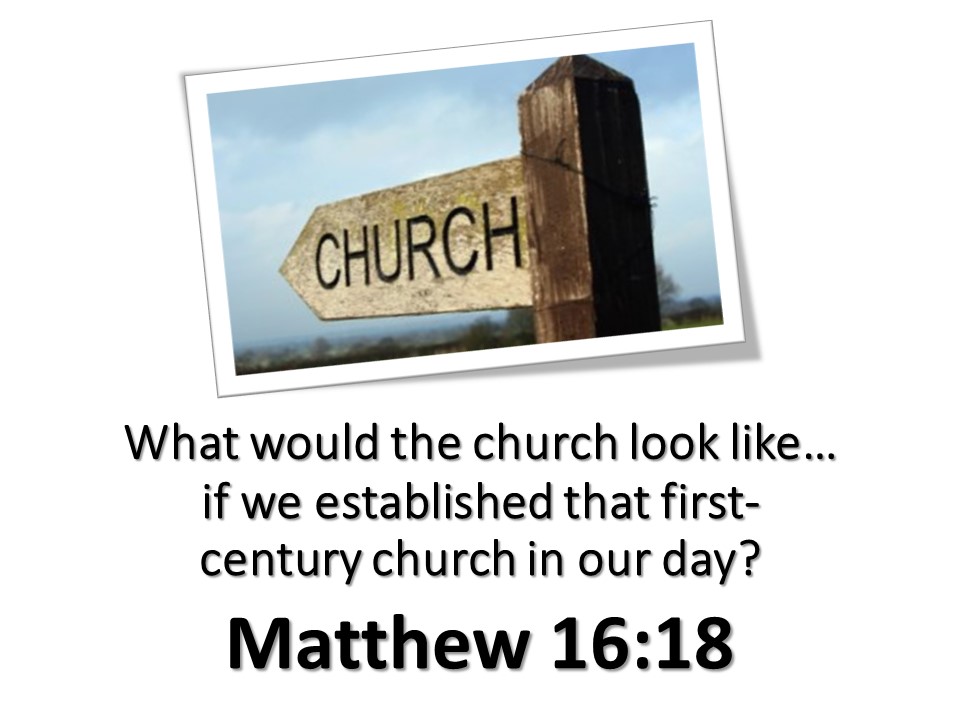
Read Matthew 16:18 and notice how easy it is to understand the promise Jesus made before He died about what was about to happen. “I will build My church.” Even a child can grasp these words. Continue to read the Bible, and you will see exactly what happened. Just days after He ascended into heaven that church became a reality, and men were added to it (Acts 2:38-47). We must never overlook this truth so plainly stated.

Read the words in Matthew 16 which follow His promise to build the church. He said to Peter, “Whatever you bind on earth will be bound in heaven and whatever you loose on earth will be loosed in heaven.” Two chapters later, He expanded this right to reveal God’s message bound upon all men to include others (Matt. 18:18). For the church to exist, there was a new testament which was about to be revealed, but when that truth was bound on this earth it was bound in heaven. We must not overlook this truth so simply stated.

To see how firmly this new way of living was binding on man, read the words of the apostle Paul. “I marvel that you are turning away so soon from Him who called you in the grace of Christ, to a different gospel, which is not another; but there are some who trouble you and want to pervert the gospel of Christ” (Gal. 1:6-7). The truth was so firmly bound on mankind that to change it is described as a perversion.

Then, read the next verse to see that the gospel could not be changed. “But even if we, or an angel from heaven, preach any other gospel to you than what we have preached to you, let him be accursed.” Do you see how easily these words show that the Lord never gave any man, including the apostle Paul, or any angel from heaven to change the truth that was revealed?

Yet, it is so easy to overlook these two truths. God first gave that Old Testament to the Jews and only God Himself could change it (Deut. 4:2; 12:32). When Jesus gave us the New Testament, He gave this same message—do not change it. How tragic it is that since Jesus left the earth men have changed the church and changed the truth bound on us in so many ways.

What would happen if all those who believed in Jesus decided to return to the simple truth given by Jesus and the apostles? What would the church look like if we established that first-century church in our day? Think about it! BY DAN JENKINS

“GOD LOVES YOU AND I LOVE YOU AND THAT’S THE WAY IT’S GONNA BE!” – MIKE