Peter, one of the original twelve apostles, stands out in my mind when it comes to zeal. Peter made some bold statements in his life: Peter rebuked Christ (Matt. 16:22), “Lord to whom shall we go? You have the words of eternal life” (John 6:68), “I will never fall away” (Mt 26:33), and “Even if I have to die with You, I will not deny You” (Matt. 26:35). Finally, when Jesus asked if Peter loved Him in general. Peter responded by saying, “Yes,” using a closer, more personal love than Jesus used. All of these statements show that Peter had zeal.
Zeal can be described as knowing what is good, desiring the good, and doing everything one can to obtain the good. When I imagine a word picture for zeal, I imagine a fire. Fires can be small, little camp fires or blazing, huge bonfires. The bigger the fire the greater it is noticed. The same idea can be applied to zeal, the greater the zeal the greater it is noticed by others.
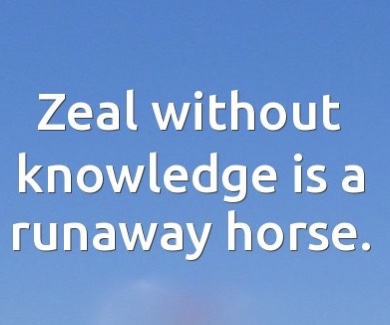
Even though zeal is a good characteristic, it also has a down side. The down side is in the first description that I gave, “knowing what is good.” The problem is with the knowledge. I might think that something is good but be wrong about it. The apostle Paul thought it was good to throw Christians into jail. He went from city to city trying to stop Christians from worshipping God (Acts 9:2). He describes himself as being very zealous (Phil. 3:6). It wasn’t until Jesus spoke to him personally, that Paul realized that he was mistaken (Acts 9:4-19). Peter thought he was doing good when he rebuked Jesus but Jesus set him straight (Matt 16:21-23). In Romans 10:2, the Jews are described as having a “zeal for God, but not coming from knowledge.” They didn’t know about God’s righteousness, God’s standard of living, so they sought to establish their own standard of living or righteousness. Since they had their own righteousness, then they did not surrender to God’s righteousness.
Zeal without knowledge can be very dangerous. Christians can be doing what they believe is good in the name of Christ. Yet they can still be wrong. It may not be popular to say such a thing but it’s true. Even atheists know it can be true of Christians and they insult us for it. Preachers might say to us, “Have faith in God. Don’t take our children to the doctor.” Sometimes a child ends up dying when it could have been prevented. Perhaps, God’s deliverance for that child would have been through a doctor. I haven’t read anywhere in the Scriptures that God is against doctors. Sometimes we pray asking God to guide us in a decision. Yet, we never stop to think that the decision might be bad for us. We think if God is on our side, then He will make sure our decision will not be detrimental. On the other hand God doesn’t want us to be ignorant or thoughtless in our decisions. He has given us the ability to discern between good and bad consequences. Perhaps, God allows us to make mistakes to teach us to think about our decisions. The Bible instructs us to not put the Lord to the test (1 Corinthians 10:9). It seems to me that if I haven’t thought about the decision enough. And I’m depending upon God to make sure my terrible decision turns out for the good, I just might be putting God to the test. It’s almost like saying, “Mom, Dad, if you care about me then you will stop me from walking out onto a busy street without looking both ways.” We can see how it would be foolish. On the other hand, we don’t always understand the same kind of thought process is foolish in religion.
So where can we get the proper knowledge? The Bible, God’s Word, has the proper perspective on God, salvation, and right versus wrong. Where God has spoken, directly, indirectly, or in principle, we can learn from God.
We also can use the minds which God has given to us. Science has made advancements which can help us understand our behaviors, how our brain functions, and maybe even will power. Christians, however, need to remember our foundation for thinking is in the Bible.
Philosophy has long been helpful in understanding God’s word. There are many philosophies out there but we can test these philosophies through logic. Anything illogical or untruthful cannot lead to a valid conclusion. Therefore, we can know for sure anything illogical and untruthful is improper. Again, as a Christian my philosophy is going to match God’s philosophy, which is found in the Bible.
I want us to understand that we can’t know everything. We will never be able to know, firsthand, all subjects. We will have to listen and learn from other people. If we attempt to learn everything on our own, we will be worn out. Also, there will be questions that cannot be answered, at least at this time. We must acknowledge our limitations and be humble enough to say, “I don’t know.” There will be times that Science and the Bible don’t seem to agree but they may not exactly contradict either. We must be willing to see things from another point of view in order to correctly analyze, understand, even refute or rebuttal each case.
Zeal is a good emotion. If it doesn’t have knowledge, then it can lead to disaster, not just for us be for others also. We must be willing to learn through our lives. Desiring the good and locking onto it will help us remain faithful to God and be honest with all knowledge. BY MATT at http://www.northglennchurchofchrist.org/
“GOD LOVES YOU AND I LOVE YOU AND THAT’S THE WAY IT’S GONNA BE!” – MIKE


 INCARNATE