HEART PROMPT – APR 15

A great number of women wonder if the perfect man exists. They have scanned the horizon and often come back thinking they must train a man to make him perfect. That leads them to the question, “Can a man learn to be perfect?” Certainly, a great number of women attempt to find out! In the long run, the realization of perfection depends upon the standard used and whether or not a man adheres to it. Many women believe their man reaches near perfection when they can get him to stop leaving his underwear on the floor and he begins putting the dishes in the dishwasher. Seeking the perfect man is no joke! A higher standard of perfection exists. A perfect man can be had!
In the pages of the Bible, Jesus stands as a sinless model of perfection. However, the Bible lists two other men as being perfect. Genesis 6:9 notes, “Noah was a just man and perfect in his generations and Noah walked with God.” Job 1:1, 1:8, and 2:3 declare Job “perfect and upright, one that feareth God, and turned away from evil”. The characteristics that went with perfection: being just, walking with God, being upright, fearing God, and turning away from evil. Truthfully, these can be reduced to two: Fearing God and keeping His commandments. Fearing God means to be reverent toward Him. Not surprisingly, the concept of these two characteristics of perfection can be found elsewhere in scripture. God declared these characteristics ought to represent the Israelites whom He delivered from Egypt (Deuteronomy 5:29, 6:2, 8:6, 13:4. The judge Samuel also voiced it to Israel: “Only fear the LORD, and serve him in truth with all your heart: for consider how great things he hath done for you” (I Samuel 12:24). King Solomon given great wisdom from God declared: “Let us hear the conclusion of the whole matter: Fear God, and keep his commandments: for this is the whole duty of man” (Ecclesiastes 12:13). King Hezekiah declared as much when he said: “I have walked before thee in truth and with a perfect heart” (Isaiah 38:3). Though other Old Testament references exist, consider one last mention of the characteristics that go with perfection spoken from the perfect man Jesus: “God is a spirit and those that worship Him must worship Him in Spirit and Truth” (John 4:24). If a woman wants to find a perfect man, the true standard involves these characteristics.
Is perfection too much to expect from a man? No! So Ladies, do not give up! Not only Jesus, Noah, and Job meet the standard. David proclaimed God made his way perfect (2 Samuel 22:33). Jesus called upon man to be perfect in Matthew 5:48, “Be ye therefore perfect, even as your Father which is in heaven is perfect.” Paul wrote, “All scripture is given by inspiration of God, and is profitable for doctrine, for reproof, for correction, for instruction in righteousness: That the man of God may be perfect, throughly furnished unto all good works.” (2 Timothy 3:16-17) The words of Paul explain the Word of God directs man to perfection. Again, Paul declares in Ephesians 4:13 it is the knowledge of the Son of God coming from the gospel which will perfect a man. He further writes in Romans 12:2 that man is to transform from his worldly ways proving the Will of God. This is action! This comes from fearing God and keeping God’s commandments as established long ago stretching even to the Garden of Eden (Genesis 2:17).
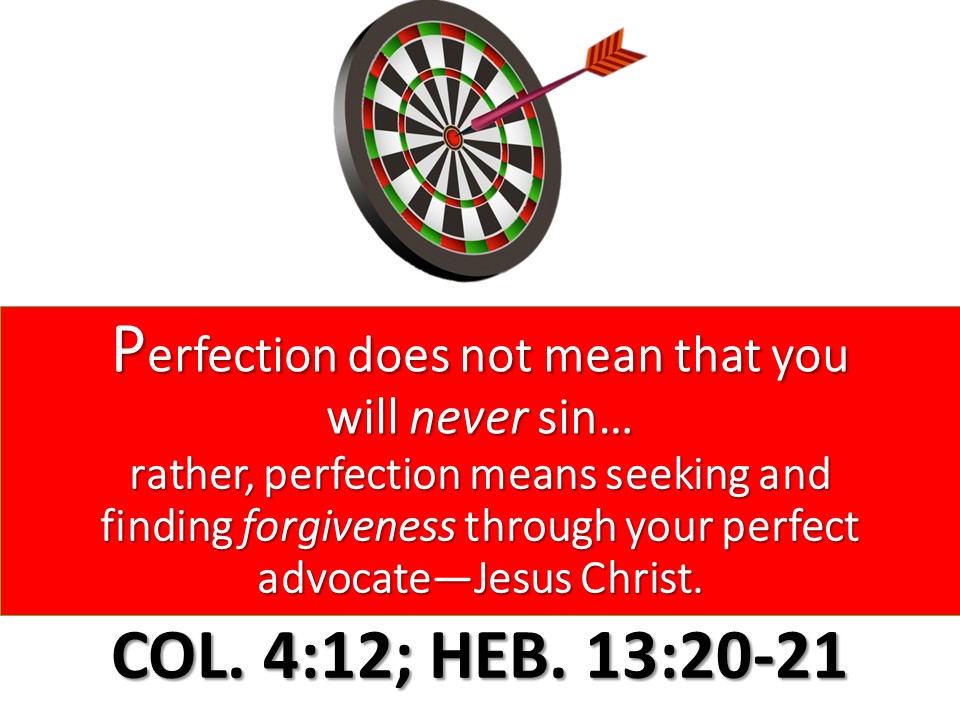
Understand this, perfection does not mean a man will not sin (I John 1:8). Though perfect men may sin, they realize through the advocate Jesus Christ, their sin will be forgiven (I John 2:1-2). In the garden, Jesus prayed fervently for himself, his disciples, and those that would believe on Him in the world. Part of the words he uttered there are as follows: “And for their sakes I sanctify myself, that they also might be sanctified through the truth. Neither pray I for these alone, but for them also which shall believe on me through their word; That they all may be one; as thou, Father, art in me, and I in thee, that they also may be one in us: that the world may believe that thou hast sent me. And the glory which thou gavest me I have given them; that they may be one, even as we are one: I in them, and thou in me, that they may be made perfect in one; and that the world may know that thou hast sent me, and hast loved them, as thou hast loved me. (John 17:19-23) Jesus expresses that when man unites with Him, He unites with them. By the glory of God in Christ, man becomes perfect. Though God’s grace exists, man does not let sin continue to reign over him, but walks in a life for Christ (Romans 6).
As Christ prayed for the perfection of men, ladies pray for your perfect man. This is a courageous work that God will aid you in. Consider Colossians 4:12: “Epaphras, who is one of you, a servant of Christ, saluteth you, always labouring fervently for you in prayers, that ye may stand perfect and complete in all the will of God.” Epaphras worked to pray for the perfection of the saints. The author of Hebrews also prayed for the perfection of the saints in Hebrews 13:20-21. James the brother of Jesus wrote: “The effectual fervent prayer of a righteous man availeth much.” (James 5:16) Do not let a day go by that you do not pray for your perfect man. Let God continue to strengthen him through your prayers.
Finally, as iron sharpens iron, ladies if you want a perfect man, perfect yourselves. Psalms 18:32 – “It is God that girdeth me with strength, and maketh my way perfect”. Micah 6:8 – “He hath shewed thee, O man, what is good; and what doth the LORD require of thee, but to do justly, and to love mercy, and to walk humbly with thy God?” God does not just desire that the male demonstrate the characteristics of perfection, but the female as well. The words of the mother of King Lemuel which she taught him (Proverbs 31:30) “Favour is deceitful, and beauty is vain: but a woman that feareth the LORD, she shall be praised.” Such a woman represents perfection in the eyes of a man and most importantly God. When a woman cleaves to a man she must remember she stands as his helpmeet. She aids him in perfection to such a degree that she need not even say a word when he struggles with perfection knowing that her example of perfection appeals to him (I Peter 3:1-2).
Seeking the perfect man? A perfect standard exists for the perfect man. Seek a man who fears God and keeps His commandments. Seek a man who desires the same perfection in you. Perfect men exist. Through His Word, Jesus sacrificed Himself to perfect those who would abide in Him (John 8:31-32). Man on his own cannot achieve perfection, he will sin. Pray for his perfection. Show him your perfection in the way you live your life for Christ. You can be the perfect woman for the perfect man. BY TRAVIS MAIN
“GOD LOVES YOU AND I LOVE YOU AND THAT’S THE WAY IT’S GONNA BE!” – MIKE


While every religious body associated with Christianity observes the Lord’s Supper in some fashion, the congregations associate with the Churches of Christ are considered unique for observing this memorial every Sunday. But does the frequency with which a congregation observes the Lord’s Supper really matter? To answer this question let us explore what the Bible has to say about the Lord’s Supper.
What is the Lord’s Supper?
Prior to His arrest Jesus shared His last Passover meal with the apostles and during the meal He instituted a new memorial that came to be known as the Lord’s Supper (Matthew 26:26-29; Mark 14:22-25; Luke 14:14-23; 1 Corinthians 11:23-26). It included the consumption of unleavened bread (based on the fact that according to Exodus 12:14-20 no leaven was to be present during the Passover meal), which symbolizes Christ’s body, and the “fruit of the vine” (Matthew 26:29; Mark 14:25; Luke 22:18), which symbolizes Christ’s blood. And Jesus instructed the disciples to “Do this [i.e. partake of these emblems] in remembrance of me” (Luke 22:19; 1 Corinthians 11:24).
The Lord’s Supper has been referred to by a variety of names and titles over the years. In Acts 2:42 it is referred to as “the breaking of bread,” which is an allusion to the fact that during the institution of the Lord’s Supper, “Jesus took bread, and after blessing it broke it” (Matthew 26:26; Mark 14:22; Luke 22:19). In some religious bodies the Lord’s Supper is referred to as the Eucharist. Eucharist is a transliteration of the Greek verb, eucharisteo, which means “to give thanks” and appears in all four of the Lord’s Supper institution narratives (Matthew 26:27; Mark 14:23; Luke 22:17, 19; 1 Corinthians 11:24). In fact, “Eucharist was the most common term in the early church for the breaking of bread in the assembly.”[1] The Lord’s Supper is sometimes referred to as Communion. This title for the Lord’s Supper derives from the Greek word koinonia, which means “fellowship,” “communion,” or “participation,” and appears in connection with the Lord’s Supper in 1 Corinthians 10:16. Finally, the Lord’s Supper is sometimes referred to as a memorial because Jesus instituted it with the instruction to remember Him (Luke 22:19; 1 Corinthians 11:24).
What are the expectations associated with the Lord’s Supper?
First, Scripture indicates that observance of the Lord’s Supper is mandatory because Jesus instituted it as a command not a suggestion. Notice the imperative statements used by Jesus in His instructions regarding the Lord’s Supper. He instructed His disciples to “Take, eat; this is my body” and “Drink from it, all of you. For this is My blood of the new covenant” (Matthew 26:26-27). Elsewhere He instructed His disciples to “Do this in remembrance of me” (Luke 22:19). As Jesus instituted this memorial He did so with a command, and therefore, established an expectation that His followers would observe it.
Second, Scripture indicates that observance of the Lord’s Supper is something to which we are expected to be devoted. Luke described the early church as being “devoted” to the breaking of bread (Acts 2:42). In other words, they viewed the Lord’s Supper as of primary importance. To them the Lord’s Supper mattered. It wasn’t something they did by happenstance or that they observed spontaneously. It was purposeful, it was meaningful, and it was prioritized. If we are going to emulate the first century church then we too must devote ourselves to the observance of the Lord’s Supper.
Third, Scripture indicates that observance of the Lord’s Supper is so important that it mandates a self-examination prior to partaking of it. Paul wrote in 1 Corinthians 11:27-29, “Whoever, therefore, eats the bread or drinks the cup of the Lord in an unworthy manner will be guilty concerning the body and blood of the Lord. Let a person examine himself, then, and so eat of the bread and drink of the cup.For anyone who eats and drinks without discerning the body eats and drinks judgment on himself.” No other activity in the worship assembly receives such a warning. Thus, Paul’s words indicate the importance of this memorial as an essential part of the worship assembly.
When did the first century church observe the Lord’s Supper?
Scripture presents a pattern of observing the Lord’s Supper on the first day of the week. In Acts 20:7 Luke informs us that Paul spoke to the church in Troas “on the first day of the week, when the disciples came together to break bread.” In this narrative detail, Luke draws a correlation between the Lord’s Supper and the first day of the week, going so far as to even indicate that the Lord’s Supper was a central part of the reason for the congregation’s assembly on Sunday. Paul supports Luke’s association of the Lord’s Supper with the assembling of the church on the first day of the week. Five times in 1 Corinthians 11 he used the phrase “when you come together” as he criticized their improper observance of and mindset toward the Lord’s Supper (11:17, 18, 20, 33, 34). Paul’s use of this phrase indicates that the assembling of this congregation and the observance of the Lord’s Supper coincided. When did the Corinthian congregation assemble? According to 1 Corinthians 16:2, Paul wrote “on the first day of every week, each of you is to put something aside and store it up.” The reason Paul associated these instructions with the first day of the week is because he knew they assembled as a congregation at that time. Therefore, when Paul addressed the Lord’s Supper in 1 Corinthians 11 and said “when you come together” we can conclude that he was referring to their Sunday assembly because he specified their assembling on the “first day of the week” in 1 Corinthians 16:2.
Based on the available information regarding the Lord’s Supper, it is evident in the New Testament that Jesus expected this memorial to be frequently observed, and the practice of the first century church was to observe this memorial when they assembled on the first day of the week. In fact, the New Testament references to the Lord’s Supper and the practice of the early church indicate that the Lord’s Supper was “the central act of the weekly assemblies of the early church.”[2] So, let us remember that Paul said, “For as often as you eat this bread and drink the cup, you proclaim the Lord’s death until he comes” (1 Corinthians 11:26). In other words, Paul reminds us that the Lord’s Supper is a memorial of Christ’s sacrifice which saves us. Why wouldn’t we want to remember Christ’s sacrifice every time we assembled on the Lord’s Day? BY KYLE RYE
[1] Everett Ferguson, The Church of Christ: A Biblical Ecclesiology for Today (Grand Rapids, MI: Eerdmans, 1996), 250.
[2] Ibid., 249-250.
 INCARNATE