HEART PROMPT – APR 7

In Luke’s account of Christ crucifixion (Luke 23) he states that two criminals were crucified with Jesus. The one criminal ridicules and tests Jesus by saying “If you are the Christ, save Yourself and us” (vv. 39). In contrast, the Bible records the following interaction concerning the other: “Then he said to Jesus, ‘Lord, remember me when You come into Your kingdom.’ And Jesus said to him, ‘Assuredly, I say to you, today you will be with Me in Paradise’” (vv. 42-43).
This second thief has become the “smoking gun” for those who teach that salvation in Christ is by “faith alone.” To try and prove that someone can be saved without being baptized in water, many will say, “What about the thief on the cross? He was never baptized, and he was saved.” Sadly, based on this view of the thief on the cross, many draw the conclusion that anyone can be saved without being baptized into Christ for the remission of sins… But what does the Bible say?
The Thief May Have Been Baptized…
1. The thief knew a lot about Jesus. The thief on the cross is often portrayed as someone who knew next to nothing about Jesus and just happened to meet Him on the cross and upon believing in Him was granted salvation. Nothing could be further from the truth. Notice what the thief knew about Jesus. He knew that Jesus was innocent, unlike himself and the other robber (Lk. 23:40-41). He knew that Jesus was “Lord” (v. 42). He knew that Jesus would establish a kingdom, and he knew that, even though Jesus was dying on the cross, He would still come into His kingdom (v. 42). He also knew that even with Jesus hanging on the cross, He still had the power to save him (v. 42). Also, it seems this encounter on the cross was not his first introduction to Jesus (cf. Mk. 12:37b).
2. Was the thief baptized? As the one who was sent by God to prepare the Jewish people for the arrival of the Messiah on the scene, John the Baptizer immersed a great many of the Jews in water (Mk. 1:4-5). Is it possible that this thief could have been among those who were baptized by John? The Bible also says that during the earthly ministry of Jesus, His own disciples reached the point where they were baptizing more people than even John was (Jn. 4:1-3). Is it possible that this thief, who knew so much about Jesus, could have been among those who were baptized by Jesus’ disciples? Based on the available evidence, it actually seems more likely that the thief was immersed in water at some point, rather than that he wasn’t.
3. It is impossible to prove that the thief was not baptized. The problem is that many have first assumed that the thief on the cross was not baptized. Based on that, they go on to assume that they can be saved the same way they assume he was saved, that is, without being baptized. The whole idea that one can be saved today like the thief on the cross is nothing more than an assumption on top of another assumption, since no one can prove that the thief was not baptized in water.
… But The Thief Didn’t Need To Be Baptized In Order To Be Saved
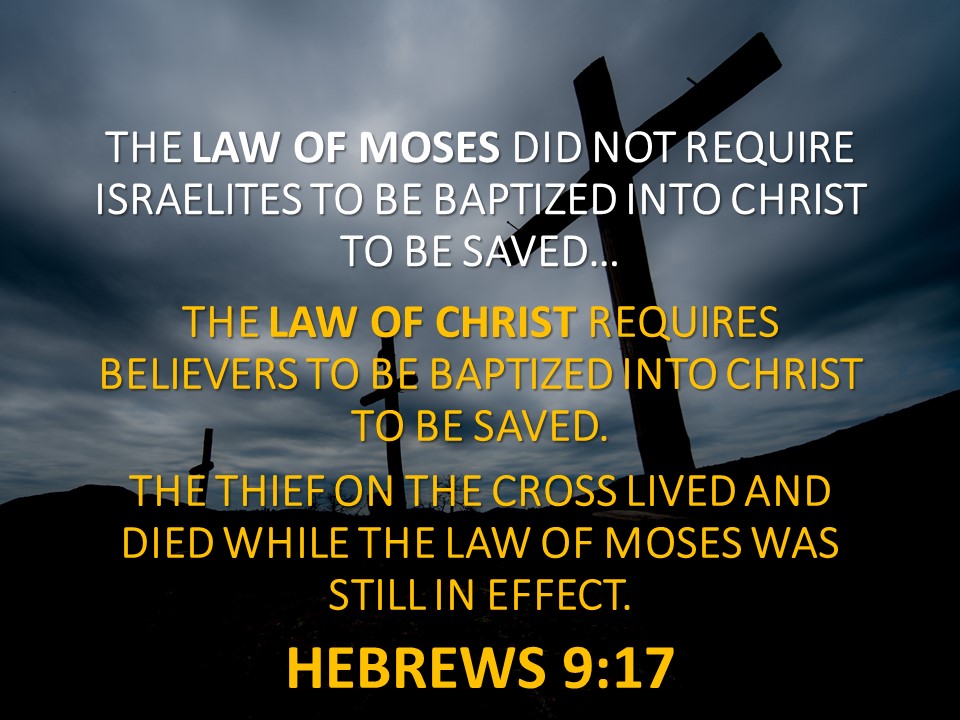
1. The terms for forgiveness and salvation were not the same under the old covenant as they are under the new. The Law of Moses did not require the Israelites to be baptized into Christ to be saved. In fact, the terms the Israelites were required to meet under the Law of Moses were different from the terms of the law of Christ. The Old Law was done way with and replaced with the new covenant, but only after Jesus died on the cross (Eph. 2:15; Col. 2:14-17; Heb. 8:13; 9:16-17). There are numerous examples throughout the book of Acts of people who met the Lord’s terms for forgiveness under the new covenant and were saved. Every detailed case of conversion to Christ recorded in the book of Acts concludes with water baptism (Acts 8:12-13; 8:36-38; 9:18; 10:47-48; 16:15; 16:33; 18:8; 19:4-5). When it comes to what one must do to be saved today, whether the thief was baptized makes as much difference as whether Moses, David, or Elijah were baptized, since, like them, he lived under the Law of Moses.
2. Jesus made baptism into Christ a necessary condition for salvation after His resurrection. It was after the death, burial, and resurrection of Christ that He issued the command for His apostles to make disciples and baptize them in the name of the Father, Son, and Holy Spirit (Matt. 28:18-20). It was after His death, burial, and resurrection, that He stated that one must believe and be baptized to be saved (Mk. 16:15-16). It was after the death, burial, and resurrection of Christ, that the apostles commanded people to repent and be baptized in the name of Jesus Christ for the remission of sins (Acts 2:38). It was after the death, burial, and resurrection of Christ, that the apostle Paul wrote that one is buried with Christ in baptism (Rom. 6:3-4). Even though it is likely that the thief was baptized with John’s baptism at some point during his life, his example is not the pattern for sinners to follow to be saved today. The thief lived and died before the command to be baptized into Christ for the remission of sins was ever issued.
3. No one can be saved like the thief on the cross today. The case of the thief on the cross was a unique circumstance, in which Jesus personally assured a penitent man of salvation under the Old Law before His death. Since no one living today lives in the era before the death, burial, and resurrection of Jesus, no one today can be saved like the thief on the cross. Having been instructed by Jesus, the apostles of Christ made known the terms one must meet for forgiveness of all past sins. When sinners wanted to know what they must do to be saved after the death, burial, and resurrection of Jesus, the Bible says, “Then Peter said to them, ‘Repent, and let every one of you be baptized in the name of Jesus Christ for the remission of sins; and you shall receive the gift of the Holy Spirit’” (Acts 2:38). The teaching of the New Testament makes immersion in water a vital condition that must be met to receive forgiveness of sins and salvation.
Conclusion
While the account of the thief on the cross is a wonderful story that teaches many important things, it is not a story that teaches us how to meet the Lord’s terms for forgiveness of sins today. Only those who obey the gospel of Jesus Christ, which was established through his death, burial and resurrection, have the same assurance of salvation that the thief had (I. Cor. 1:23; Rom. 6:3; Heb. 5:9). Have you been baptized into Christ for the remission of your sins? BY WADE CASEY
“GOD LOVES YOU AND I LOVE YOU AND THAT’S THE WAY IT’S GONNA BE!” – MIKE

In his letter to the Ephesian Christians, Paul opens with an emphasis on the blessings we’ve received from the Father in the Son.
Blessed be the God and Father of our Lord Jesus Christ, who has blessed us in Christ with every spiritual blessing in the heavenly places, even as he chose us in him before the foundation of the world, that we should be holy and blameless before him. In love he predestined us for adoption to himself as sons through Jesus Christ, according to the purpose of his will, to the praise of his glorious grace, with which he has blessed us in the Beloved. In him we have redemption through his blood, the forgiveness of our trespasses, according to the riches of his grace, which he lavished upon us, in all wisdom and insight making known to us the mystery of his will, according to his purpose, which he set forth in Christ as a plan for the fullness of time, to unite all things in him, things in heaven and things on earth.
In him we have obtained an inheritance, having been predestined according to the purpose of him who works all things according to the counsel of his will, so that we who were the first to hope in Christ might be to the praise of his glory. In him you also, when you heard the word of truth, the gospel of your salvation, and believed in him, were sealed with the promised Holy Spirit, who is the guarantee of our inheritance until we acquire possession of it, to the praise of his glory (Eph. 1:3-14).
He begins, “Blessed be the God and Father of our Lord Jesus Christ” (Eph. 1:3).
The word “blessed” is eulogetos — like our word “eulogy.” It means, “to speak well of.”
There are related words for “blessing” men, but this word is used only of God in the New Testament. Men may be praised for their benevolent deeds occasionally, but God is blessed because of his intrinsic nature. He is, therefore, worthy of reverential praise.
God is the source of all spiritual blessings.
As the apostle expounds the spiritual benefits of being in Christ in Ephesians 1:3-14, he relates these blessings to the nature of God. God blesses because of who he is. His redemptive blessings are “according to” his good pleasure, his grace, his purpose, and his will (Eph. 1:5, 7, 9, 11).
Paul shows that God is the source of all spiritual blessings by the phrase “according to” (Grk. kata). It means “in accordance with, in conformity with, corresponding to” (Arndt, 407). He chose to bless us in Christ “according to” his nature and will.
We ought, therefore, to praise him from whom all blessings flow.
Look through Ephesians 1:3-14 to see how many times phrases like “in Christ,” “in him,” or “in whom” occur.
“In Christ” is the sphere in which God blesses. He chose us “in him.” He adopted us “through Jesus Christ.” God’s grace is given “in the Beloved.” Redemption is “in Him.” Forgiveness of sins is “in him.” God’s purpose is “in him.”
As God alone is the source of spiritual blessings, so Christ is the only access to them.
The Lord Jesus said, “Except ye believe that I am he, ye shall die in your sins” (Jn. 8:24).
Likewise, He said, “I am the way, and the truth, and the life: no one cometh unto the Father, but by me” (Jn. 14:6).
“Consequently, he is able to save to the uttermost those who draw near to God through him, since he always lives to make intercession for them” (Heb. 7:25).
Ephesians 1:7 identifies salvation as redemption — the forgiveness of sins.
Salvation is not “closing the gap between our real and our ideal existence and thus achieving self-fulfillment” (Cottrell, 49). Salvation is not finding freedom from the world and its suffering through “self-migration.” Salvation is not human achievement. The Eastern Religions of Hinduism and Buddhism fail to identify the source of man’s problems, and they fail to provide the solution (ibid., 49ff).
God’s Word reveals our condition. We have violated the moral law of our God, Creator, and Ruler. Salvation is redemption by God, the forgiveness of personal sins committed against God himself.
How is forgiveness achieved? It is accomplished by the in-my-place death of his divine Son who came in the flesh — Jesus Christ, whose blood averts God’s judicious wrath (Rom. 5:8-9; Rom. 3:26; Heb. 2:17; 1 Jn. 2:1; 4:10).
How do we access the grace of God through Christ?
Paul discusses the salvation process in the book of Galatians. He said that the Galatian Christians “are all sons of God by faith” (Gal. 3:26). They were not children of God without faith, and the apostle did not say that they were children of God by faith alone.
In fact, the next verse identifies how they became children of God by faith. Beginning with an explanatory term, Paul writes, “For as many of you as were baptized into Christ have put on Christ” (Gal. 3:27).
Notice the tenses of the verbs. They “are all sons of God by faith” — present tense. For they “were baptized into Christ” — past tense.
Because they were baptized, they are children of God. When the Galatians were baptized, they were baptized into Christ. But when the Galatians entered Christ, they became children of God by faith. Therefore, when the Galatians were baptized, they became children of God by faith.
Expressing the same truth differently, we may say that the Galatians were children of God by faith because they were “in Christ.”
But the Galatians were in Christ because they were baptized into Christ. Therefore, the Galatians were children of God by faith because they were baptized into Christ.
This agrees, of course, with the Lord’s command:
“Go into all the world and proclaim the gospel to the whole creation. Whoever believes and is baptized will be saved, but whoever does not believe will be condemned” (Mark 16:15-16).
God chooses, adopts, bestows his grace, redeems and forgives sins “in Christ.” Every spiritual blessing is found in Christ, and the only way to get into Christ is by faith — believing in Christ and doing what he requires (see Matt. 7:21).
Christ requires obedience (Heb. 5:9), and obedience necessitates baptism for the forgiveness of sins.
When the penitent believer is baptized for the forgiveness of sins, he accesses the blood of Christ through the grace of God. At that time, God has decreed that he will redemptively bless.
That is how the Galatians were saved, and this is how everyone enters into Christ to be blessed with every spiritual blessing. BY JASON JACKSON AT https://www.christiancourier.com/articles/1206-every-spiritual-blessing-is-in-christ
“GOD LOVES YOU AND I LOVE YOU AND THAT’S THE WAY IT’S GONNA BE!” – MIKE

