HEART PROMPT – FEB 24

How many times when discussing the Scriptures with someone that differs with us do we hear them respond, Well, that s just your interpretation? This statement is made generally to imply that we simply cannot understand the Bible alike, that one interpretation is as good as another and that we are really dealing with opinion anyway. Many believe there to be no consequence to the many interpretations of the Bible as long as we believe in Jesus as the Son of God and accept Him as our personal Savior. Hence, the idea of unity through diversity is universally accepted in the denominational world as being perfectly acceptable to God.
But the apostle Paul said, Give diligence to present thyself approved unto God, a workman that needeth no to be ashamed, handling aright the word of truth (2 Tim. 2:15.) This passage clearly shows God s approval dependent upon handling God s word properly. The fact that we are instructed to use the word of truth correctly indicates the possibility of misunderstanding and wrongly applying God s Word. But more than this, it necessarily implies the possibility of understanding God s word accurately and finding His favor.
Many today seem unconcerned with all the confusion and think nothing of the division that exists in the religious world. But the fact that so many different denominations teach and practice different things, while they all claim to be following the same Lord and use the same Bible is not evidence that we cannot understand the Bible alike. Paul wrote, whereby, when ye read, ye can perceive my understanding in the mystery of Christ (Eph. 3:4). Paul s understanding was revealed by inspiration. It was not an interpretation, but a revelation. And he wrote so that we also might also understand that which was revealed.
I realize that some Scripture is easier to understand than others. There is such a thing as the milk and the meat of the gospel (see Heb. 5:11-14). Peter speaks of Paul s writings containing some things hard to be understood. But he points out further that the ignorant and unstedfast wrestle with these passages as they do also the other scriptures, unto their own destruction (2 Peter 3:16). Even then individuals misinterpreted that which should have been understood. Why is this?
The problem lies not in the seed (the Word of God, Luke 8:11), but in the soil (the heart) into which the seed is sown. Only the honest and good heart receives the seed (Luke 8:15). Since it is the honest heart that understands and receives God s instruction, does this imply that most people are dishonest when dealing with Scripture? Not necessarily. While many cannot see the truth of God because of bias and prejudice, there are also many honest people that have simply been deceived. They either have never heard God s truth, or they are honestly mistaken.
But when honest individuals are confronted with God s truth they will not label it as your interpretation. Instead, they will carefully consider it and recognize it as being God s Word. They will understand it and apply it. They will receive and obey it.
Remember, we can understand the Bible alike. Jesus said, Ye shall know the truth, and the truth shall make you free (John 8:32). VIA Timberland Drive church of Christ
“GOD LOVES YOU AND I LOVE YOU AND THAT’S THE WAY IT’S GONNA BE!” – MIKE
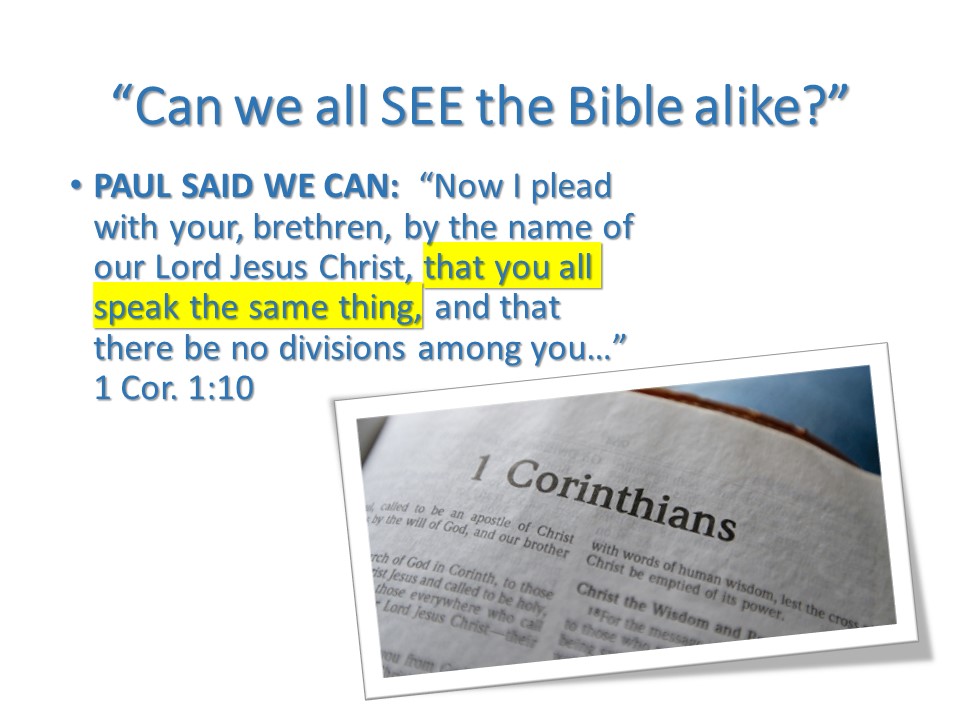

Recently a preacher raised the question: “Can we all understand the Bible alike?” He declared that we cannot, and asserted that those who believe that we can are simply entertaining an ignorant viewpoint.
The claim is frequently made: “You understand the Bible one way, and I understand it another. Neither of us should condemn the other.” Another variation of the same tune: “Well, that is your interpretation of the Scriptures. I have mine as well. Perhaps both of us are right.”
These statements contain a logical contradiction. There is no such thing as “understanding the Bible differently.” If two people differ on the meaning of a biblical text, one of them is wrong about the matter—possibly both. We might misunderstand something differently, but we do not understand something differently.
Moreover, a passage does not yield two different interpretations; somewhere, there is misinterpretation.
We operate daily upon the presumption that we, frail mortals though we are, can make ourselves understood to our peers. A department store places an advertisement in the newspaper about an upcoming sale. Hundreds of people flock to the same establishment on the correct day at the right time expecting specific items at a certain price to be available for purchase. How is it that they understand the ad alike?
A recipe is printed on a cereal box for oat bran muffins. Hundreds of ladies across the country follow it and bake delicious muffins for their families. Do they understand the instructions alike?
A physician prescribes a medication. Do we believe that the pharmacist will understand what the doctor has prescribed, and are we confident that we can understand the instructions for taking the medicine?
If we can sensibly operate our lives on a routine basis, recognizing that we are able to communicate with one another in an intelligible fashion, why can’t we acknowledge that God, who is infinitely wiser and abler than man, can clearly make his will known to humanity?
If one suggests that Jehovah could not clearly make himself known to man, he reflects upon the power of the Lord. If one argues that God purposely did not reveal himself to mankind in a lucid fashion, he reflects upon the benevolence of his maker. If one contends that man has no responsibility to understand and obey the precepts of the Scriptures, it is he who evidences great ignorance of his obligation to Heaven.
The Bible is replete with passages which have as their underlying basis the assumption that we can uniformly understand our divine responsiblility as made known in the sacred writings. Consider the following:
Can we understand the Bible? Of course we can. Can we understand it alike? Why not?
If we can understand that 2 + 2 = 4, if we can understand that fifty-five miles per hour means just that, then we can understand, “He that believeth and is baptized shall be saved” (Mark 16:16). We can understand that there is “one body” (Ephesians 4:4), and that that body is the church (Colossians 1:18). We can further know that salvation is in that body (Ephesians 5:23), and outside of that body no redemption is to be found (2 Timothy 2:10).
The problem with those who contend that men cannot agree upon the Scripture’s teaching is simply this: they are seeking a way to justify error! BY WAYNE JACKSON, DECEASED – https://www.christiancourier.com/articles/225-can-we-understand-the-bible-alike
“GOD LOVES YOU AND I LOVE YOU AND THAT’S THE WAY IT’S GONNA BE!” – MIKE

