Guest writer – Scott Crawford
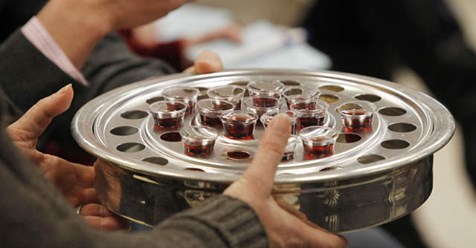
When one says the word “communion” in the context of Christian worship, the first – and likely typical – thought that comes to mind is the Lord’s Supper. This is not surprising since the idea of communion conveys the underlying essence of what is happening during that ceremonial observation. Paul notes in 1 Corinthians 10:16 that there is a “cup of blessing” and a “bread which we break,” both of which symbolize a communion among those participating – the first is a communion in the blood and the second in the body of Christ. Thus, the word communion in this respect has taken on the mantle of a title (i.e., “We take Communion every Sunday.”) instead of being recognized as a descriptor of what is being accomplished (a sharing in the blood and body of Christ).
Often, the Greek word which is translated as “communion” in 1 Corinthians 10:16 is translated as “fellowship” in other places. Passages such as Acts 2:42 where the new church is noted to be “devoting themselves” to four things: “the apostles’ teaching and to fellowship, to the breaking of bread and to prayer” – notice that fellowship and breaking of bread are two distinct activities. There is also Galatians 2:9 where it is noted that “James and Cephas and John” gave Paul and Barnabas the “right hand of fellowship.” Even John talks about fellowship saying that if one claims to have “fellowship with him” but does not live as those “in the light,” then it is the rankest form of self-deception (1 John 1:6-7).
So, the communion, the sharing, the fellowship that is being described in these (and other) verses is pointing us toward a way of life and worship that brings Christians into contact with one another for a common good.
As a way of life, Christians have fellowship with one another when we bear the burdens of the other. One of the first verses that comes to mind regarding this thought is Hebrews 10:24. Then, as now, there are difficulties in this life that confront the Christian and seek to turn one from the right path into despair and isolation. The Hebrews writer is telling us to come together as an assembly for the purpose of drawing strength from our common experiences, so that we might encourage each other to continue in good works regardless of the wickedness in the world.
The concept of fellowship also seems to go along with the idea of contributing to the needs of others so that those with more might help those in need or suffering. Paul notes that it pleased those in Macedonia and Achaia to “make a contribution for the poor among the saints in Jerusalem” (Rom. 15:26). Paul also praises the Philippians for their desire to “share” with him in the “matter of giving and receiving” because they were willing to send him a gift “more than once” for his needs (Phil. 4:15-16).
In worship the idea of communion should be associated with the Lord’s Supper. In fact, not only are we sharing the blood of Christ that was spilt and the body of Christ that was so brutally treated on our behalf, but we are also sharing with all those Christians that have come before us and all those that are yet to believe. As the song says, Christians are connected “by one bright chain of loving rite” until the coming of our Lord. But the idea of communion should also be associated with other practices. When Christians sing, that singing is done to teach and admonish one another (Col. 3:16), or there is a sharing. When Christians pray to God, those prayers bring us closer to God in our “adoption as sons” as we directly address God as “Abba! Father!” (Rom. 8:15) – there is a sharing in the family of God.
As an idea, communion should go beyond one part of a worship assembly – although it is an especially important part. Communion should speak to Christians of the common participation that we have in the life of Christ. Communion should point to the intimate bond that binds our fellowship together in the spiritual blessings of our common salvation. Communion should remind us that there is a sharing that Christians have with one another as the good of others is sought above the good of the self. Communion is best seen in the cohesive nature of the body, speaking to our oneness. Whereas there are many parts to the body each works together for the good of the whole (Rom. 12:4-5). Whereas each of us is an individual with needs and talents, we are also united because “by one Spirit we were all baptized into one body” (1 Cor. 12:13).
“God loves you and I love you and that’s the way it’s gonna be!” – Mike



 INCARNATE