Category: Uncategorized
How Do You Dig?

HAVE YOU EVER watched a paleontologist on TV or online after a fossil discovery?
To say that he is careful is a gross understatement.
He gently bushes away the sand and clay.
He painstakingly excaves the soil from around the aged bones.
While he’s no doubt thrilled with his find, his excitement is tempered by a certain caution.
He knows that a reckless, hasty, or hurried approach could irreparably damage or destroy the fossil itself.
Those of us who are students of the Bible can take a lesson from the scientist who digs for dinosaur bones.
With the same meticulous care of a paleontologist, we too ought to chip away at the rubble of human opinion so as to uncover the truth of God’s Word.
While zeal and enthusiasm for the Scriptures is a commendable trait, our primary goal should be like that of the Bereans in Acts 17:
“These were more fair-minded than those in Thessalonica, in that they received the word with all readiness, and SEARCHED (Greek – anakrino, “to examine, to judge, to ask questions, to search, to discern) the Scriptures daily to find out whether these things were so” (v. 11 – emphasis mine, mb).
“God loves you and I love you and that’s the way it’s gonna be!” – Mike
Today’s Praise – “Just As I Am”
What Makes Judas’ Actions so Tragic?
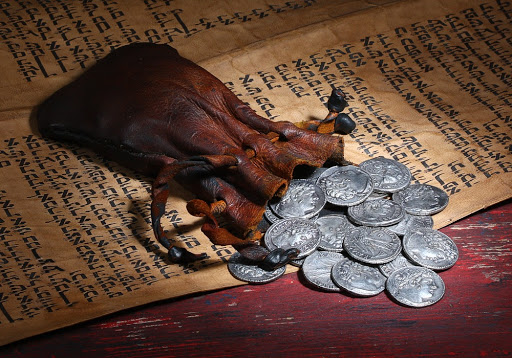
HAVE YOU EVER heard someone say that Judas betrayed Jesus for a mere thirty pieces of silver?
It is true that the chief priests paid Judas thirty pieces (Mat. 26:14-16). It is also true that his was the Old Testament price of a slave (Exo. 21:32). What is it, however, that makes Judas’ action so tragic?
Is it that he sold Jesus? Or, is it that he sold Jesus for such a small amount?
It sometimes seems that what people find so shocking is that Judas betrayed the Lord for so little. Indeed, some might feel that Judas sinned in selling Jesus too cheaply. But would his crime have been less heinous if the reward had been greater? Could we be more understanding if he had gotten a million dollars instead of a mere thirty pieces of silver?
Judas Iscariot was not the last to betray the Lord for a certain price. Whether the value received seems more or less than the infamous thirty pieces matters not.
The shameful and damnable crime is in selling Christ at all, not matter what one receives in return.
Many who have marveled over the enormity of Judas’ crime perhaps have not considered that there are other ways to sell Christ. What of the youth who compromise principles to be accepted by friends? What of the woman who leaves the church to please her husband? What about the man who accepts dishonesty in business because there is money to be made? What about the one who returns to the world because it’s easier than being faithful to the Lord?
We have thought that Judas was a unique person.
The sad truth is, however, however, that the evil that ruled in the heart of Judas rule in much of humanity. Judas, no doubt, had the same kind of yearnings, made the same excuses, and rationalized his actions just as do others who betray the Lord.
The bottom line is not how much or what kind of payment one receives. What is significant is that Jesus is “sold” at any price. (David Pharr, The Voice of Truth International, Vol. 36, 11-12)
“Then Judas, His betrayer, seeing that he had been condemned, was remorseful and brought back the thirty pieces of silver to the chief priests and elders” (Mat. 27:3).
“God loves you and I love you and that’s the way it’s gonna be!” – Mike
Today’s Praise – “What The Lord Has Done in Me”
Listen…
 INCARNATE