When Did Jesus NOT Pray?

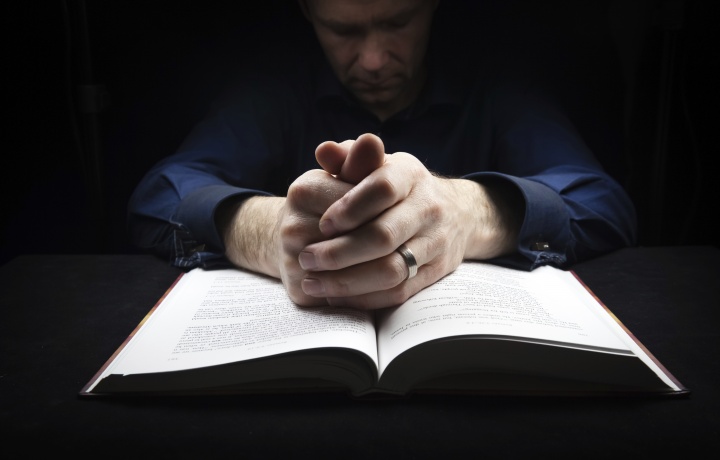
praying-man

IT’S TEMPTING TO skip to the end of the Gethsemane story, because there in the final moments of the garden narrative, when Jesus was arrested, we often start thinking about the Lord’s Supper.

But please don’t do that now. Don’t rush straight to the arrest.  Back up and then slow down as you consider the text.  Back up, not just to any meal, but to the time of the last meal Jesus ate with His disciples (Mat. 26:2ff; John 13ff).

In a manner of speaking, this was the condemned Man’s last meal before His execution, and what exactly was Jesus doing on this occasion with His disciples?  Do a little contextual reading and you discover that He was talking about, among other things, and practicing PRAYER.

Watch John’s account:

“And whatever you ask in My name (PRAYER—mb), that I will do, that the Father may be glorified in the Son” (14:13).

“If you abide in Me, and My words abide in you, you will ask what you desire (PRAYER—mb), and it shall be done for you” (15:7).

“And in that day you will ask Me nothing.  Most assuredly, I say to you, whatever you ask the Father in My name (PRAYER—mb) He will give you” (17:23).

Mark in your Bible:  Jesus spoke about prayer 3x.

Then later, while the group was actually eating, Matthew records, “And as they were eating, Jesus took bread, blessed (PRAYER—mb) and broke it, and gave it to the disciples and said, ‘Take, eat; this is My body.’  Then He took the cup, and gave thanks (PRAYER—mb), and gave it to them, saying, ‘Drink from it, all of you’” (Mat. 26:26-27).

Mark in your Bible:  Jesus practiced prayer 2x.

But this redundant emphasis upon prayer didn’t stop at this meal prior to Gethsemane.  After the group split up, Jesus took Peter, James and John to the garden where He continued His prayer vigil.  There He started praying again—ironically offering the same thing over and over.

“He went a little father and fell on His face, and PRAYED, saying, ‘O My Father, if it is possible, let this cup pass from Me; nevertheless, not as I will, but as You will” (Mat. 26:39).

“Then He came to the disciples and found them sleeping, and said to Peter, ‘What!  Could you not watch with Me one hour?  Watch and PRAY, lest you enter into temptation.  The spirit indeed is willing, but the flesh is weak” (v. 40).

“Again, a second time, He went away and PRAYED, saying, ‘O My Father, if this cup cannot pass away from Me unless I drink it, Your will be done.’  And He came and found them asleep again, for their eyes were heavy” (vv. 42-43).

“So He left them, went away again, and PRAYED the third time, saying the same words…” (v. 44).

Mark in your Bible:  Jesus prayed 3x and mentioned prayer 1x.  

If you underscore the times that the idea of, or exact mention of, prayer is used in both John and Matthew, you are hit by a veritable inspired, machine-gun barrage on this subject (8x).

Now ponder.

What was Jesus urging, and what was He practicing before, during and after the Passover/Lord’s Supper meal?

PRAYER.

But now, recalling our introduction, go to the garden where the arrest was about to take place.

Suddenly, there is a scuffle—a fuss.

Peter, in his rashness and impetuosity, whips out his blade and cuts of Malchus’ ear (cf. Mat. 26:51; Mark 14:47; Luke 23:50; John 18:10 for details).

Jesus immediately, miraculously healed the stricken servant and then told Peter and his peers to stop the violence.

Now mull over exactly what Jesus said:

“Or do you think that I cannot now PRAY to My Father, and He will provide Me with more than twelve legions of angels” (Mat. 26:53)?

Wow.

Mark in your Bible:  Jesus did NOT pray.

Please don’t miss this!

  • What was Jesus talking to the disciples about around the time of that last meal?  He was talking about PRAYER (i.e., asking of the Father).
  • What was Jesus doing at that last meal?  He was PRAYING (i.e., thanking the Father).
  • What was Jesus doing after that meal while in the garden?  He was PRAYING over and over again (asking His Father).

Jesus’ life and ministry was saturated in prayer.  And yet–here in the garden, WHEN HE COULD HAVE PRAYED ONCE AGAIN, WHEN HE COULD HAVE summoned the host of heaven to stop the cross, WHEN HE COULD HAVE PETITIONED His Father’s intervention, He didn’t pray.

He could have, but He didn’t. 

The one prayer that Jesus could have uttered, that would have effectively stopped Calvary in its tracks, never left His lips.

And why didn’t He pray that prayer?

Because He had already prayed, “Nevertheless, not as I will, but as You will…”

“God loves you and I love you and that’s the way it’s gonna be!” – Mike

Who is the Prophet Like Moses?

How was Jesus a prophet like Moses?

biblehands2

ALMOST 1,400 YEARS before Jesus came to earth in the flesh, Moses told the Israelites:

“The LORD your God will raise up for you a Prophet like me from your midst, from your brethren. Him you shall hear” (Deuteronomy 18:15).

Centuries later, after the Lord fed the five thousand with loaves and fish, the people realized the fulfillment of this ancient prophecy.

“Then those men, when they had seen the sign that Jesus did, said, ‘This is truly the Prophet who is to come into the world’” (John 6:14).

The apostle Peter later confirmed this when he preached at Solomon’s porch:

“For Moses truly said to the fathers, ‘The Lord your God will raise up for you a Prophet like me from your brethren. Him you shall hear in all things, whatever He says to you. And it shall be that every soul who will not hear that Prophet shall be utterly destroyed from among the people’” (Acts 3:22-23).

The martyr, Stephen, also declared this truth (cf. Acts 7:37-38).

But how was Jesus a prophet like Moses? Study the following passages and note the striking parallels:

1. Both were sent from God (Exodus 3:1ff; John 8:42).

2. Both were born under foreign rule (Exodus 1:8-14; Luke 2:1).

3. Both, as infants, were threatened by wicked monarchs (Exodus 1:15-16; Matthew 2:16).

4. Both spent their early years in Egypt and were miraculously protected from harm (Exodus 2:10; Matthew 2:14-15).

5. Both rejected the offer and opportunity to become world rulers (Hebrews 11:24; Matthew 4:8-9).

6. Both were initially rejected by their peers (Exodus 32:1; Isaiah 53:3; Matthew 27:21-22; John 1:11).

7. Both suffered disrespect (Numbers 16; John 12:37; Mark 6:4).

8. Both had family who let them down (Numbers 12:1; John 7:5).

9. Both were teachers (Deuteronomy 4:1-5; Matthew 22:16; John 3:2).

10. Both were prophets and spoke on behalf of God (Exodus 4:15; John 8:26).

11. Both knew God on an intimate level (Exodus 33:11; Deuteronomy 34:10; John 1:18).

12. Both spoke directly to God (Exodus 3:1-10; Deuteronomy 34:10; Luke 9:34-36).

13. Both gave the people bread from heaven (Exodus 16:14-15; John 6).

14. Both performed miracles (Exodus 4:1ff; Deuteronomy 34:10-12; John 5:36).

15. Both were deliverers–Moses delivered Israel from the bondage of Pharaoh; Jesus delivered spiritual Israel, the church, from the bondage of Satan.

16. Both were shepherds (Exodus 3:1; John 10:10-11; Matthew 9:36).

17. Both were baptized (1 Corinthians 10:1-2; Matthew 3:13-17).

18. Both fasted forty days in the wilderness (Exodus 34:28; Matthew 4:2).

19. Both were mediators (Deuteronomy 4:5; Exodus 32; Hebrews 8:6; 1 Timothy 2:5).

20. Both of their faces shone with the glory of heaven (Exodus 34:34-35; Matthew 17:12).

21. As Moses lifted up the bronze serpent in the wilderness to heal the people, so Jesus was lifted up on the cross to  heal obedient believers from their sins (Numbers 21:8-9; John 3:14; 12:32).

22. As Moses sent out twelve spies to explore Canaan, Jesus sent out twelve apostles to reach the world (Numbers 13; Matthew 10:1).

Even though there are many other similarities which the two have in common, God made it clear whom we are to follow and obey:

“While he was still speaking, behold, a bright cloud overshadowed them; and suddenly a voice came out of the cloud, saying, ‘This is My beloved Son, in whom I am well pleased. Hear Him’” (Matthew  17:5).

“God loves you and I love you and that’s the way it’s gonna be!” – Mike

What’s a Preacher to Do?

One of my greatest fears is that the church has been operating under a warped view of the preacher and his work for several generations.

preacher2

I’M NOT COMPLAINING. I’m not crying for help.  I’m not necessarily describing you or your local church. I’m certainly not trying to start a debate (please don’t take this there).  Still, I wanted to share some important (though hard) observations that have been on my mind for a long time.

One of my greatest fears is that the church has been operating under a warped view of the preacher and his work for several generations.  We confidently boast that our preachers are not “pastors,” yet we treat them like they are in daily practice. We teach that the work of the preacher is to “preach the word” as a faithful minister of Jesus Christ, yet we often drench our ministers with unrealistic and excessive expectations that we ourselves are unwilling to practice.

We create a rigid and exhaustive job description which few can actually meet.  Then, we hire an outside man to come into our area, become a part of our local church, and do “church things” for us.  He becomes the shepherd and the savior of the church.  He’s the silver bullet that will turn things around! 

If he works well, brings good results, and is liked by the church, then we will keep him around.  But, if he doesn’t measure up to our expectations, if we don’t get the results we hoped for, or if the members become unhappy, then we will just find a new preacher. Another family will be uprooted, another wanted bulletin will be posted, and another preacher will come along to step into his place.

In many ways, the preacher has become like a mere employee of the church who’s job is to simply serve the needs and wants of the local church consumer.  This faulty system has turned God’s ministers into professional holy men and Christians for hire.  He becomes a tool to use for our purposes and objectives.  He is depreciated to the status of a hired hand instead of held high as a brother and fellow laborer in Christ.

Is this current setup really what God intended?  Is this system a healthy recipe for church success?  Does this fit the preacher/local church model we read about in the New Testament?

Could this be why so many good men “leave the ministry” each year?  Is this problem more prevalent than we would like to admit?

I write this as a Christian who has made a commitment to preach the Gospel.  I love preaching, I deeply love the church, and I love preachers.

I know things will never be perfect, but I believe we have a lot of room for improvement when it comes to how we view and treat our preachers.  I also know that I am not alone in observing these sobering and all too common scenarios.  I pray that we can all try to acknowledge the cracks in our current setup.  Let’s start now by making a resolution to do what we can as preachers, elders, and church members to move forward in a better direction, even if it is just one small step at a time.

Brandon preaches for the North Lownes church of Christ in Montgomery, AL.

“God loves you and I love you and that’s the way it’s gonna be!” – Mike