
What is THIS?

bf5c2e990bda8b22c53067042d449d99-colorful-heart-sticker-by-vexels

Finish the following Bible passage:  “By THIS all will know that you are My disciples…” (John 13:35—emphasis mine, mb).

  • “if you sing a cappella (i.e., without instrumental accompaniment) in your worship assemblies.” Col. 3:16; Eph. 5:19
  • “if you observe the Lord’s Supper every first day of the week.” Acts 20:7; 2:42
  • “if your women do not lead in the assembly or usurp authority over a man.” 1 Tim. 2:12-15; 1 Cor. 14:26-35
  • “if you do not tithe, but rather engage in a free-will offering each Lord’s Day as you have been prospered.” 1 Cor. 16:1-2
  • “if you teach and practice that divorce is sanctioned for only one reason—and that is the sexual unfaithfulness of your spouse.” Mat. 19:9
  • “if you baptize penitent believers for the remission of sins.” Acts 2:38; 22:16; 1 Pet. 3:21
  • “if you correctly employ the appropriate biblical term for the brother who proclaims the gospel from the pulpit as a ‘preacher’—and not a ‘pastor’.” 1 Tim. 3:1-7; Titus 1:5-9
  • “if you correctly interpret and teach what the Bible says about the coming of the Son of Man/Christ.” Mat. 16:28; 24:29
  • “IF YOU HAVE LOVE FOR ONE ANOTHER.” Lev. 19:18; John 15:12; Rom. 13:9; 1 Pet. 2:17; 4:8; Heb. 13:1; 1 John 4:12

“Preacher, are you saying that doctrine doesn’t matter?”  Nope—I’ve never said that, I’ve never taught that, nor have I ever even thought that.  Right doctrine is ESSENTIAL.  Period.  Dot.  End of sentence (Acts 2:42–“in the apostles’ doctrine”; 1 Tim. 1:3—“teach no other doctrine”; 4:6—“good doctrine”; 4:12—“doctrine”; 4:16—“the doctrine”; “doctrine”—5:17; 6:1—“God and His doctrine”; 6:3—“the doctrine”; 2 Tim. 3:16—“for doctrine”; Titus 1:9, 2:1—“sound doctrine”; 2:7—“in doctrine”; 2:10—“the doctrine of God”).

But sometimes well-intentioned brethren emphasize the right thinking about doctrine (and they should), but they unfortunately fail to first emphasize the right practice of doctrine—and that is in and with patient LOVE.

Ya’ll ever notice this…?

In Ephesians 4, in that grand chapter about unity, before the apostle Paul talked about one body, one Spirit, one hope, one Lord, one faith, one baptism, and one God, he predicated them all with LOVE.  “I…beseech you to have a walk worthy of the calling with which you were called, with all lowliness and gentleness, with longsuffering, bearing with one another in LOVE” (vv. 1a, 2—emphasis mine, mb).  Question.  Did Paul ever say in this chapter (or anywhere else for that matter) that doctrine was unimportant?  A thousand times no!  But what active heart attitude did he say must first be practiced in order for doctrinal unity to be enjoyed?  Read the latter part of verse two again and then commit it to memory.  “Bearing with one another in LOVE.”

But now watch it again.

In 1 Corinthians 13, the same apostle through divine inspiration said, “If I speak with the tongues of men and of angels, but have not LOVE, I have become as sounding brass or a clanging cymbal.”  In the context of speaking in foreign tongues (cf. Acts 2:4, 6-11), Paul said—now get this—“If I am miraculously endowed with the ability to teach God’s Word in a language which I’ve never studied before, but I don’t possess or either speak the truth in LOVE (Eph. 4:15), then all I’m doing is making a bunch of loud racket” (e.g., sounding brass and a clanging cymbal).1

But keep reading.

“And though I have the gift of prophecy (i.e., the miraculous gift to speak for God—cf. Mat. 7:22), and understand all mysteries and knowledge (i.e., miraculous gifts of comprehension)…but have not LOVE, I am nothing” (v. 2a, c).  Paul said, “Even though the Holy Spirit revealed to me truths, ideas and concepts, which the church as a whole has neither known nor grasped up until this time, if I fail to exhibit Christian love, then his special capacity and discernment is absolutely worthless to either me or the church.”  In other words, his knowing the truth without first practicing truth (i.e., LOVE) would have been meaningless.

Our Lord made this very same point in Matthew.

Jesus told the doctrinally fastidious scribes and Pharisees of His day, “You pay tithe of mint and anise and cumin, and have neglected the weightier matters of the law: justice and mercy and faith.  These you ought to have done, without leaving the others undone” (23:23b).  These guys were so “gun-ho” about keeping every facet of the law that they actually gave ten percent of the seeds (which were used to spice their foods) in their herb gardens.  Now watch, Jesus never condemned them for their religious fervor in terms of sacrifice; He did censure them, however, for their failure to harmonize their efforts with expressions of genuine love.  The Jewish world knew theses religious leaders by their devotion and ardor—even to the point of minutia, but they didn’t know them as a group by their LOVE.   And as important as it was to properly and fully sacrifice, these devotees of the law didn’t keep the, watch it—“weightier” matters of the law—at all.  They got doctrine right, but they missed the heaviest doctrine of all—love.

So many of my good brethren today in their zeal for doctrinal accuracy wholly miss this concept of love.  They “bite and devour” one another (Gal. 5:15) over important, yes—even essential matters, but they overlook THE MOST IMPORTANT, THE MOST ESSENTIAL matter of all—Christ-like LOVE. 

Our Lord said, “By THIS all will know that you are My disciples, if you have LOVE for one another” (John 13:35).

Beloved, are you known by your love?

1/ John MacArthur, “In New Testament times, rites honoring the pagan deities Cybele, Bacchus, and Dionysus included speaking in ecstatic noises that were accompanied by smashing gongs, clanging cymbals, and blaring trumpets.  Paul’s hearers clearly got his point: unless it is done in love, ministering the gift of languages, or speaking in any other human or angelic way, amounts to no more than those pagan rituals.  It is only meaningless gibberish in a Christian guise.”  The MacArthur New Testament Commentary, 1 Corinthians, 331).

“God loves you and I love you and that’s the way it’s gonna be!”–Mike
What is Faithfulness?

31kelley2-mobileMasterAt3x

It was a Sunday morning, October 23, 1983.

A Hezbollah suicide bomber drove his truck packed with over 2,000 pounds of explosives into the U.S. Marine barracks in Beirut, Lebanon.

214 Americans were killed while they slept in their beds; another 128 were wounded in the horrific blast.

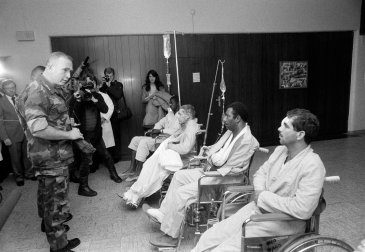
A few days after the tragedy, Marine Corps Commandant, Paul Kelly, visited some of the survivors in a Frankfurt, Germany hospital.

Among them was a Corporal named Jeffrey Nashton, who had been severely wounded in the attack.

Nashton had so many tubes running in and out of his body that someone said he looked more like a machine than a man.

As Kelly neared him, Nashton, struggling to move and racked with pain, motioned for a piece of paper and a pen.

He wrote a brief note and then passed it back to the Commandant.

The slip of paper had only two words – “Semper Fi,” the Latin motto of the Marine Corps, meaning “forever faithful.”

Thought: Christianity in general and marriage in particular aren’t simply about starting journeys – they’re about being forever faithful.

general-pxkelley

INCARNATE:  10 Do not fear any of those things which you are about to suffer. Indeed, the devil is about to throw some of you into prison, that you may be tested, and you will have tribulation ten days. Be faithful until death, and I will give you the crown of life (Rev. 2:10).  

“God loves you and I love you and that’s the way it’s gonna be!” – Mike

WHY Should We Pay Attention?

b718e0fa7ce957b3d07174e31744ceca

A U.S. Army officer told of the contrast in his pupils during two different eras of teaching at the artillery training school at Fort Sill, Okla., (home of the Field Artillery).

In 1958-60 the attitude was so lax the instructors had a problem keeping the men awake to listen to the lectures.

During the 1965-67 classes, however, the men, hearing the same basic lectures, were alert and took copious notes.

“What was the difference between the classes of 58-60 and the class of 65-67?” you ask.

The latter class knew that in less than six weeks they would be facing the enemy in Vietnam.

13 “Watch, stand fast in the faith, be brave, be strong” (1 Cor. 16:13; cf. 1 Pet. 5:8; Eph. 6:11).

“God loves you and I love you and that’s the way it’s gonna be!” – Mike

Should We Pray for Our Enemies?

If we ONLY pray for our enemies, and then hypocritically treat them with unkindness and disdain, our prayers won’t get through the ceiling…

praying

QUESTION:  Should we pray for our enemies?

ANSWER: This is an important question. Let’s study the
Scriptures together and see what the Bible says:

Not only should we pray, but we MUST pray for our enemies. Jesus – the ultimate authority (Mat. 28:18; Eph. 1:21; Phil. 2:9; Col. 2:10; 1 Pet. 3:22) said, “Love your
enemies, bless those who curse you, do good to those who hate you, and pray for those who spitefully use you and persecute you” (Mat. 5:44).

But notice that Jesus said we’re to do MORE than just pray for our enemies. He taught us to LOVE our enemies, BLESS our enemies, and DO GOOD to our enemies.  If they’re hungry, we’re to feed them; if they’re thirsty, we’re to give them a drink (cf. Rom. 12:14-21; Luke 10:25-37).

The Lord did not say that we are obligated to LIKE our enemies. He taught through Paul (John 16:13), “IF IT IS POSSIBLE, as much as depends on you, live peaceably with all men” (Rom. 12:18). The noted theologian, Tom T. Hall,
wrote back in 1973:

I love little baby ducks, old pickup trucks
Slow-movin’ trains and rain
I love little country streams, sleep without dreams
Sunday school in May – and hay
And I love you, too
I love leaves in the wind, pictures of my friends
Birds of the world and squirrels
I love coffee in a cup, little fuzzy pups
Old TV shows – and snow
And I love you, too
I love honest, open smiles, kisses from a child
Tomatoes on the vine and onions
I love winners when they cry, losers when they try
Music when it’s good – and life
And I love you, too.

Much of our frustration with Jesus’ command about praying for our enemies may be a result of confusing “loving” and “liking.” It’s been my observation that people tend to, like Tom T., use the word “love” in a very broad and expansive way. They use it to describe their feelings for things like ducks, trucks and tomatoes, but when Jesus said, “love your enemies,” He wasn’t saying that we must have warm and affectionate emotions towards those who hurt and mistreat us. Rather, He was telling us to act in a certain way towards our enemies, regardless of how they behave (Mat. 5:45-48; 1 Cor. 13:4-7).

If we ONLY pray for our enemies, and then hypocritically treat them with unkindness and disdain, our prayers won’t get through the ceiling (Prov. 15:8; 29:9).

Jesus, by example, prayed for His enemies (Luke 23:34).

Jesus did not retaliate against His enemies. He could have summoned more than twelve legions of angels to prevent Calvary (Mat. 26:53), but He didn’t. He could have returned pain for pain against His enemies at the cross (1 Pet. 2:20-23; cf. Mat. 26:67-68; Mark 14:65; Luke 22:63-65), but He didn’t.

“God loves you and I love you and that’s the way it’s gonna be!” – Mike

Did Jesus Have Feelings?

JesusWept

IF HOLLYWOOD TEACHES us anything–which is very, very little, it teaches us not to trust how it portrays any real-life character. Writers, directors, and producers all have their personal say in how an individual is brought to the big screen. “Based on a true story” is the motion picture industries’ way of saying:  “We are using copious amounts of creative license and editorial bias to show you what we’d like you to see about this particular person in history.”

I remember reading years ago about the 13th century Scottish hero, William Wallace, often referred to today as “Brave Heart.” Hollywood gave him a rather extensive facelift. Truth be known, the William Wallace of the silver screen and the William Wallace of history are two radically different entities. They ain’t even second cousins.

But nowhere is Hollywood’s disposition towards real people more evident than in the life of our Lord. Cinema and pop culture has morphed Him into a rather stolid, dull, and largely unemotional being. He’s a disconnected, Vulcan-like therapist for broken and hurting folks. What’s worse is that He is depicted as moving in and among the ancient masses with the energy and enthusiasm, forgive me, of a baked potato. You see, Hollywood wants you to think of the Jesus of history as obtuse at best and dull and out of touch at worst. In other words, He is uncaring and irrelevant.

But friends, the Bible shows the Messiah to be quite different from how He is rendered in modern media.

The Jesus of Scripture is a man of intense passion and feeling:

  • Watch Him overthrow the tables of the moneychangers in the temple in Matthew 21. Did Jesus care about sin, hypocrisy and greed?  Was He ever aroused by transgression and iniquity?


  • Watch Him shed tears at Lazarus’ tomb in John 11.  Did Jesus feel deeply at funerals or was he an emotional vegetable?  Did He weep or was he devoid of affection?


  • Watch Him interact with the crowds of sick folks in Matthew 14.  The Holy Spirit said Jesus was “moved with compassion.”  Does that sound like He didn’t care and that he was unaffected by pain?


  • Listen to Him lift his broken voice on Gethsemane’s hill as He pours out his heart to God in Hebrews 5.  The NKJV describes his laments as “vehement” (NKJV), while the ESV describes them as “loud cries and tears.”  Does this sound like a man who is incapable of sensitivity?

Our Lord was no half-human android. He had heart, He felt strongly, and He was passionate!

Give Hollywood its credit. It knows how to appeal to the carnal and it knows how to make (and lose) LOTS of money.

It just doesn’t know how to deal with the real Son of Man.

“God loves you and I love you and that’s the way it’s gonna be!”  Mike