Did You Get the Ax?

hand-axe-tree-stub_1161-134

“HUSBANDS, LIKEWISE, DWELL with them with understanding, giving honor to the wife, as to the weaker vessel, and as being heirs together of the grace of life, that your prayers may not be hinders” (1 Pet. 3:17).

Every Christian husband wants to believe that his prayers are heard and accepted.  “Hear my prayer, O God; give ear to the words of my mouth” (Psa. 52:2).

He wants to know that his petitions find their place in the ears and heart of Jehovah.  “Now this is the confidence that we have in Him, that if we ask anything according to His will, He hears us.  And if we know that He hears us, whatever we ask, we know that we have the petitions that we have asked of Him” (1 John 5:14-15).

But Peter reminds us that that doesn’t always happen.  Sometimes a husband’s prayers are hindered.  “Hindered.”  Let that term sink into your cerebrum for a moment.  The English word rendered “hindered” in the Greek is ekkopto and is pronounced ek-ko’p-to.  It is a verb and is found sixteen times in eleven New Testament verses (cf. Mat. 3:10; 5:30; 7:19; 18:8; Luke 3:9; 13:7, 9; Rom. 11:22, 24; 2 Cor. 11:12).    It means “to cut out, to cut off, or to hew down.”  Contextually the apostle says that is is possible for a husbands’s prayers to “get the axe.”

What exactly does that imply?  Note the following:

1. A husband can AXE his own prayers.  There are times when what the head of the household says to God doesn’t make it beyond the plaster ceiling.  Oh sure, The Father hears everything a man utters (mat. 12:37), but He chooses not to heed nor answer a husband’s petitions in the affirmative due to sins and failures (Ezek. 14:3; Isa. 59:2; Psm. 66:18; Prov. 21:13; 28:9; Mal. 3:7-10; Mark 11:25; Jas. 1:5-7; 4:3).

2.  By contrast, a husband can ADVANCE his own prayers.  Watch those words–“Dwell with them with understanding, giving honor to the wife, as to the weaker vessel…”

“Understanding” speaks of being sensitive to your wife’s deepest physical and emotional needs.  In other words, be thoughtful and respectful.  Remember, you are to nourish and cherish her (Eph. 5:25-28).  By God’s design, a wife is to be the special object of her husband’s love and care.  As a ‘weaker’ vessel she is under his authority and protection.  ‘Weaker’ doesn’t mean spiritually or intellectually, but physically and perhaps emotionally…  It’s not a negative thing for a woman to be a weaker vessel.  In making the man stronger, God designed a wonderful partnership.  One way a husband can protect and provide for his wife is to practice chivalry…  ‘Giving honor’ is another way of saying, ‘Treat your wife with respect’ while ‘grace of life’ is a reference to marriage.  ‘Grace’ simply means a gift, and one of the best gifts life has to offer is marriage.  Thus when Peter says to give her respect as a ‘fellow heir of the grace of life,’ his is commanding husbands to respect their wives as equal partners in the marriage…  These aren’t casual suggestions.  According to Peter, your applying them has a direct bearing on how your prayers are answered.”1

Good brother, are you hacking down your prayers–or are you getting them up to God?  “The eyes of the LORD are on the righteous, and His ears are open to their cry” (Psm. 34:15).  What’s your relationship with your wife?

Think about it.

“God loves you and I love you and that’s the way it’s gonna be!”  –Mike


Does God Cook with a Microwave or a Crock Pot?

crockpot

  • Ours is the age of instant.  We consume instant potatoes, instant coffee and instant oatmeal.
  • Ours is the culture of the drive through.  We can remain in in the quiet comforts of our vehicle and still pick up our laundry, carry out our banking, grab our lunch and buy our over-priced Starbucks latte.
  • Ours is the environment of speed.  We wield on-demand cable TV, 5G wireless service, and high-performance internet access.

Hurry has become our most revered deity.

Waiting has become the cardinal sin – an abomination of the worst order.

The devil is not longer a spirit entity who attacks our faith, but anything that causes us delay.

To be left in the waiting room is anathema.

These shifts in our cultural thinking and practice have impacted, not only our lives, but our views of the Almighty (Psa. 50:21).  He too must hustle and rush at the same frantic pace of humanity.  Since He transcends time, He ought to bring about prompt deliverance.

In essence, God ought to be instant.

Someone we can pick up at the drive through – and faster than a speeding bullet.

The problem is – God isn’t in a hurry (2 Pet. 3:8).  Ever.  You could say He cooks like Grandma used to – without the luxury of a modern microwave.

Jehovah often allows His children to simmer in the crock pot of patient endurance (Jas. 1:3-4).  His divine recipe for our spiritual health and maturity includes nothing more dramatic than letting us wait for His perfect will to unfold (2 Cor. 6:4; Col. 1:11).

You see, He knows that real faith is refined in the oven of days, months, years and even decades, and not in the quick setting of an Insta-Pot.

Think about it.

  • When Abram and Sarai were sure it was far too late to start a family, God allowed the couple to saute yet another quarter-century before blessing them with Isaac.
  • When Isaac and Rebekah wanted children to grace their home, God let husband and wife swelter the heat of perseverance for 20 years before answering their prayers.
  • When Joseph was sold into slavery by his jealous brothers, God allowed twenty-two years to elapse before the siblings were finally brought together and reconciled.
  • When Moses was ready to lead the Hebrews out of Egyptian bondage, God left the future deliverer in the oven of Midian for another forty years.

These Bible folks grace the sacred pages of Hebrews chapter eleven because they waited on God (Psm. 27:14; 37:9, 34; Isa. 40:31) and learned to submit to His protracted plan.  In so doing, they not only increased their faith, but gave Jehovah glory.

Dear reader, are you ever impatient with God?

Are you tired of waiting?

It is quite possible that you are in the crock pot – right where the Almighty wants you to be.

“God loves you and I love you and that’s the way it’s gonna be!”  –Mike

What Gets You All Torn Up?

tessa-rampersad-353909-unsplash

JESUS RODE INTO Jerusalem on a colt (Luke 19:28-36).

Some folks were giddy with excitement while others were furious (vv. 37-39).

Part of the crowd welcomed Christ as their earthly sovereign whom they thought had come to establish the Davidic kingdom and overthrow the Roman Empire.

A smaller segment of the people experienced anger towards Jesus because they interpreted His ride into Jerusalem as rank arrogance and blasphemy.  Somewhere between all of this praise and verbal aggression, Jesus cried.

“Now as He drew near, He saw the city and wept over it” (v. 41).

It’s interesting to note that according to the Greek, the word “wept” in v. 41 is different from the word used of Jesus as Lazarus’ tomb.

The word in John 11:35 means “to weep silently.”  But the word here in Luke 19 refers to laments and sobs.  It’s the same word employed in Luke 9:52 when folks were upset over the death of Jarius’ daughter.

Think about it for just a moment.

Jesus didn’t just weep and cry over Jerusalem.  He sobbed.  He got all torn up.

God had:

  • Chosen
  • Loved
  • Nurtured
  • Forgiven
  • Chastened
  • Protected, and
  • Restored her.

And yet, she rejected and killed the prophets and would soon crucify the Son of God.  And just as she was judged by the Babylonians in 586 B.C., she would again be judged in A.D. 70 by the Romans.

Josephus claims that 1,100,000 people were killed during the siege of Jerusalem and that 97,000 were captured and enslaved.

H.H. Milman in The History of the Jews noted:

“The slaughter within was even more dreadful than the spectacle from without.  Men and women, old and young, insurgents and priests, those who fought and those who entreated mercy, were hewn down in indiscriminate carnage.  The number of the slain exceeded that of the slayers.  The legionaries had to clamber over heaps of dead to carry on the work of extermination.”

The really sad thing about it all was that Jerusalem refused to see what was going to happen to her again (vv. 43-44; cf. Mat. 24:2).  She was blind to her own iniquities and inevitable doom.

But Jesus wasn’t.  He could see here sins and deficiencies all too well.  He knew her streets would run red with blood.  And that got Him “all torn up.”  He didn’t just weep; He sobbed.

May I ask you a personal question, dear Christian?

What gets you all torn up?

  • As you contemplate the spiritual plight of billions who are lost in sin and headed for eternity in a devil’s hell (Mat. 7:13-14; 21-23), what gets you all torn up?
  • As you think about your own deliberate sins and how they separate you from the pardon of Jehovah (Heb. 10:26-31), what gets you all torn up?
  • As you ponder loved ones who embrace religious error and division (1 Cor. 1:10-13; 3:1-4), what gets you all torn up?
  • As you recall the awful price paid on Calvary’s Mount on your behalf (2 Cor. 5:21), what gets you all torn up?

Luke says that Jesus sobbed.  He got all torn up.

Think about it.

“God loves you and I love you and that’s the way it’s gonna be!”–Mike

Will You Let God Do the Fighting?

800px-ramesses_ii_on_chariot

D-DAY HAD finally arrived.1

The Hebrews had languished for nearly five centuries under the heavy hands of their Egyptian oppressors (Exo. 12:40).  Generations had known only cruelty, affliction and misery (1:11-14).  In their calamity, they cried out to the LORD (2:23)—and He heard them (2:24-25; 4:31).

Now, in the fullness of His providence, the LORD was ready to bring His people out of bondage.  He had previously sent nine miraculous acts of judgment upon the Egyptians, each one more severe than the previous (cf. chapters 7-10).  Finally, in His most fearsome and awesome display of power, the LORD plagued the nation with the death of every first born (chapters 11-12).  While He “passed over” the Hebrews (12:23-28), He passed through the Egyptians—and every home suffered loss, from the lowest member of society to the king himself (12:12, 29-30).

The Egyptians had had all they could stand and then drove the Hebrews from their domain (12:33-36).  The NKJV says, “The Egyptians urged the people, that they might send them out of the land in haste.  For they said, ‘We shall all be dead’” (12:33).

Oddly enough, as the Israelites existed Egypt, they took what appeared to be a very bizarre detour:

“From the standpoint of military strategy, the detour God told the Israelites to take was sheer lunacy.  They were already well on their way to freedom when God ordered them to turn around, go back, and camp between the desert and the sea…  Wherever they were, the Israelites were completely vulnerable.  They were out on Egypt’s frontier, surrounded by desert, with their backs to the sea.  Why on earth would God put His people in this kind of position?  Any military strategist would have recognized immediately that they were trapped…”2

From Pharaoh’s perspective, the Hebrews had gotten turned around in the desert and inadvertently cornered themselves, so he decided this was an excellent opportunity to force them back into captivity (14:5ff).  With their backs to the sea, the king decided it was time to exhibit his own prowess.  Yahweh (i.e., Jehovah), the God of the Hebrews had great power, but so did he—Amenhotep II3—the living god of the Egyptians, and he’d display it with the full might of his own military forces including 600 choice chariots (14:7).

Now think about what was transpiring on this occasion in the minds of the Hebrews.  Pharaoh’s indomitable army was in route.  They would march down into the midst of the helpless Hebrews and crush them.  Thousands would surely die horrible, agonizing deaths, while the rest would be dragged back into oppression.  It was a nightmare unfolding before their very eyes.

I’ve often pondered this pivotal note in Old Testament history.  It occurs to me that the children of Israel actually believed God was impotent—at least now. Despite His promises to the contrary (3:8, 17-22; 4:21-23), despite the fact that He has raised up a deliverer in the person of Moses (ch. 2-5), despite the fact that He had shown a vast array of incredible signs and wonders over the past several months and executed judgement against the gods of Egypt (ch. 7-12; 12:12), the Hebrews believed at this very moment that they were doomed.  They were stuck between a rock and hard place, between the waters of the Red Sea and the violent aggression of Pharaoh’s soldiers.  The inevitable conclusion to hundreds of years of subjugation was slaughter—then more subjugation.  Jehovah could put on a series of exciting shows, but in the end He just couldn’t save.  Watch:

And when Pharaoh drew near, the children of Israel lifted their eyes, and behold, the Egyptians marched after them. So they were very afraid, and the children of Israel cried out to the Lord. Then they said to Moses, “Because there were no graves in Egypt, have YOU taken us away to DIE in the wilderness? Why have YOU so dealt with us, to bring us up out of Egypt? Is this not the word that we told YOU in Egypt, saying, ‘Let us alone that we may serve the Egyptians’? For it would have been better for us to serve the Egyptians than that we should DIE in the wilderness” (14:10-14—emphasis mine, mb).

Moses took the immediate blame for their plight (notice how many times Israel said, “YOU”—mb), but ultimately the imminent death of the Hebrews was God’s fault.  From their amnesic perspective, He wasn’t living up to His word and despite all of His miraculous bravado during the ten plagues, He apparently didn’t have sufficient power to stop the Egyptians now.

The truth of the matter was, every expression of providential care, every miraculous act of judgment against Egypt, and every distinction the Lord made between the Hebrews and the Egyptians should have been an occasion when Israel’s faith (as well as yours—1 Cor. 10:11; Rom. 15:4) was not only being built, but intensified!  So that by Exodus 14, when Pharaoh’s mighty army showed up on the horizon, the Hebrews should have said, “Stand still and watch everybody—God’s gonna fight for us again!”

Brethren, even though this story is thousands of years old, it’s as fresh and current as this past hour’s Facebook post.  Think about it.  When you’re stuck—when you’re between a rock and a hard place and your back is up against the sea, it’s tempting to share Israel’s faithless and illogical view.  “God, despite the countless times I’ve prayed to you, you’re obviously not going to deliver me.  This detour is actually a dead-end…” (cf. Psm. 106:7-8).

In reality, it’s when your suffering is the most palpable, and your doubts have risen to the surface that they must give way to faith in God (cf. Mark 9:24).  Pay close attention to what Moses told Israel at this juncture:

“Do not be afraid. Stand still, and see the salvation of the Lord, which He will accomplish for you today. For the Egyptians whom you see today, you shall see again no more forever. The Lord will fight for you, and you shall hold your peace” (14:13-14).

Now re-read those phrases and commit them to memory:

  • “The salvation of the LORD.”
  • “HE will accomplish for you.”
  • “The LORD will fight for you.”

Did ya’ll catch that…?  Fighting was God’s job—faith was Israel’s job. 

Dear reader, faith in God doesn’t mean we will never hurt, experience pain, or be free from troubles (Job 5:7; 14:1; Eccl. 2:23; John 16:33; Rom. 5:3-5; 12:12; Jas. 1:2-4; 2 Cor. 4:17).  Faith in God doesn’t mean we’ll never know what it’s like to be stuck with our backs against the sea (Psm. 46:1; Nah. 1:7).  Faith in God means looking at His deliverance in times past and trusting Him with the same in the future (Psm. 9:9-10; 59:9-10; 62:8; Prov. 11:8).  It means remembering that He cannot lie, that He’s never been caught off guard, and that He’s never been impotent or less than all powerful (2 Sam. 22:33; 2 Chron. 20:6; Job 26:7-14; Psm. 71:18; 147:4-5; Jer. 10:12-13).  It means accepting the fact that He’s always in control, He promises to never forsake you—and that ultimately even the grave will bow to His divine will (Deut. 31:6; Isa. 41:10; Psm. 94:14; Heb. 13:5-6; Rev. 1:18).  In other words, it means letting God do the fighting—because He’s the only one qualified to do so.

Are you confused by a divine detour?  Are you stuck between a rock and a hard place?  LET GOD DO THE FIGHTING FOR YOU.

1  “Deliverance Day”; Philip Ryken, “Between the Desert and the Sea,” Exodus–Saved for God’s Glory, 383; 3  John J. Davis, “The Call of Moses,” Moses and the God’s of Egypt, 80

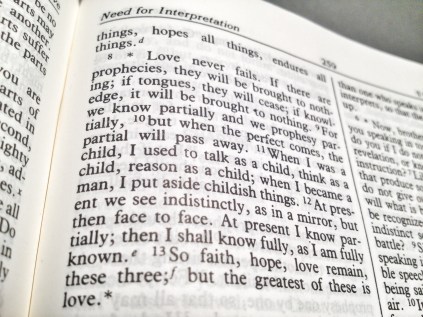
What Did I Learn When I Re-Read 1 Corinthians 13?

1-corinthians

I’VE BEEN RE-READING through 1 Corinthians 13 this week.

Each time I mull over and meditate on the verses within this chapter, I try to treat them as though they’re new to me—as though I’ve never read them before.  I’ve been trying not to bring my prejudices and preconceptions to the text; I just want the Word to teach me.  Here’s what I’ve gleaned thus far:

  1. The context of the chapter is miraculous; Paul mentions gifts of tongues, prophecies, faith and knowledge (v. 2).


  1. Chapter thirteen is actually sandwiched between two other chapters concerning miraculous gifts. Chapter twelve addresses the number and MANIFESTATION of gifts, chapter fourteen addresses the use and REGULATION of gifts, while chapter thirteen addresses the DURATION of gifts.


  1. Each member of the Corinth congregation who possessed a gift was able to exercise it of their own free will and volition (cf. 14:32). Unlike many Pentecostals today, there was no out-of-control, frantic behavior by those who had received an endowment.


  1. Not everybody who exercised their miraculous gift did so with the right intent. Some used it with selfish, proud and arrogant motives rather than for the edification of the church body at large (v. 3). “Look at me! Look at the gift I possess!” The underlying problem that permeated Corinth was division (cf. 1:10ff), and ultimately what created the division in the first place was a lack of love.


  1. Agapē love is based upon a decision as opposed to a feeling.


  1. Love (vv. 4-8a) is expressed by what it does positively (e.g., patience, kindness, bears-believes-hopes-endures all), as well as by what it doesn’t do negatively (e.g., envies, parades, puffs up, behaves rudely, seeks its own, is provoked, thinks evil, rejoices in iniquity).


  1. It is possible to understand, from an historical perspective, how the lack of love hurt the church at Corinth and still act in an unloving fashion today.


  1. The apostle made a clear distinction between those gifts which were temporary (e.g., miraculous) and the gifts that were permanent (e.g. faith, hope and love). See #2—and remember DURATION.


  1. Paul distinguished between that which was “in part” (v. 10b) and that which was “perfect” (v. 10a). The Word was being received in part/fragments—while the finished, finalized (Jude 3) Word would be perfect/complete (cf. Eph. 4:11-13).


  1. The miraculous gift period of the early church was child-like and immature because it did not possess the finalized, entire Word of God (v. 11). It only had bits and segments of the whole, divine revelation.


  1. The miraculous gift period of the early church was like looking into a cloudy, brass mirror (v. 12). But when God fully and finally revealed the totality of His Word in the latter part of the 1st century, the church’s insight would no longer be obscured, and she would be able to see and understand the Father’s will from a sharper and richer perspective (i.e., “face to face”).


  1. Paul couldn’t have been talking about the return of Jesus when he said, “When that which is perfect is come,” and I don’t need a degree in Greek language to know that: a)  If “that which is perfect” refers to Jesus at His final coming, THEN ALL MIRACULOUS GIFTS ARE PRESENT IN THE CHURCH TODAY.  But Paul didn’t say, “These twelve…”, he said, “these three” (v. 13), and b) If “that which is perfect” refers to Jesus at His final coming, THEN WE DO NOT HAVE THE COMPLETE, FINALIZED WORD OF GOD TODAY.


  1. Even though miraculous gifts are no longer employed in the 21st century, love must continue to be practiced.