HEART PROMPT – APR 2

From the book of Genesis to the Bible’s last book, the book of Revelation, we read about people having faith. In some cases, Jesus said people had little faith (Matthew 8:26; 14:31). Yes, people can be weak in faith, but it also is possible to have a strong faith (Romans 4:19,20).
The expression “live by faith” is used at least four times in the Bible, once in the Old Testament and three in the New. It first appears in Habakkuk 2:4, where it is written, “Behold the proud, his soul is not upright in him; but the just shall live by his faith.”
In a context in which he wrote about God making man righteous through the gospel, Paul reminded the early Christians that “The just shall live by faith” (Romans 1:16,17). In contrast to the impossible task of being justified by the law of Moses, Paul told Christians that “The just shall live by faith” (Galatians 3:11). The final time we read the words “The just shall live by faith” is found in Hebrews 10:38. After that statement, the writer speaks about believing to the saving of the soul (10:39), then he shows us example after example of Old Testament characters whose lives exemplified a living faith (Hebrews 11).
In every era of mankind’s history, those who have pleased the Lord God have been those who chose to live by faith. The reality is, “The just shall live by faith.” Yes, it is a choice. Faith is not something that can be injected with a needle, transplanted from one person’s heart to another’s, or purchased with money. Having faith is an individual response.
When the Bible says, “The just shall live by faith,” what does the word “just” mean? It comes from the Greek word “δ καιος/dikaios,” which means “righteous, observing divine laws; in a wide sense, upright, righteous, virtuous, keeping the commands of God” [Thayer, word no. 1342]. So, being righteous means to comply with God’s instructions. That same Greek word is translated frequently into our English Bible as “just,” but more often it is translated as “righteous.” If you want to think in terms of, “The righteous shall live by faith,” that is not a mistake.
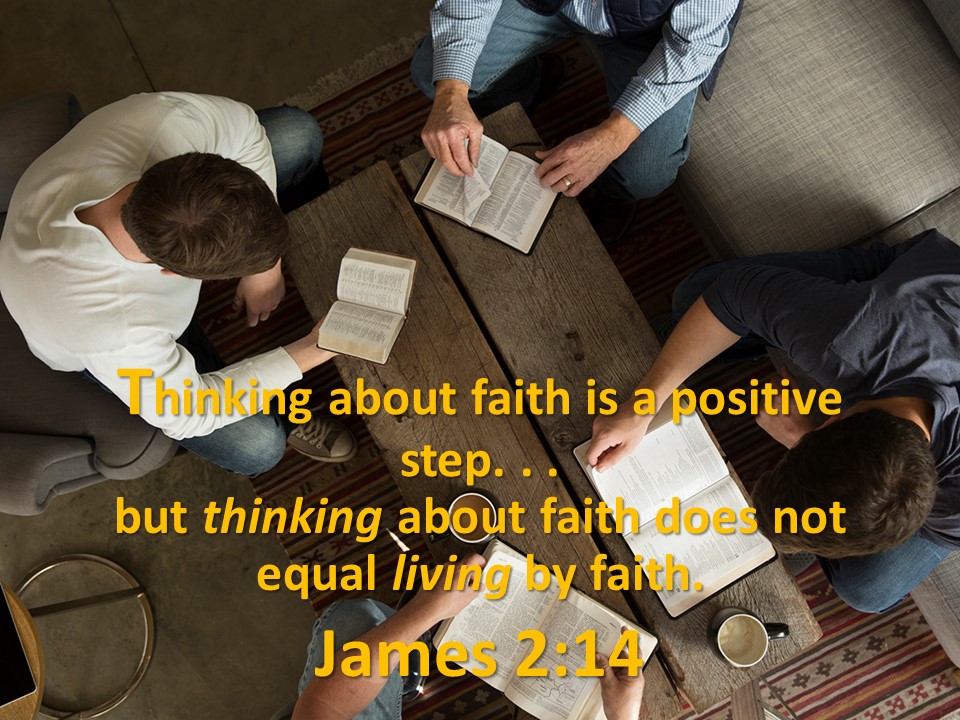
The one who is blessed is the one who lives by faith. Thinking about faith is a positive step, but thinking about faith does not equal living by faith.
Asking about faith, if the inquiry is from a sincere heart, is good. However, asking about faith and living by faith are not the same.
Putting in the effort to learn about faith has the potential to bring great benefits, but learning about faith and living by faith are different. Multitudes receive instruction about faith, but in the end many do not choose to live by faith.
Some pray about faith. Jesus’ disciples appealed to Him to increase their faith (Luke 17:5). Requesting faith and living by faith are different.
Many Christians know and sing the spiritual hymn entitled “Living by Faith.” It is one thing to sing about faith; it is another thing entirely to live by faith.
Talking about faith is not wrong, but do not confuse talking about faith with living by faith. From James 2:14-26, we learn that the kind of faith which pleases God is faith that manifests itself in action. And, it is not only faith in action, but it is action which is in harmony with the revealed will of God. In that context, James referred to the possibility of talking about faith: “What does it profit, my brethren, if someone says he has faith but does not have works? Can faith save him?” (James 2:14). The point: that kind of faith, a faith that is lifeless and non-active, cannot save anyone. One can talk about his faith from the rising of the sun until he goes to bed at night, but if he is not living by faith, his talk is just hot air.
Recently I tried to reason with an atheist about the human body showing design, which would indicate it came from an intelligent Designer. His response was, “You believe what you want to believe and I will believe what I want to believe.” While believing is a choice, you and I do not believe in God, the Bible, Jesus, and heaven because that is our personal whim or feeling, something that we just desire to believe. Biblical faith is always based on evidence (Hebrews 11:1), and like the example of Abel reminds us, faith is man’s response to God’s revelation/instruction (Hebrews 11:4; Romans 10:17).
If one has a faith which pleases God, what does he do? First, he accepts the facts/truthfulness of the Lord’s message, just as Paul exclaimed, “. . . I believe God that it will be just as it was told me” (Acts 27:25). Second, such a person trusts in the Lord, having a sense of dependence on Him (Proverbs 3:5). Third, biblical faith includes submitting to the Lord. When God said Moses did not believe Him (Numbers 20:12), the context shows that meant Moses failed to obey the Lord. Real, God-pleasing faith is demonstrated by submitting to the Lord’s will.
“Living by faith” is an ongoing process. It is what God wants us to do each day: trust in Him and have a heart that is ready to obey Him at all times. When the devil sends his fiery darts our way, a strong faith can serve as a shield to protect us (Ephesians 6:16). Whether it feels like matters are going smoothly in our lives or we are facing disappointment, turmoil, and opposition, let us keep on choosing to live by faith. BY ROGER CAMPBELL
“GOD LOVES YOU AND I LOVE YOU AND THAT’S THE WAY IT’S GONNA BE!” – MIKE
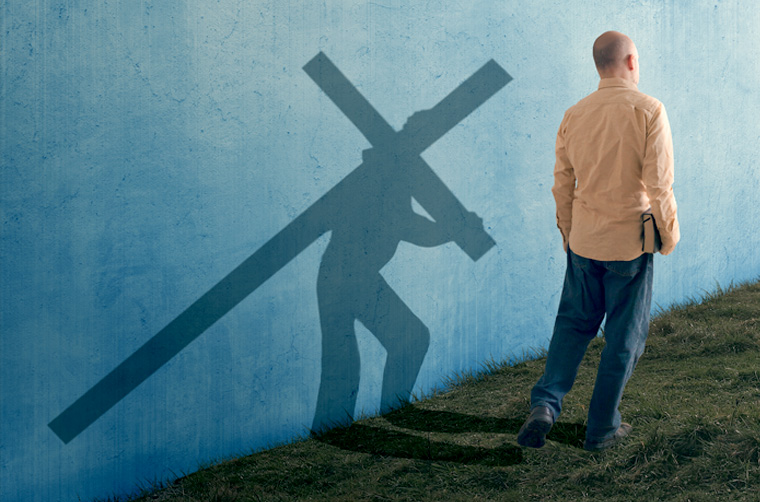
The cross holds much meaning for people today. Whether is it worn on chain, displayed prominently on a hill beside the road, hung on a place of worship, eulogized in sermon because of its spiritual significance, or just revered in thought or song, it means many different things to people today. But to the audience of Jesus in Luke 14:27 it meant none of those things, nor held any of those significances. This is true for a simple reason….
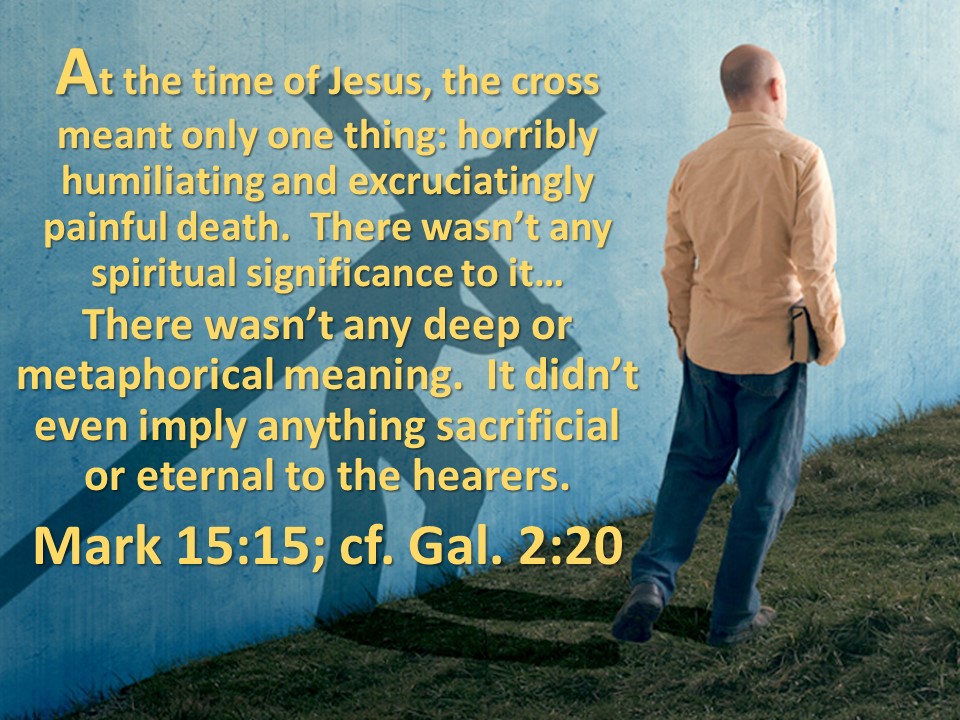
At the time Jesus urged the multitudes following Him to become true disciples through the admonition to “take up his cross and follow Me,” the cross had NONE of the spiritual significance the world attaches to it today. It couldn’t mean any of those spiritual things then because Jesus hadn’t yet given “the cross” any spiritual significance. Then a cross meant only one thing: horribly humiliating and excruciatingly painful death. There wasn’t any spiritual significance to it. There wasn’t any deep or metaphorical meaning. It didn’t even imply anything sacrificial or eternal to the hearers. Jesus’ audience didn’t know He was going to be sacrificed, let alone that it would be on a Roman crucifix. They had no spiritual concept of what Paul would later call being “crucified with Christ” (Galatians 2:20) or, “the cross of our Lord Jesus Christ, through which the world has been crucified to me, and I to the world” (Galatians 6:14). To them, a cross just meant death. Think about a couple salient points….
So, what about it? Are you ready to take up your cross daily to follow Him? I hope so, because that is the cost of discipleship affixed by the Lord. Conversely, you just tag along after Him with the crowds as long as it is convenient, doesn’t cost too much, and you get some physical blessings or benefits. Which will it be for you? BY PHILIP STRONG
“GOD LOVES YOU AND I LOVE YOU AND THAT’S THE WAY IT’S GONNA BE!” – MIKE
 INCARNATE