
The New Testament affirms that the old law or covenant was taken out of the way (Galatians 3:24-25; Hebrews 10:9). Some suggest there were two laws in the Old Testament era—a moral law and a ceremonial law—and that only the latter was taken away.
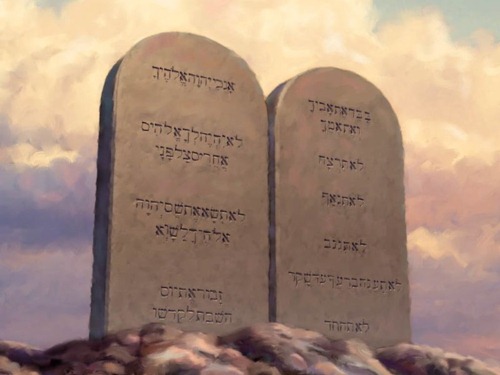
Those who make this distinction say the moral law, which consists of the Ten Commandments, is called “the Law of God.” It was given by God, who wrote it on stone tablets which were placed in the ark of the covenant. It is to stand forever. The ceremonial law, which consists of all the other ordinances, is what was called “the Law of Moses.” It was given by Moses, who wrote it in a book which was kept beside the ark of the covenant (Deuteronomy 31:24-26). Only this law was abolished by Christ. The practical effect of all this is: since the Ten Commandments are still in place, people today must keep the Sabbath.
Does the Bible teach the moral/ceremonial law distinction, with the old moral law still in force?
To begin with, the Bible does not use the expressions moral law or ceremonial law. That does not necessarily mean the concepts are not there, but it is interesting. Looking further, the suggested distinctions do not hold up in Biblical usage.
The expressions law of Moses and law of God are used interchangeably. Ezra brought “the book of the law of Moses” to read (Nehemiah 8:1), yet in v. 8 that same book is called “the law of God.” In describing the events of Jesus’s birth, Luke says, “And when the days for their purification according to the Law of Moses were completed, they brought Him up to Jerusalem to present Him to the Lord (as it is written in the Law of the Lord, ‘Every firstborn male that opens the womb shall be called holy to the Lord’), and to offer a sacrifice according to what was said in the Law of the Lord, ‘A pair of turtledoves or two young pigeons’” (Luke 2:22-24).
Since Luke cited the sacrificial regulations of Leviticus 12 as “the Law of the Lord,” it is obvious that the law of God was broader than the Ten Commandments; it included sacrificial laws as well. See 2 Chronicles 31:2-4 for a similar example, or the events of 2 Chronicles 34.
The Bible says the law of Moses was given by God (Ezra 7:6), and the Law of the Lord was given by Moses (2 Chronicles 34:14).
Jesus attributed statements both in and out of the Ten Commandments to God (Matthew 15:4). In Mark’s gospel, He attributed both those same statements to Moses (Mark 7:10)!
Mark 12:28-31 says when a scribe asked Jesus what the greatest commandment was, Jesus cited two: to love God with all your heart (Deuteronomy 6:5) and to love your neighbor as yourself (Leviticus 19:18). He said no other commandment was greater than these. (Paul later wrote that many of the Ten Commandments were summed up in the command to love your neighbor [Romans 13:9]). If the moral/ceremonial law distinction is valid, the greatest commandments were taken away while lesser laws were left intact!
In Romans 7:4-7, Paul cited “You shall not covet,” the last of the Ten Commandments, as part of the law from which we have been released. In 2 Corinthians 3:6, he wrote that the law written on stones is a “ministry of death” which has been replaced by a new covenant, one of life. Therefore, the notion that only the ceremonial law was taken away is clearly false.
This moral/ceremonial law distinction that some suggest is not Biblical. Romans 10:4 says, “Christ is the end of the law for righteousness to everyone who believes.” He is not merely its termination; He is the one who offers righteousness, the goal or aim which the law intended. Righteousness cannot be achieved by keeping laws. It requires forgiveness, and that is obtained in Christ (Ephesians 1:7). Are you in Him? BY TIM HIMMEL
“GOD LOVES YOU AND I LOVE YOU AND THAT’S THE WAY IT’S GONNA BE!” – MIKE


 INCARNATE
