HEART PROMPT – MAR 18


QUESTION: “Please explain Acts 16:14. What does the Bible mean when it says, ‘…The Lord opened her [Lydia’s] heart…?’ By what means did He accomplish this? Does He open our hearts in the same way today?”
ANSWER: The passage reads, “Now a certain woman named Lydia heard us. She was a seller of purple from the city of Thyatira, who worshipped God. The Lord opened her heart to heed the things spoken by Paul.” Several observations are in order. Note:
The term “heart” is used here in a figurative sense and refers to Lydia’s intellect. Scripture teaches that when a person engages his or her heart, he/she “thinks” (Matt. 9:4; Heb. 4:12), “understands” (Matt. 13:15), “reasons” (Mk. 2:6), “perceives” (Jn. 12:40 NAS), and/or believes (Rom. 10:10). Thus, when Luke through inspiration recorded that Lydia’s heart/intellect was “opened,” he simply meant that she had come to a comprehension and acceptance of Paul’s message (cf. Lk. 24:45; Acts 26:18); she had been receptive to the Gospel (v. 15; cf. Acts 8:6, 12; Heb. 12:1-2). Compare Eph. 1:18, “The eyes of your understanding [heart—NIV] being enlightened…”
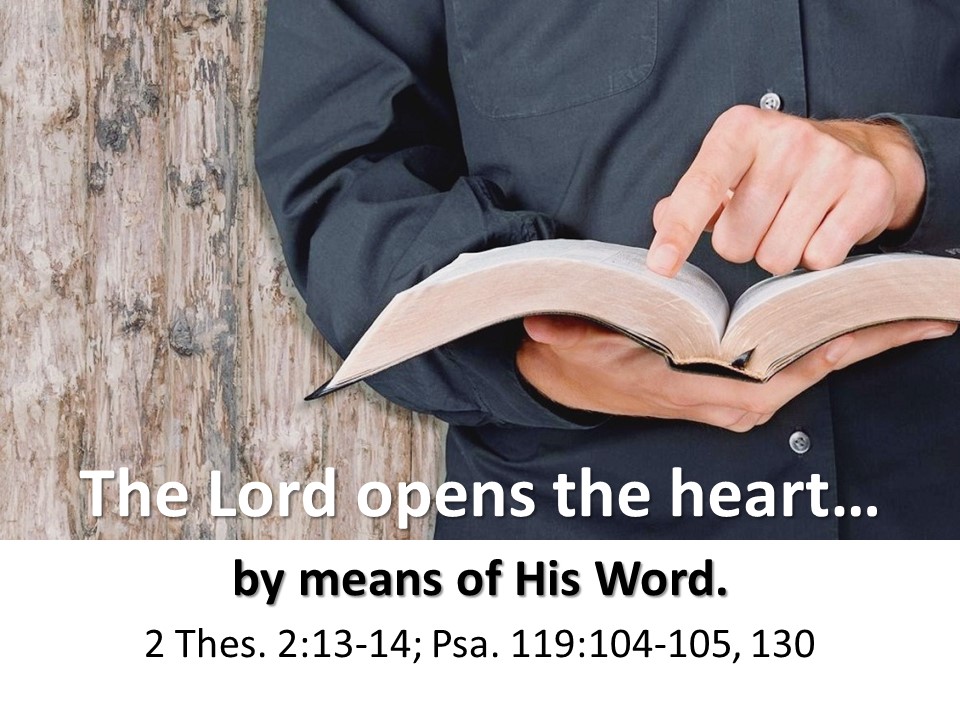
The Lord opened Lydia’s intellect by means of His Truth (Rom. 16; 1 Cor. 15:1-2; Jas. 1:12). Truth removed all obstacles which would have prevented Lydia from accepting the good news about Jesus being the Messiah. All wrong ideas were removed so she could believe (Jerry Moffitt, “Acts,” Moffit’s Bible Commentary—the New Testament, Vol. I, 180). Likewise, the Lord opens our hearts (Lk. 8:15) through the very same agency (2 Thess. 2:13-14; Psm. 119:104-105, 130, Psm. 19:7a) today (Jn. 6:63; 8:31-32).
Lydia’s heart would have been considered closed had she refused to hear and obey. Compare 2 Cor. 3:15, “But even to this day, when [the law of] Moses is read, a veil [covering—ERV] lies on their heart.” As J.W. McGarvey notes:
“The statement that the Lord opened Lydia’s heart implies that previously her heart was in some way closed. It was certainly not closed by the hardness of a sinful life, or by inherited depravity; for such a supposition is forbidden by the steadfastness with which, under great temptation, she had previously clung to the worship of God. It was closed in the sense in which the pious and earnest heart of a Jewish worshiper might be closed. Every Jew, and every Jewish proselyte, was at that time so wedded to the belief that the coming Christ would establish an earthly kingdom, as to have the heart very tightly closed against the conception of a crucified Christ, whose reign as a king is purely spiritual. It was this that had caused the mass of the Jews to reject the Christ while he was still on earth, and it continued to be their “stumbling block” (Jn. 5:44; 1 Cor. 1:23). Whether Lydia was a Jewess or a proselyte, this was ‘the hope of Israel’ in which she had been instructed, and for which she had been taught to devoutly pray; and if the natural effect of it had not been removed from her heart, she must have rejected the gospel, as did the mass of those who had been her teachers. The statement then that the Lord “ opened her heart” means that he removed this mistaken conception [through the Truth— mb] which would have prevented her from receiving the Christ” (J.W. McGarvey, “Acts XVI.13-15,” New Commentary on ACTS OF THE APOSTLES, 90- 91). BY MIKE BENSON
“GOD LOVES YOU AND I LOVE YOU AND THAT’S THE WAY IT’S GONNA BE!” —MIKE
SUPPOSE THERE’S A man with a bad reputation in the community…
He’s impatient, unkind, and uncompassionate, and he takes advantage of people in business deals. He treats people poorly, disdaining those he considers beneath him.
He’s also a church member who holds conservative, orthodox convictions on matters of faith. In fact, he holds his convictions quite rigidly and will not tolerate anyone who deviates even slightly.
There’s an obvious problem here, right?
He seems to believe that the most important part of faith is what we do toward God, what might be called the vertical aspect. If our worship and doctrinal convictions are right, then we’re okay.
Or maybe not.
Jesus opposed that particular perspective frequently and vocally. Look at the second part of his response to a question he was asked, and notice how closely he aligns love for neighbor with love for God:
And one of the scribes came up and heard them disputing with one another, and seeing that he answered them well, asked him, “Which commandment is the most important of all?” Jesus answered, “The most important is, ‘Hear, O Israel: The Lord our God, the Lord is one. And you shall love the Lord your God with all your heart and with all your soul and with all your mind and with all your strength.’ The second is this: ‘You shall love your neighbor as yourself.’ There is no other commandment greater than these” (Mark 12:28-31).
What does it mean to be God’s child?
Love God, love people, Jesus says. Yesterday we considered the first, but with Jesus the second matters just as much.
In fact, he links them so strongly as to make them inseparable. If you love God, you will love people.
It’s everywhere in Jesus’ teachings.
The hero of his most famous parable was a hated Samaritan—his theology wasn’t too good, but he was praised because he had a heart for hurting people.
The unnamed villain of another story was sent to hell for what? Bad theology?
Not so much.
He wasn’t even condemned for treating poor Lazarus terribly. He wasn’t mean or harsh. He didn’t throw the beggar off his property or spit on him as he walked by.
He just ignored him. He was indifferent, unconcerned. His great sin was doing nothing.
But through his teaching and living Jesus taught us that loving God means loving God’s people.
He was gentle with the adulterous woman brought to him in shame.
He forgave the “woman of the city” who let her hair down and cried on his feet.
He hung out with drunks, prostitutes, and tax collectors.
In fact, you can’t read a page of the gospels without seeing his kindness toward people.
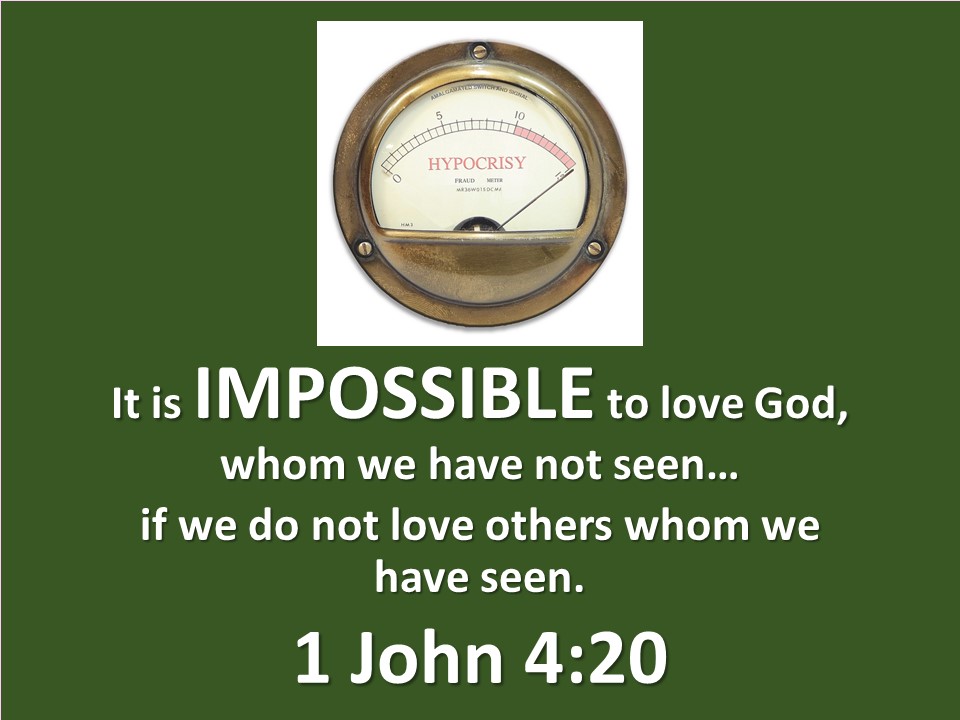
And that’s what he tells us to do. It comes through so clearly that we come to realize that we don’t really love God if we don’t.
None of this means God doesn’t care about our theology.
But it does mean we can have some pretty good theology and still not know God. BY CHUCK WEBSTER
KneEmail: And one of the scribes came up and heard them disputing with one another, and seeing that he answered them well, asked him, “Which commandment is the most important of all?” Jesus answered, “The most important is, ‘Hear, O Israel: The Lord our God, the Lord is one. And you shall love the Lord your God with all your heart and with all your soul and with all your mind and with all your strength.’ The second is this: ‘You shall love your neighbor as yourself.’ There is no other commandment greater than these” (Mark 12:28-31).
“GOD LOVES YOU AND I LOVE YOU AND THAT’S THE WAY IT’S GONNA BE!” – MIKE