Category: Uncategorized
INCARNATE – CAN WE ALL SEE THE BIBLE ALIKE?

Recently a preacher raised the question: “Can we all understand the Bible alike?” He declared that we cannot, and asserted that those who believe that we can are simply entertaining an ignorant viewpoint.
Your Understanding, My Understanding
The claim is frequently made: “You understand the Bible one way, and I understand it another. Neither of us should condemn the other.” Another variation of the same tune: “Well, that is your interpretation of the Scriptures. I have mine as well. Perhaps both of us are right.”
These statements contain a logical contradiction. There is no such thing as “understanding the Bible differently.” If two people differ on the meaning of a biblical text, one of them is wrong about the matter—possibly both. We might misunderstand something differently, but we do not understand something differently.
Moreover, a passage does not yield two different interpretations; somewhere, there is misinterpretation.
Can God Make Himself Understood?
We operate daily upon the presumption that we, frail mortals though we are, can make ourselves understood to our peers. A department store places an advertisement in the newspaper about an upcoming sale. Hundreds of people flock to the same establishment on the correct day at the right time expecting specific items at a certain price to be available for purchase. How is it that they understand the ad alike?
A recipe is printed on a cereal box for oat bran muffins. Hundreds of ladies across the country follow it and bake delicious muffins for their families. Do they understand the instructions alike?
A physician prescribes a medication. Do we believe that the pharmacist will understand what the doctor has prescribed, and are we confident that we can understand the instructions for taking the medicine?
If we can sensibly operate our lives on a routine basis, recognizing that we are able to communicate with one another in an intelligible fashion, why can’t we acknowledge that God, who is infinitely wiser and abler than man, can clearly make his will known to humanity?
If one suggests that Jehovah could not clearly make himself known to man, he reflects upon the power of the Lord. If one argues that God purposely did not reveal himself to mankind in a lucid fashion, he reflects upon the benevolence of his maker. If one contends that man has no responsibility to understand and obey the precepts of the Scriptures, it is he who evidences great ignorance of his obligation to Heaven.
What Saith the Scripture?
The Bible is replete with passages which have as their underlying basis the assumption that we can uniformly understand our divine responsiblility as made known in the sacred writings. Consider the following:
- Christ declared that man shall not live by bread alone, but “by every word that proceedeth out of the mouth of God” (Matthew 4:4). If spiritual life is only to be found in the words from God, does it not stand to reason that humanity is capable of understanding that message?
- When Jesus rebuked the Sadducees for their error concerning the resurrection of the human body, he charged that a part of their problem was that they were ignorant of the Scriptures (Matthew 22:29). Does this not presuppose that had they been good students of the Old Testament they could have uniformly known that there was to be a resurrection of the body?
- Though none of us was alive to witness the first-century miracles performed by the Lord Jesus, the history of those events was written down in order that we might believe those signs which documented the Master’s claim of deity (see John 20:30-31). Can we believe the biblical narratives regarding Christ’s deeds and confidently have a united understanding that he is the Son of God? If not, of what value is the New Testament?
- Of the early church it is said: “And the multitude of them that believed were of one heart and soul” (Acts 4:32). How could such a statement possibly be made unless those early saints were capable of agreeing upon the apostolic instruction?
- The citizens of the city of Berea were considered to be nobler than those of Thessalonica, because they received the word of God with all readiness of mind, examining the Scriptures daily to determine the accuracy of what they were being taught (see Acts 17:11). Does this affirmation not imply that these inquirers were able to draw harmonious conclusions about the word of God?
- The Christians in Rome were commanded to be on the lookout for those who caused divisions and occasions of stumbling “contrary to the doctrine which ye learned” (Romans 16:17). If we cannot understand the Bible alike, how could anyone ever be disciplined for walking contrary to sound doctrine? That would make no sense whatsoever.
- In the New Testament epistles, the churches are constantly admonished to “speak the same thing,” to be free from divisions, and to “be perfected together in the same mind and in the same judgment” (1 Corinthians 1:10; cf. Philippians 2:2). How can we possibly take this instruction seriously if we are incapable of understanding the Bible alike?
- The apostle Paul plainly declared that by reading the message which he wrote, we would be able to perceive his understanding of the gospel of Christ (see Ephesians 3:1-7). He thus subsequently charges: “Wherefore be ye not foolish but understand what the will of the Lord is” (Ephesians 5:17).
- The inspired Scriptures are said to be profitable “for teaching, for reproof, for correction, for instruction which is in righteousness: that the man of God may be complete, furnished completely unto every good work” (2 Timothy 3:16-17). If we do not have the ability to understand the Scriptures, how can the holy writings profit us in the aforementioned categories?
Can we understand the Bible? Of course we can. Can we understand it alike? Why not?
If we can understand that 2 + 2 = 4, if we can understand that fifty-five miles per hour means just that, then we can understand, “He that believeth and is baptized shall be saved” (Mark 16:16). We can understand that there is “one body” (Ephesians 4:4), and that that body is the church (Colossians 1:18). We can further know that salvation is in that body (Ephesians 5:23), and outside of that body no redemption is to be found (2 Timothy 2:10).
The problem with those who contend that men cannot agree upon the Scripture’s teaching is simply this: they are seeking a way to justify error! BY WAYNE JACKSON, DECEASED – https://www.christiancourier.com/articles/225-can-we-understand-the-bible-alike
“GOD LOVES YOU AND I LOVE YOU AND THAT’S THE WAY IT’S GONNA BE!” – MIKE
TODAY’S PRAISE – FEB 19
HEART PROMPT – FEB 19
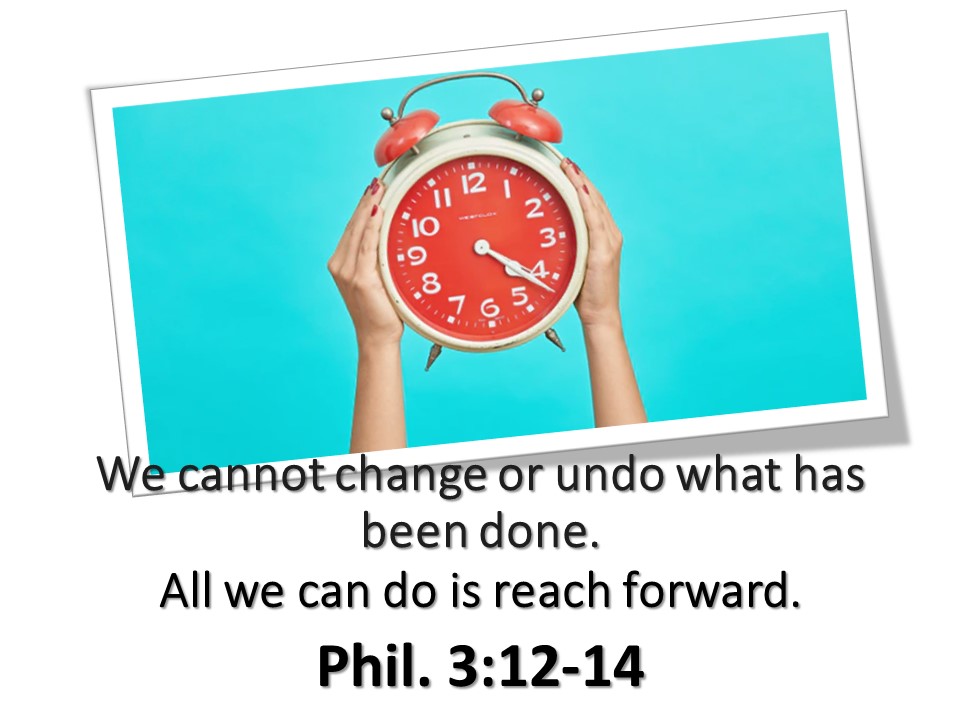
INCARNATE – FORGETTING THOSE THINGS LEFT BEHIND

Paul wrote, “Forgetting those things which are behind and reaching forward to those things ahead, I press on toward the mark of the high calling of God in Jesus Christ (Phil. 3:13-14).
First, Paul’s not saying he forgot the past or stop learning from it. In fact, some nine or ten times he refers back to his time as a persecutor of The Way. He never forgot what he did to those who were Christians. He also never stopped learning from that time in his life when he did those things. Further, there were those who would never let him forget: Judaizers who were all the more fervent to pursue him and put him to death.
When Paul said “forgetting those things behind,” he means that he is no longer influenced by his past life as a Hebrew of Hebrews and Pharisee of Pharisees. He might recount his history and life as a Jew, but now as a Christian all those things he once counted as gain he counts as loss. He is no longer influenced by them.
Remembering our past is good to a point. It can help us learn from our mistakes. Our past can remind us of what we once were, and remind us why we don’t want to go back to that way of life–ever. There are also some who will never let us forget the mistakes of our past. However, as with Paul, there comes a time when the past is the past. We cannot change or undo what has been done. All we can do is reach forward.
The past can move us to urgently seek something better and serve One who is greater. Reaching forward becomes the driving passion, not the past. Yes, we sinned–but we have been forgiven. Yes, we messed up and used bad judgment, but now we are growing wiser and learning more all the time.
What can we learn from our past? Where are we growing? Whatever our past, the future is brighter and more pressing. So let us not be overburdened by the past, look to the future, and hope for the city whose builder and maker is God. BY RICKIE JENKINS
“GOD LOVES YOU AND I LOVE YOU AND THAT’S THE WAY IT’S GONNA BE!” – MIKE
 INCARNATE