Category: Uncategorized
INCARNATE – RESOLVING CHURCH CONFLICTS

The Lord’s plan for his church is flawless. As individual members of his body, however, we are in the process of growth; we have not reached a state of perfection. There is no such thing as a flawless family or perfect work environment. Nor is there a perfect congregation.
Problems will arise within a church for a number of reasons. For instance, individuals will have different opinions. We must “speak the same thing” in matters of doctrine (1 Cor. 1:10; cf. 2 Jn. 9-10), but there must be latitude in other areas. Different stages of spiritual development, personality differences, misunderstandings — all of these things can contribute to tension. While we recognize that personal friction is inevitable, the New Testament commands us to work towards the resolution of all conflicts.
In Philippians 4:2-3, Paul exhorted the church at Philippi.He wrote:
“I exhort Euodia, and I exhort Syntyche, to be of the same mind in the Lord. Yea, I beseech thee also, my true yokefellow, help these women, for they labored with me in the gospel, with Clement also, and the rest of my fellow-workers, whose names are in the book of life.”
The cause of the problem between these women is unknown; however, Paul’s admonition to unity contains some key aspects for conflict resolution.Consider the following points.
- The situation was urgent. The word translated “exhort” is parakaleo, literally “to call near, beside, into the proximity of.” It is rendered “appeal to, urge, exhort, encourage” (Arndt and Gingrich, Greek-English Lexicon of the New Testament, p. 617). Paul entreated them to resolve their difficulties. One must not “let the sun go down” upon his wrath (Eph. 4:26).
- Paul exhorts both individuals. “I exhort Euodia, and I exhort Syntyche, to be of the same mind” (v. 2). Problems can be resolved when both sides are willing to sit down and work towards reconciliation. Most significantly, this calls for both sides to desire resolution. Offended parties may never agree on the nature of the blame, or the offense. But their desire should be to move forward with sincerity, humility, and love. Attitude plays a major role in solving problems (cf. Eph. 4:1-3).
The principles for dealing with personal grievances are set out by the Lord in Matthew 5:23ff and 18:15-17. When a brother is aware that a spiritual sibling has something against him (i.e., a genuine concern), then that brother is obligated to initiate contact to resolve the problem (Mt. 5:23).
On the other hand, the person who has an actual complaint (i.e., not a petty grievance) against a brother, is obligated to remedy the conflict as well. The stand-offish gripe, “he didn’t come to me,” is neither biblical nor practical. Both the offender and the offended are required to seek out the other so that these types of situations do not remain unaddressed. - Paul looks for intervention. “Yea, I beseech thee also, true yokefellow, help these women” (v. 3). Paul encouraged this faithful member of the church in Philippi to give assistance. He did not recommend that either member fire a shot of accusation, followed by a membership move to another church. Although this tactic is faddish, it resolves nothing.
Noteworthy is the fact that Paul addressed this mediator as a “true yokefellow” (i.e., an authentic co-worker in the Lord). Similarly, in Galatians 6:1-2, Paul advised the spiritually minded to restore those overtaken in a trespass. Some people are more capable in dealing with volatile crises. Others may get caught up in a “feeding frenzy” of excitement and controversy, assuming the worst of the elders, the preacher, or other members. A qualified person can assist in problem-solving by focusing on resolution. He will not become part of the problem. As the apostle Paul indicated, a capable intermediary may be able to make a positive contribution in settling a conflict. - Paul notes that the souls of people are at stake. “Yea, I beseech thee also, true yokefellow, help these women, for they labored with me in the gospel, with Clement also, and the rest of my fellow-workers, whose names are in the book of life” (v. 3). The work of the church suffers as problems go unresolved. Attitudes of hostility and resentment have no place in the Lord’s church. We all are trying to live for Christ. Can we not maintain that perspective?
Christian unity is the product of Christianity in practice. Through prayer, and the application of texts like Philippians 4:2-3, God’s people can all work and worship in unity; the bond that holds us together is love (Col. 3:14). We will have a perfect environment in heaven. Until then, the Lord expects us to work out our problems — staying focused on heaven. BY WAYNE JACKSON, DECEASED – https://www.christiancourier.com/articles/1179-resolving-church-conflicts
“GOD LOVES YOU AND I LOVE YOU AND THAT’S THE WAY IT’S GONNA BE!” – MIKE
HEART PROMPT – FEB 12
TODAY’S PRAISE – FEB 12
INCARNATE – FRUITS OF REPENTANCE

“When John the Baptist told the Jews that they must bring forth fruit worthy of repentance, what did he mean by ‘fruit’ (Matthew 3:8)?”
There are three things to be taken into consideration in answering this question.
- Exactly what is “repentance”?
- What is the significance of the expression, “worthy of”?
- What is implied by the phrase, “bring forth fruit”?
We will examine each of these items.
What Is Repentance?
The Greek verb that is translated “repent” is metanoeo. Literally, it means “after thought.” It suggests the idea of thinking about a deed after the commission of it.
In the case of a sinful action, repentance requires a retrospection of the act and a subsequent feeling of sorrow for having committed the sin.
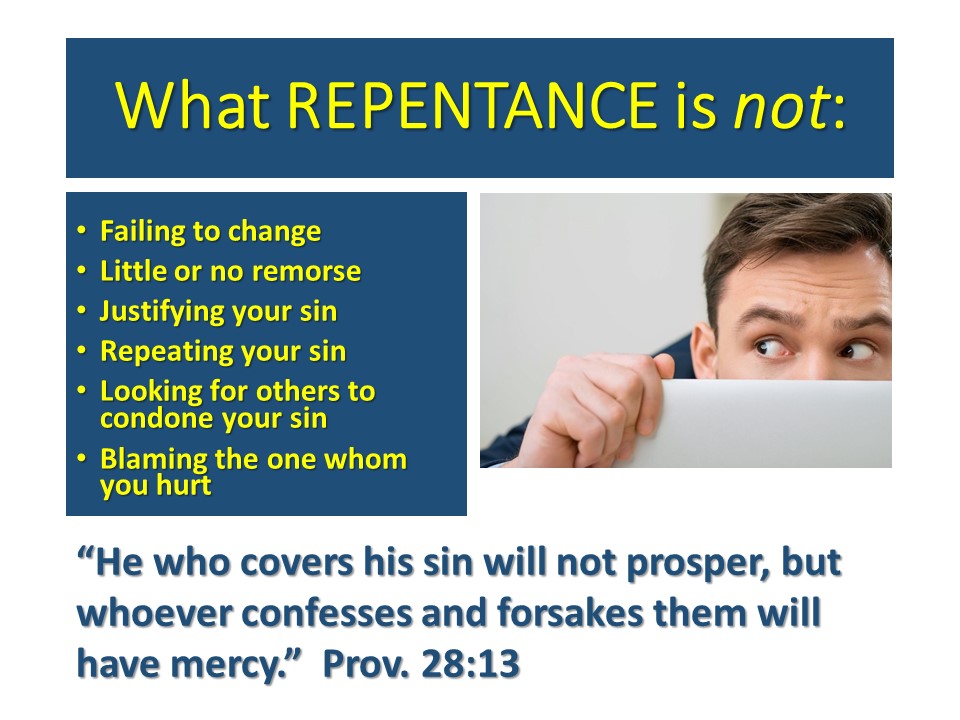
Repentance involves more than being sorry for the wrong act. This is beyond dispute. True repentance includes sorry but also a resolve to stop the wrongful conduct, replacing it with godly living.
J. H. Thayer commented upon the term in the following fashion. He said that repentance is:
“the change of mind of those who have begun to abhor their errors and misdeeds, and have determined to enter upon a better course of life, so that it embraces both a recognition of sin and sorrow for it and hearty amendment, the tokens and effects of which are good deeds” (1958, 406).
Here is a clear example of how this word was used in the New Testament to include more than just sorrow.
In response to Peter’s sermon on the day of Pentecost (Acts 2:14-36), his listeners were “pricked in their heart” (Acts 2:37). Their sorrow at crucifying their own Messiah prompted them to ask, “What shall we do?”
Peter responded, in part, “Repent” (Acts 2:38a).Obviously, repentance demanded more than mere regret. It required action that manifested a change of life.
Later on, Paul would write that “godly sorrow leads to repentance” (2 Cor. 7:10). The repentance of this text, therefore, must be reformation, not mere grief over the act.
What Does It Mean to Be Worthy of Repentance?
The expression “worthy of” (axios) originally had to do with comparing objects that were of equal weight. The metaphorical use in the New Testament may be employed of things both good or bad.
For example, someone who spends his time and energies in proclaiming the gospel is worthy of support — that is, financial support commensurate with his labor (Mt. 10:10; 1 Tim. 5:17-18).
Here’s another example. A person who commits a capital crime (e.g., murder) is worthy of death (Acts 23:29; 25:11).
With reference to the issue at hand, the change of life that is characteristic of repentance must correspond to the gravity and nature of the offense. Otherwise, there simply is no repentance.
What Is the Fruit of Repentance?
Finally, what is the actual “fruit” required in genuine repentance? Several factors must be taken into consideration.
First, if the sin has been against another person individually, amendment must be addressed to that person.
When David committed adultery with Bathsheba, it is absurd to conclude that his confession to Nathan, “I have sinned against Jehovah” (2 Sam. 12:13), would have exhausted the scope of his repentance. Who would claim he had no responsibility to acknowledge the wrong to Bathsheba, his partner in adultery?
Too many people labor under the illusion that they can make a generic confession at a church service, without ever making things right personally with the victims of their sin.
Much less, even, is it the case that one may secretly repent of a sin, and subsequently, deny that the transgression ever was committed! Strange indeed is the meaning of repentance in such a person’s spiritual lexicon.
Second, whenever possible, an attempt at restitution should be made. There are a number of Old Testament passages that make clear this point (see Ex. 22:1ff; cf. Lk. 19:8b). Though we are not bound by the specifics of Mosaic legislation, the principle is important nonetheless.
In the case of a murder, the destroyed life can never be restored, but the murderer might be able, to the best of his ability, help support the widow and children of his victim.
If someone steals money, it should be repaid to the extent of his ability. If a banker has embezzled a million dollars from the financial institution for which he has worked, he might never be able to repay that entire sum, but he should attempt to do what he can. If a person declares bankruptcy, he is morally obligated to repay his creditors (as much as is feasible).
We are not permitted to enjoy the fruit of our crimes. Of course, it is always possible that a victim of abuse might “forgive” the debt (Mt. 18:27), but the sinner must never take that for granted. We must never reason, “Because I cannot repair all my sins, I will make no attempt to remedy any of them.”
The conscientious Bible student is forced to conclude that any repentance without the full compliment of elements that define that term is no repentance at all. BY WAYNE JACKSON, deceased at: https://www.christiancourier.com/articles/1015-what-is-the-fruit-of-repentance
“GOD LOVES YOU AND I LOVE YOU AND THAT’S THE WAY IT’S GONNA BE!” – MIKE
 INCARNATE