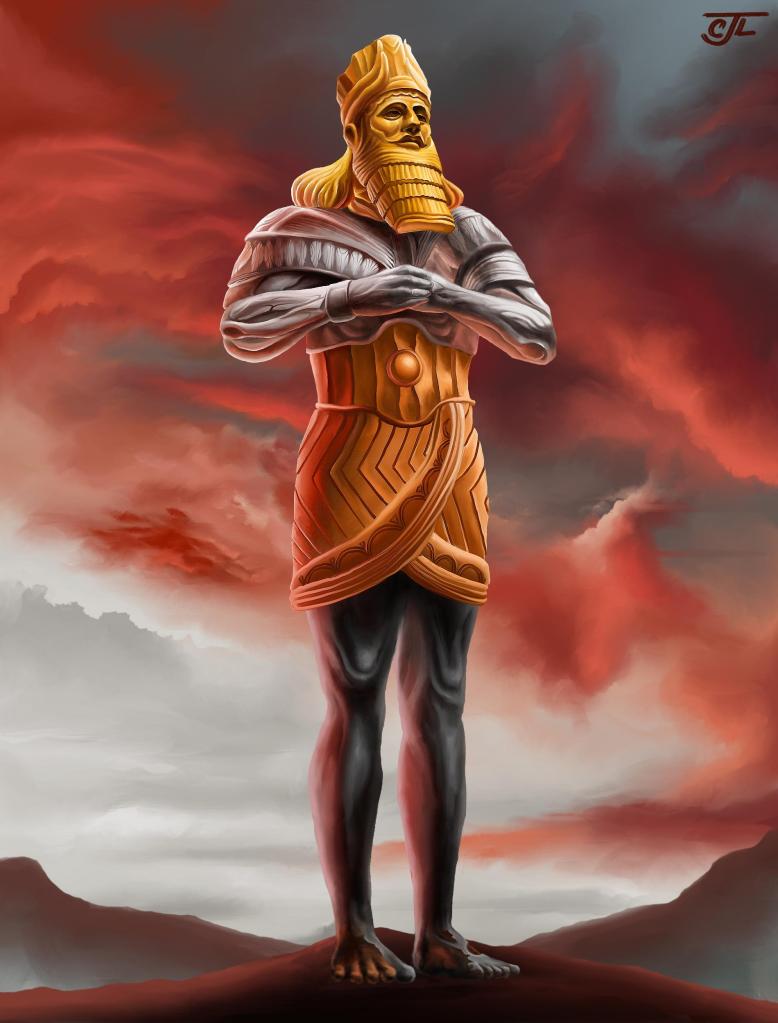
The Book of Daniel contains some of the most memorable messages of the Old Testament record. For this study, we are going to focus on chapter two, a section in which the basic thrust is that the king of the Babylonian Empire, Nebuchadnezzar, had a dream, and the prophet Daniel explained it. Daniel informed the powerful monarch that “there is a God in heaven” (2:28). In this chapter we see God’s power, His prediction, and His providence.
God’s Power – Nebuchadnezzar had a dream, but he could not recall what it was. He wanted to know (1) what he had dreamed and (2) the dream’s meaning. Through Daniel, Jehovah revealed the dream’s significance. From Daniel’s inspired message, we are able to see God’s great power.
God has the power of knowledge, knowing what is in the darkness as well as deep and secret things (2:22). God has the power of light, as “light dwells with Him” (2:22). God has the power of revelation, as “He reveals deep and secret things” (2:22). He also has power in the kingdoms of men: “He removes kings and raises up kings . . . the Most High rules in the kingdom of men, gives it to whomever he will . . .” (2:21; 4:17). Nebuchadnezzar ruled because the Lord willed it to be so, giving him “a kingdom, power, strength, and glory” (2:37). Brothers and sisters, our Lord is Almighty! Let us take courage and comfort from the truth that He lives, and the whole world is in His hands.
God’s Prediction – God alone knows with 100% accuracy what will transpire in the future. Daniel told Nebuchadnezzar that Jehovah made known “what will be in the latter days”(2:28), foretelling via the prophet “what will be” (2:29). What were the specifics of God’s prediction for Nebuchadnezzar and others?
First, Daniel told the emperor what he had seen in his dream (2:31-35):
You, O king, were watching; and behold a great image! This great image, whose splendor was excellent, stood before you, and its form was awesome. This image’s head was of fine gold, its chest and arms of silver, its belly and thighs of bronze, its legs of iron, its feet partly of iron and partly of clay. You watched while a stone was cut out without hands, which struck the image on its feet of iron and clay, and broke them in pieces. Then the iron, the clay, the bronze, the silver, and the gold were crushed together, and became like chaff from the summer threshing floors; the wind carried them away so that no trace of them was found. And the stone that struck the image became a great mountain and filled the whole earth.
Next, the prophet revealed God’s prediction – the true meaning of Nebuchadnezzar’s dream. Yes, the king’s dream and Daniel’s inspired explanation involved symbols, but there is sufficient information provided to understand them clearly. Through Daniel’s message to Nebuchadnezzar, God spoke of five kingdoms. Which five? The fifth is identified in God’s word, and the first four are clearly revealed in world history as well as in the Scriptures.
(1) Babylonian Empire (head of God) – Daniel plainly told Nebuchadnezzar, “You are this head of gold” (2:38).
(2) Medo-Persian Empire (chest and arms of silver) – a kingdom that was inferior to Babylon (2:39). The Book of Daniel identifies “the Medes and Persians” as successors to the Babylonians (5:28-31; 8:20).
(3) Greek Empire (belly and thighs of bronze), which is specifically named in Daniel 8:21 – World history shows that the Greeks, under Alexander the Great, did, indeed, conquer the Medo-Persian Empire and rule in its stead.
(4) Roman Empire (legs of iron with feet partly of iron and partly of clay) – Called “the fourth kingdom” (2:40), the Romans overthrew the Greeks and were a mighty force in world affairs during the life of Jesus and the early church.
(5) God’s kingdom – “And in the days of these kings the God of heaven will set up a kingdom which shall never be destroyed; and the kingdom shall not be left to other people it shall break in pieces and consume all these kingdoms, and it shall stand forever” (2:44). This kingdom would be God’s, it would be set up in the days of the Roman kings, it would conquer all others, and it would never be destroyed. How exciting is that?!
Look at the New Testament record. Jesus was born during the days of Roman rule (Luke 2:1). It also was during the days of the Roman Empire that John the Baptizer and Jesus foretold the nearness of God’s kingdom (Luke 3:1; Matthew 3:2; 4:17), Jesus died at the hands of the Romans (John 19:12-18), and the Lord’s church began under Roman rule (Acts 2).
What was the fifth kingdom, the one that God Himself established? The church – the Lord’s church, which He purchased with His blood (Acts 20:28) and over which He now rules as King (Colossians 1:13,14). Do not look to the future for the start of Jesus’ kingdom; look to the past, look to the first century, when it began in Jerusalem (Acts 2).
God’s Providence – It is true that God granted Daniel the miraculous ability to interpret dreams, but it was by His providence that Daniel was “in the right place at the right time.” By God’s providence, Daniel later was made “ruler over the whole province of Babylon” (2:48) and a high official in the Medo-Persian regime (6:1-3). How did Joseph get into such a high position in Egypt? What about Esther in the Medo-Persian ranks? The same answer: Daniel, Joseph, and Esther were elevated to such high places through God’s providence. The Lord God rules in the kingdoms of men! Believe it. And, that majestic, ruling Lord causes His kingdom to overcome and endure forever. His providence is wonderful! Believe it. Roger D. Campbell
“GOD LOVES YOU AND I LOVE YOU AND THAT’S THE WAY IT’S GONNA BE!” – MIKE




 INCARNATE