Category: Uncategorized
INCARNATE: A STUDY IN DISAPPOINTMENT

Have you ever been really disappointed? I mean really, really hurt by something you had hoped would go a different way? How did you handle it? What advice would you give others facing disappointment? What is disappointment anyway?
At its most fundamental level, disappointment stems from unmet expectations. We hope for and begin to expect a certain outcome. And when it doesn’t happen, our hopes are unsatisfied and we are disappointed. Someone said, “Expectation is the root of all heartache.”
From this background, some people wrongly conclude that the key to avoiding disappointment in life is to eliminate all expectations. Maybe you have seen the slogan, No Expectations” or something similar. While it is important to avoid unrealistic expectations, is it really realistic to think we can take all expectations out of life?
Expectations are a part of daily existence. We expect the sun to rise in the morning and set at night. We expect the law of gravity and other natural laws to operate throughout the day. We expect people to act the way they typically act. And we come to expect the consequences we always receive from our own actions.
Expectations are not wrong in and of themselves. They provide stability and predictability to life, and they make it possible to plan our activities. Imagine the chaotic world in which we would try to live if God chose to capriciously suspend his laws of nature, or if people could never be counted on to do what is expected.
But managing our expectations is important to a happy and healthy life. We need to be careful about setting our sights too high, or too low. Excessive optimism is not only unrealistic, it is a recipe for disaster. We’ve all known of supervisors who have placed people into positions for which they were totally unprepared—and unqualified. On the other hand, pessimism can cause us to constantly seek the worst in others, and miss out on the joys of life. The Bible reminds us that love “beareth all things, believeth all things, hopeth all things, endureth all things,” (1 Cor. 13:7).
One sure way to be disappointed is to hold other people to our own perfectionist standards. We need to be careful about constructing images of perfection in our own minds. And we need to be especially careful about imposing them upon others. Each individual is going to have to find his or her own way in life. Although I must try to teach and encourage, I must stop expecting others to work out the details exactly the way I would.
This is especially difficult for people who are proficient in occupations of precision, where there is only one right answer. People in the fields of mathematics, the sciences, medical technology, electronics, engineering, etc. may find it challenging to remember that not every decision is black and white. A computer programmer may learn a lot about expectations and disappointment when he finally recognizes that his wife is not a computer.
God has created us with amazing abilities, and an almost infinite set of variations. He holds us to a standard, and gives us the motivation we need to walk within it, but manages to be loving and patient with each of us as we grow and develop. In short, he has realistic expectations.
But we need to also try not to disappoint God, because disappointment hurts. Disappointment is painful. And disappointment is always avoidable if the expectations are reasonable, like God’s. “Like as a father pitieth his children, so the Lord pitieth them that fear him. For he knoweth our frame; he remembereth that we are dust,” (Ps. 103:13-14). God does not set unrealistic expectations upon us.
God loves us, and will always provide what is best for us. If we cooperate, we may find that the disappointments in life are barely worth mentioning. In hindsight, it’s probably best we did not get some of the things we thought we wanted at the time.
I hope your disappointments in life are few. But when they come, I hope they are not too painful, and that you learn and grow from them. Disappointment may be one of the ways God helps us grow and mature into our fullest potential. Sometimes a loving father has to say, “No.” Robert C. Veil, Jr.
“GOD LOVES YOU AND I LOVE YOU AND THAT’S THE WAY IT’S GONNA BE!” – MIKE
INCARNATE: DOES THE CHURCH OF CHRIST BELIEVE IN THE OLD TESTAMENT?

Sometimes, we who are members of the church of Christ are accused of not believing in the Old Testament. The accusation is made because we teach that one must follow the teachings of the New Testament. To teach that one must follow the New Testament does not mean that we do not believe in the Old Testament. The allegation that members of the church of Christ do not believe in the Old Testament is false.
The Bible itself refers to the Old and New Testaments, or covenants – “Then said he (Christ, h.h), Lo I come to do thy will, 0 God. He taketh away the first (covenant, or testament, h.h) that he may establish the second (covenant, or testament, h.h ).” The Old Testament is old because a second testament was given. The New Testament is new because it is the second or more recent testament given to us and because it came after the first testament.
The purpose of the Old Testament (sometimes referred to as “the law and the prophets” because it contains the Law of Moses and the words of various Old Testament prophets) was to “bring us to Christ, that we might be justified by faith” (Galatians 3:24). When Christ died on the cross, the Old Testament fulfilled its purpose, and the New Testament was enacted as the will of God. Therefore, the New Testament sets forth God’s conditions for salvation, regulates our worship, and regulates our conduct.
God poignantly signaled an end of the Old Testament and the beginning of a New Testament at the transfiguration of Christ. When Peter suggested building three tabernacles, one for Moses, one for Elijah, and one for Christ, God spoke from heaven saying of Christ, “This is my beloved Son, in whom I am well pleased, hear ye him” (Matthew 17:5). Furthermore, Paul was referring to the Old Testament when he spoke of Christ “blotting out the handwriting of ordinances that was against us, which was contrary to us, and took it out of the way, nailing it to his cross” (Colossian 2:14). The writer of Hebrews reminds us that “God, who at various times and in various ways spoke in times past to the fathers by the prophets (The Old Testament, hh), has in these last days spoken to us by His Son (The New Testament, hh)…” (Hebrews 1:1,2, NKJ).
Though the Old law has been fulfilled (Matthew 5:17), a study of the Old Testament is still useful. It is written “for our learning” and “for our admonition” (Romans 15:4; 1 Corinthians 10:6,11). For instance, when Paul urged strong Christians to bear the infirmities of the weaker ones, he did so by appealing to the example of Christ, showing that in the Old testament it is written of Christ, “The reproaches of them that reproached thee fell on me” (Romans 15:1-4; Psalms 69:9). Furthermore, Paul encouraged the Corinthians “to take heed lest they fall” by reminding them that Israel, though once chosen by God, became displeasing to God when they murmured and when they committed fornication and idolatry (1 Corinthians 10:1-12). Many other truths can be learned and illustrated through careful study of the Old Testament.
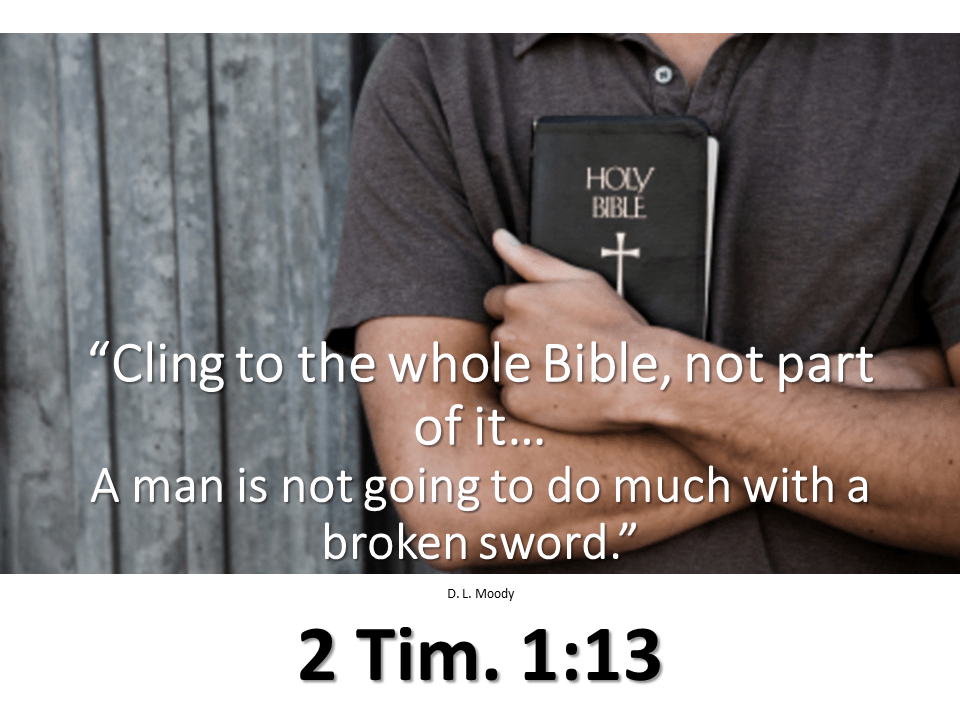
Members of the church of Christ believe In the Old Testament. The Old Testament contains the first thirty-nine books of the Bible. We do not deny the existence nor the authenticity of the Old Testament. We believe that it was inspired by God (2 Timothy 3:16; 2 Peter 1:20,21) and that it is a part of God’s revelation to man. The Old Testament pointed to Christ and the New Testament (John 5:39). We study the Old Testament and learn from it, but it is the words of Christ and the New Testament that will judge us in the last day (John 12:48). HAROLD HANCOCK
“GOD LOVES YOU AND I LOVE YOU AND THAT’S THE WAY IT’S GONNA BE!” — Mike
HEART PROMPT – DEC. 1
 INCARNATE