Why Did Jesus Repeat Himself?

“Therefore do not worry…”

choking

I READ AN old fable about a man who met Death on the road to town one morning.  When he recognized the Dark Specter, he cried out, “What are you doing HERE?!”  Death ominously replied, “I’m going to take one hundred people with me today.”  The man said, “A hundred people—that’s terrible!”  “That’s just the way it is,” said Death.  “It’s what I do.”  The man in panic turned around and rushed back in the direction of the borough to warn everybody that Death was on his way.  When evening fell, the man met Death yet again, this time as he was heading out of town.  “You told me that you were only going to take ONE HUNDRED people this morning!” the man protested.  “So why did a THOUSAND die?!”  Death replied, “I kept my word.”  “I took only one hundred people.  Worry took the other nine hundred…”

Brethren, worry can kill—emotionally, physically – and yes, worst of all, spiritually.  Our English word translated “worry,” actually comes from the German term that means “to strangle, to choke.”  If you take a moment and think about it, worry is (have you got your seatbelt on?), a form of self-murder. 

When we worry, we’re strangling ourselves.  When our minds are overwhelmed with apprehension and doubt, we’re asphyxiating ourselves in the spirit realm.  When our hearts are filled with anxiety, we’re cutting off the life-giving oxygen supply to our souls (cf. Prov. 12:25).

Think of worry as a type of slow suicide.

When Jesus says something once, wouldn’t you agree that we ought to pay attention and obey?  Well, in Matthew 6:25-34 our Lord actually says the same thing THREE times.  Watch:

  • v. 25—“Therefore I say to you, do not worry…”
  • v. 31—“Therefore do not worry…”
  • v. 34—“Therefore do not worry…”

“Do not worry about WHAT, Lord…?”  Notice what He says.

worried-woman_23-2147990545

“About your LIFE, what you will eat or what you will drink; nor about your body, what you will put on” (v. 25b).  Read that again.  “Your L I F E…”

Worry ultimately says, “Jesus, I can trust you to save my soul, but I can’t trust you to take care of my LIFE” (i.e., my most basic needs—like food, shelter and clothing).  Worry says, “Jesus, You’re impotent.”  Worry says, “Jesus, You’re not big enough to handle my real problems.”  Worry says, “Jesus, You can calm the storm on the sea, but You can’t quiet the tempest in my heart.”

Think about that tonight before you pillow your head, dear Christian.

“Do not worry…”

Jesus said it three times—and just maybe He said it over and over because we’re hard-headed and need to hear it more than once.

Never forget:  Jesus owns EVERYTHING (Psa. 24:1), Jesus controls EVERYTHING (Dan. 2:20-21; 1 Chron. 29:12), and Jesus provides EVERYTHING (Gen. 22:14; Phil. 4:19).

Online sermon on worry from the West Huntsville church:  https://westhuntsville.org/sermons/jesus-teaching-on-worry/
“God loves you and I love you and that’s the way it’s gonna be!” – Mike

What is Courage?

He was a secret, fearful disciple, but he took courage…

pppas0005

HE WAS A member of the Jewish council, the Sanhedrin (cf. Luke 23:50a).

Think of the Sanhedrin as the Supreme Court of the Jews.

It was the authoritative body to which all questions of Hebrew law were finally addressed.

Scripture tells us that he wasn’t just a member of this mighty council, but he was a prominent member of this judicial body (cf. Mark 15:43).

Think upper crust.

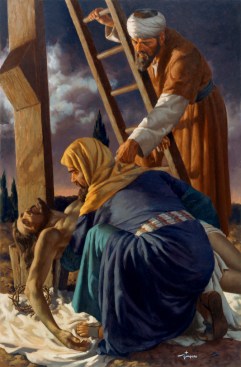
Ironically, it was this man who stepped forward and asked Pilate for the body of Jesus following the crucifixion.

I find that fascinating.  As far as we know, Jesus’ own family didn’t request His body, nor did those closest to Him – the twelve.

“Joseph of Arimathea, a prominent council member, who himself was waiting for the kingdom of God, coming and taking courage, went in to Pilate and asked for the body of Jesus” (Mark 15:43).

Take special note of the phrase, “and taking courage…”

Let that simmer in your skillet for a few moments.

All four gospel accounts mention Joseph’s request for the corpse of the Lord, but Mark’s account alone employs the words “and taking courage…”

Joseph was a secret disciple of Jesus (cf. John 19:38), but he took courage.

Think about the enormous courage it must have taken to ask Pilate for Jesus’ body.

Pilate probably already had a bad taste in his mouth with reference to the Sanhedrin.

The Jewish council had brought Jesus to his court on trumped up charges, insisted that he find the Lord guilty, and then have Him put to death.

When Pilate resisted the council’s will, the Sanhedrin threatened to go to the Romans.

“From then on Pilate sought to release Him, but the Jews cried out saying, ‘If you let this Man go, you are not Caesar’s friend…’” (John 19:12a).

“You are not Caesar’s friend…” was the council’s way of political intimidation.

I’m inclined to think that probably didn’t help Joseph’s cause.

And yet, he—a prominent member of the Sanhedrin, went to Pilate (who didn’t exactly have close, warm associations with the Sanhedrin), and asked for the dead body of the very man the Sanhedrin at large (cf. Luke 23:51) wanted to kill!

That took courage.

Dear friend, the next time you’re tempted to not take a stand for Christ, the next time you’re inclined to remain in the shadows and not do a good work for fear of others, remember Joseph of Arimathea.

He was a secret, fearful disciple, but he took courage.

“God loves you and I love you and that’s the way it’s gonna be!” – Mike

Who’s Going To Be FIRST?

The very men whom Jesus taught often wrangled for position and status…

IT’S WEDNESDAY, AUGUST 10, 1994. You are a passenger aboard flight 2033 from Seoul, South Korea to the resort island of Cheju. You and 151 fellow-vacationers are looking forward to a much-needed rest.

The jetliner is only moments from touchdown. You glance out the thick, two-ply window. The plane is scarcely 30 feet off the ground, but it’s obviously moving far too fast. The runway is soaked from a local tropical storm and wind shear is making the landing all-the-more precarious. When the aircraft does reach the earth, it is more than 1,700 meters beyond the landing threshold. A harrowing, split second later the plane crashes through a guard post and then slams into the airport safety barricade.

You are terror-stricken. The two cockpit occupants exit out the nearest window. With the assistance of the six-member cabin crew, you and your seat-mates escape only moments before the plane is engulfed in flames.

A Transportation Ministry investigation reveals the incredible news. The flight was on final approach when a conflict arose between the Captain and co-pilot. That’s right, a conflict (in Alabama we call conflict a “fuss”).  The real reason for the crash wasn’t because of inclement weather, but because of a clash of strong wills.

Co-pilot, Chung Chan-kyu, asked Captain Barry Woods numerous times whether he wanted to “go around.” (Chan-kyu was convinced that there was not sufficient distance for the Airbus to land safely without crossing the end of Runway 6). When Woods said, “No,” Chan-kyu grabbed the throttles to take control. The two argued and scuffled as the plane hurtled toward the ground. Transcripts from the flight report that the Captain shouted, “No!” “No!” and “What are you doing?! Don’t… Wait, man… You’re gonna kill us!”

As I read the story, I found myself wondering aloud, “Who was in charge of the plane…?!” Only one of the pilots had the right to land the craft, but neither would relinquish his power.

“Who’s going to be first?” “Who’s going to land the plane?” That sounds a lot like the New Testament apostles to me. They fussed and argued over the same fundamental issue.

When Jesus announced that He would “be betrayed into the hands of men” (Luke 9:44), the twelve began a verbal tussle over who would take charge when he was gone. The text says, “Then an argument arose among them as to who should be greatest” (Luke 9:46, Phillips). (The King James version translates the word argument as “reasoning;” the term in the Greek is dialogismos and refers to a heated debate). As improbable as it may sound, the very men whom Jesus taught and trained often wrangled (Matthew 20:20-28Mark 9:34Luke 22:24) for position and status over what they believed would be (Acts 1:6) the future kingdom.

I’ve come to the conclusion that “Who’s going to be first?” is THE underlying issue; it is THE core problem — in most arguments. Folks want power; they want to be first. In a manner of speaking, they want to “grab the throttles” and control the plane themselves.

People are strange, aren’t they? They want the front of the bus, the back of the church, and the center of attention. Chan-kyu and Woods did. The apostles did. We do. Think about it, and you will probably agree. Nobody wants to be second in command; nobody wants to play second fiddle. And that is why disagreements arise.

  • When church members have a “falling-out,” it is usually over power issues and who’s going to be in control of a ministry.
  • When married partners quarrel, it is often over who is going to be in charge of the checkbook and how money is to be spent.
  • When siblings argue, it is typically over who’s going to be first. “Why is his piece of cake bigger than mine?!” “Why does he get to stay out past midnight, but I have to be in before 11:00?”
  • When nations war and fight, it is typically over which country is going to dominate and rule.
  • When presidential candidates vie for political office, it is always over “who’s going to fly the plane.” Both Democrats and Republicans want to “grab the throttles” and take the lead in our country.

When arguments do occur, I find it helpful to take a step backwards and ask, “What’s happening here?” “Why are people fussing?”  “What’s the underlying issue?”

You see, once we can determine the actual cause of the discord, we then can begin to work on a solution, just as Jesus did.

He used a little child to illustrate the real way to “first place” and greatness. The Bible says, “Then a dispute arose among them as to which of them would be greatest. And Jesus, perceiving the thought of their heart, took a little child and set him by Him, and said to them, ‘Whoever receives this little child in My name receives Me; and whoever receives Me receives Him who sent Me. For he who is least among you all will be great’” (Luke 9:46-48 NKJV).

What was Jesus’ point?

Simply that if you want to be “high,” you must first — like a child — be “low” (i.e., humble, 1 Peter 5:6). You must manifest a serving nature (John 13:1ff) and lack the personal, selfish ambition (Philippians 2:3,4Galatians 5:26Romans 12:10) that is so prevalent among adults. You must imbibe the spirit of Christ (Philippians 2:5-11) and “receive” (i.e., assist) others.

Have you been in fuss lately? Are you ready to “grab the throttles?” (Don’t feel too bad, the apostles could relate). Look at a small child…and remember.

“God loves you and I love you and that’s the way it’s gonna be!” – Mike

Is God Really in Control?

Guest Editor: Adam Noles – Green Forest church of Christ, Poplar Bluff, MO

wjpas0423

Guest Writer – Adam Noles

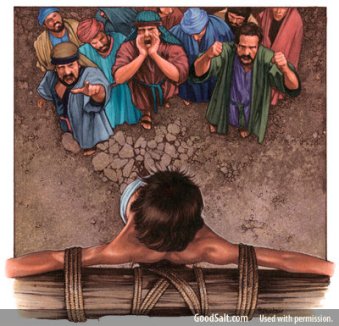
THE PEOPLE MOCKING Jesus didn’t know that Jesus staying on the cross was what was best for them and for the rest of humanity.

The fact that Jesus was on that tree was not because God wasn’t powerful enough to take Him down.

It wasn’t because God wasn’t loving enough – in fact, 1 John 3:16 says, “by this we know love: that He laid down his life for us.”

We can look at the cross and say, “If God’s not getting rid of the evil in my life, I can still trust that He’s all-powerful. I can still trust that he’s all-loving…”

Even the Son of God did not have evil removed from his life.

Jesus asked for this cup to pass from Him, and God told him, “No.”

He knows what’s best for us as our Father, and we have to trust him.

“And we know that all things work together for good to those who love God, to those who are the called according to His purpose” (Romans 8:28).

Green Forest church of Christ, Poplar Bluff, MO.

http://www.greenforestchurchofchrist.org/audio-sermons?fbclid=IwAR0Q3yRFftFKEF1nnoaxHQhNDo2l2s3XRDjplr8tovpAV5oVkEiI6_TQn4E