What Can We Do While We Wait?

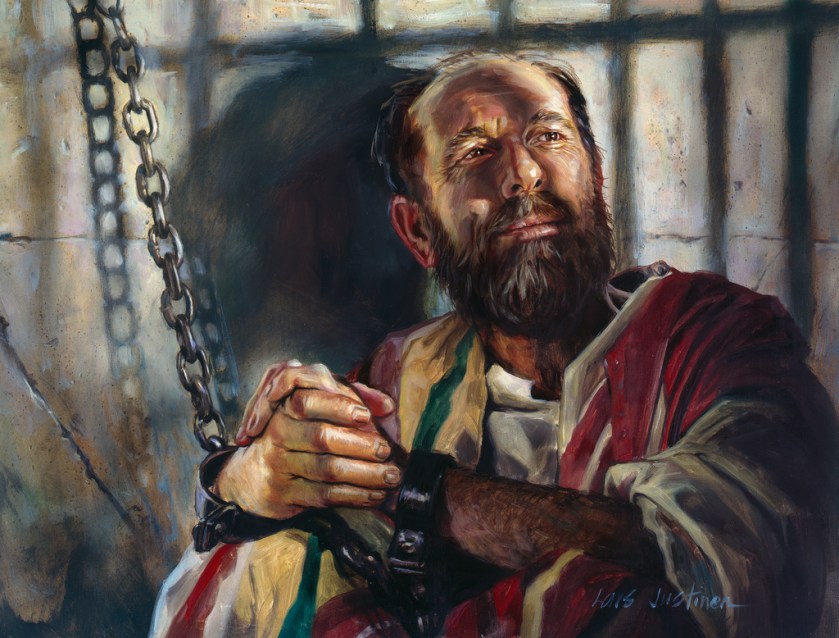
Knowing his death was imminent, and that that his own demise would leave a void in the life of his beloved son in the gospel, Paul penned his last inspired words from “quarantine”, not to a congregation, but to an individual. 

LJ-P-8-782

Photo via goodsalt.com

It was a massive fire.  It started around the merchant shops near the Circus Maximus on the windy night of July 19, 64 AD.  The conflagration lasted a total of nine days and destroyed more than 60,000 buildings, including 90% of all the homes in the municipality.  In its aftermath, more than two-thirds of Rome was left in charred ruins.

Angry citizens blamed the maniacal twenty-six-year old Emperor for the blaze.  In an effort to exonerate himself, Nero claimed Christians were responsible instead.

Sometime thereafter, the apostle Paul, as the veritable “firebrand” (pun intended) of the church, was arrested, imprisoned and awaited execution.  He would be one of many saint-scapegoats who were unjustly put to death for the city-wide fire.

Knowing his death was imminent (2 Tim. 4:6-8), and that that his own demise would leave a void in the life of his beloved son in the gospel, Paul penned his last inspired words from “quarantine”, not to a congregation, but to an individual.   As Paul “greatly desired” (ESV) to see Timothy (2 Tim. 1:4), we also long to be in company of fellow-Christians and to worship with them in person once again.

What did Paul say and do, while in quarantine, for Timothy that we can emulate today (2 Tim. 1:3-5)?  Note:

  • We can THANK God for others in the church. “I thank God…as I remember you…” (v. 3; cf. Phil. 1:3).  We can send an email or a card, or just make a phone call, and let our friends know that we’re grateful for them and for how they bless our lives.


  • We can PRAY for our brethren in distress. “I remember you constantly in my prayers…” (v. 3).  We can lift their names before the Father’s throne and ask for His providential care during these uncertain times.


  • We can REMIND our fellow Christians of their devotion. “I am reminded of your sincere faith…” (v. 5).  We can encourage and boost the hearts of who have stood strong in Christ before and help them (1 Thes. 5:11) to remain so now.

Rather than being overwhelmed by his circumstance and looming death, Paul chose instead a) to hold tenaciously to an attitude of thanksgiving (cf. 1 Thes. 5:18), b) to continually petition the Father (cf. 1 Thes. 5:17) on Timothy’s behalf, and c) to lift up the young evangelist as he kept, and further spread, the gospel flame (cf. Heb. 3:13).

If Paul could do that then, why can’t we do similarly today…?

“God loves you and I love you and that’s the way it’s gonna be!” – Mike 

 

How Do You Prepare for a Crash?

All of us face crisis in our lives. ALL OF US…

Passengers, Crew Of US Airways Flight 1549 Celebrate 5th Anniversary Of Miracle Landinge

sed“HOW DID HE do it?!”

The national media touted Chesly Sullenberger as a national hero.  The internet, newspapers, and television all gave him special praise.  Even the President made a congratulatory call.  The accolades were not unwarranted.  Mr. Sullenberger, or “Sully” as he’s called by his friends, did something extraordinary.

He was piloting US Airways flight 1549 over New York City when his craft collided with a flock of birds.  Moments later he somehow managed to land the crippled aircraft in the Hudson River without the loss of life or serious injury.  It was an incredible effort.  Many deemed it “miraculous.”

But it really wasn’t a miracle.  A miracle—in the biblical sense—is not just something highly unusual, it is something that supersedes the laws of nature (Mark 16:17-19).  If Airbus A320 had suddenly suspended in mid-air, that would have been a miracle.

But don’t misunderstand me; Sullenberger did something worthy of the laurels he received.  What made that real-life story so compelling is that he was uniquely qualified for this kind of emergency.  He had been preparing virtually all of his life for this very kind of circumstance.

  • He had his pilot’s license by age 14 and was flying a crop duster in Texas by age 15.
  • He has logged more than 19,000 hours of flight time.
  • He named “best aviator” in his class at the Air Force Academy.
  • He had flown F-4 Phantom II fighter jets.
  • He was a flight leader in Europe and the Pacific.
  • He led war-game exercises over Nevada.
  • He investigated air disasters.
  • He mastered glider flying.
  • He studied the psychology of how cockpit crews behave in a crisis.
  • A few years ago he started a California consulting firm that offers companies ways to apply the latest safety advances in commercial aviation.

Chesly Sullenberger was ready.  When the pressure was on, he called upon his years of training, expertise, and observation.  Even when it was obvious the plane was going down, Sullenberger not only flew the broken jetliner, but he came over the intercom and calmly told his 149 fellow-passengers, “Brace for impact.”

I hope the analogy is obvious.  All of us face crisis in our lives.  ALL OF US.  Maybe it’s an untimely death.  Maybe it’s the crushing financial difficulty or loss of a job due to the national quarantine.  Maybe it’s a serious, life-threatening illness like COVID-19 itself.  Maybe it’s a heart-breaking, soul-wrenching relationship problem that’s come to the surface.  Maybe it’s a haunting private addiction.  Maybe it’s that tornado that ripped through your neighborhood and demolished your house.  Maybe it’s a combination of these issues.  Sooner or later we all face “mid-air collisions,” right?

But why is it that some brethren not only endure great adversity, but they seem to somehow conquer it?  In terms of this aviation accident, why is it that some folks manage to “land safely,” even under great duress, while other children of God “crash and burn”?  Why is it that some Christians continue to live faithfully despite incalculable pain, while others leave the Lord and the church?

The answer may sound too simplistic, but it’s biblical.  It’s a matter of genuine faith.  FAITH!

Dear reader, are you preparing?  Are you, like Chesly, training (1 Pet. 1:6-7)?  Paul says, “Faith comes by hearing, and hearing by the Word of God” (Rom. 10.17).  Faith comes from hearing and reading and thinking about the Word!

Some brethren spend a lifetime with a TV remote in their hand.  Other’s skip Lord’s Day Bible Study and the evening assembly, not to mention Wednesday night class.  They don’t even bring a Bible to the assembly.  “Do I have to?” “Am I obligated to?” they ask.  “Do I have to read, and study and meditate?”  “I don’t have the time!” they insist.  Then the collision comes.  They crash.

There’s a flock of birds that has collided with our lives.  Were you ready for this crash?  Where is your faith?

“God loves you and I love you and that’s the way it’s gonna be!” – Mike
Who is the Prodigal?

Cow Cattle GIF - Find & Share on GIPHY

WHEN I WAS a young teenager living in East Tennessee, a neighbor kept several cattle in a large pasture behind our house.

Perhaps it be would more accurate to say, “…A neighbor tried to keep several cattle in a pasture behind our house.”

One particular bovine found a broken strand in the barbed wire fence which separated the pasture from our property.

Occasionally I would come home from school and find her traipsing around the backyard, browsing on the occasional patch of herbaceous vegetation, and scattering free fertilizer.

Having spent my childhood in the streets of Dayton, Ohio, I didn’t have a lot of experience corralling large livestock, but eventually I would manage to direct her back to her side of the enclosure — at least, temporarily, until she decided to try the Benson backyard buffet again.

Once she discovered the way out, it was difficult to keep her in where she belonged.

For Bossy, that twisted, three-strand barrier was the cow equivalent of the Berlin Wall and had to be breached.

Those of you who have raised cattle know what I’m talking about.

Stay with me for a minute.

I’m always taken back when I hear my religious friends teach the “once-saved, always-saved” doctrine.

Essentially they’re saying, “You can’t leave if you’re ‘in’, and if you do in fact leave, you were never ‘in’ in the first place.”

The fifty-dollar theological phrase for this is “perseverance of the saints” (i.e., “once-saved, always saved.”)

People aren’t cattle, but experience, observation, as well as the Bible tells us that sometimes folks, unfortunately, do wander (Hebrews 2:1; Psalm 119:176; Isaiah 53:6) from their saved state in the church (Acts 1:25; Acts 8:20-22; Galatians 5:2-4; Hebrews 5:12-6:6).

They fall.  They leave.  They quit.

For them, the grass appears greener on the other side and they want to taste what the world has to offer.

Remember the story of the Prodigal son (Luke 15:11-32)?

A young man approached his father and asked for the immediate payment of his inheritance (v. 12). The request was granted and the son then left for a distant land. There he wasted his fortune, and then found himself on hard times (v. 13). Penniless, the young man was forced to seek employment feeding pigs (vv. 14-15). Eventually he came to himself, acknowledged his foolish ways, and headed back home (17-19). His grieving father saw him in the distance, ran to meet him, embraced him, and then gave a lavish party in his honor (vv. 22-23).

Now study the text carefully.

The head-strong son “struck out on his own” and in so doing, severed his relationship with his father.

Someone says, “Yeah preacher, he left–BUT he was still the man’s son.”

The Bible says the son journeyed to a “far country.”

Now watch it.

He was “in” (saved); then he was “out” (lost).

He had once enjoyed the privileges of sonship, but later found himself an estranged, destitute, swine-feeding servant.

Did the young man leave — did he, in essence, “break out of the fence?”

Obviously, he did.

WHAT was his status while he was gone?

JESUS SAID the son was “dead” (v. 24), lost, separated!

Calvinism says, “You can’t leave…you can’t be lost.”  “It’s impossible…”

Bossy left, at least, every once in a while.  (A cow can’t leave a pasture she was never in in the first place).

The Prodigal left.  (A son can’t return to his father if he’s never left in the first place).

Some of you reading this very message have left the Lord.

You’ve either departed (1 Timothy 4:1; 1:6; 3:1; 4:21; 5:7; Hebrews 3:12) from Him by embracing religious error (Colossians 2:8; 2 Timothy 4:3-4; Titus 1:14, 2 Peter 3:17), or you have left the Lord in a practical way by engaging in sinful practices (Romans 8:12-13; 1 Corinthians 5:1-13; 1 Thessalonians 4:3-7; 2 Peter 2:20-22) — or both.

In either case, you’ve left the safe (Ephesians 1:3) heaven of the body of Christ and alienated yourself from your Father in heaven (cf. Gal. 6:1-2; Jas. 5:19-20).

Whatever your sin, you can come home again. Your Father is anxious for you to return.

Come now.

Please.