What MUST the Baptizer Say?

Is it necessary for one who is baptizing to say a certain verbal formula just prior tothe baptism itself?

IS IT NECESSARY, i.e., Scripture required, for one who is baptizing another to say a certain verbal formula just prior to the baptism itself?

Must he actually utter the words, “I now baptize you in the name of the Father, the Son and the Holy Spirit” in order to certify the immersion?

Let’s consider these questions together in the light of Scripture (2 Tim. 3:16-17; 2 Pet. 1:3):

1. QUESTIONS

. What if the immerser says nothing just prior to the candidate’s immersion? Is the immerser guilty of sin? How might he go about repenting of this omission? Would a second immersion be necessary because he was silent just before the baptism took place?

. When a candidate is immersed for the remission of sins is he still in sin because the one doing the immersing did not articulate a specific verbal formula?

. Is any candidate’s salvation in any way dependent upon the verbiage of the individual performing the baptism?

. Is there a specific passage of Scripture which instructs the one doing the baptizing to say a certain verbal formula?

. Is there an approved example in the New Testament which illustrates where the individual doing the baptizing actually said, “I now baptize you in the name of…?”

2. It is essential that we differentiate between what the candidate MUST DO (Acts 16:30), and what the one doing the baptizing COULD SAY.

Every candidate MUST believe on the Lord Jesus and be baptized (Mk. 16:16; Acts 2:38; 22:16; Rom. 6:3-4; 17-18; Col. 2:12; Tit. 3:5), but every individual doing the immersing is free to speak or remain silent at the event.

3. The emphasis in Scripture has to do with the AUTHORITY for baptism and not the exact terminology employed at the time.

As Wayne Jackson states, “No passage in the New Testament, which mentions baptizing ‘into” the ‘name’ of the Father, the Son and the Holy Spirit (or ‘into’ Christ, or ‘in’ His name), has reference to what is being said at the time of the immersion. …There is no allusion whatsoever to a formalized ‘language code’ that is required in order to validate the immersion.”1

Watch:

. “Baptizing them IN (Greek – eis, into) THE NAME OF the Father and of the Son and of the Holy Spirit” (Mat. 28:19b).

. “Baptized IN (Greek – eis, into) THE NAME OF the Lord Jesus” (Acts 8:16).

. “Be baptized IN (Greek – epi, upon) THE NAME OF Jesus Christ” (Acts 2:38).

. “Baptized IN (Greek – en, in) THE NAME OF the Lord” (Acts 10:48).

. “Baptized IN (Greek – eis, into) THE NAME OF the Lord Jesus” (Acts 19:5).

“To be baptized ‘upon the name’ or ‘in the name’ of Jesus suggests the ground or occasion for the baptism. ‘The name’ in the Sacred Writing often denotes the sum of the divine attributes of the Person named; all that is involved in the Being whose name is thus designated. ‘Into the name’ denotes union or communion with. Thayer says that ‘be a usage chiefly Hebraistic the name is used for everything a name covers. . .to do a thing in the name of another, i.e., by one’s command and authority, acting on his behalf, promoting his cause.’ Thus acting by the authority of Christ from the relationship we sustain to him our Redeemer and Lord, we are baptized into a state of union and communion with God the Father, Christ the Son, and the Holy Spirit”‘ (emphasis mine – mb).2

Sometimes one performing a baptism will hold his free hand high in the air as we says, “I now baptize you in the name of…”

Hopefully we all recognize and agree that having his hand in the air is neither required nor commanded.

It is simply a customary activity employed to add (it is argued) solemnity to the occasion.

The person who is being baptized is not in any way impacted by this token gesture.

Well, the same is true of what is said at immersion.

Both hand gestures and verbal statements are merely customs which preachers and other have employed down through the years as they carry out their work.

The key word in that sentence is customs and customs are not commands (cf. Mat. 15:8).

Brethren, let’s be very cautious about speaking where the Bible does not speak and legislating where the Bible has not bound (1 Pet. 4:11; Col. 3:17).

The Word of God does not specify what one doing the immersing must say;3 it does mandate what he must do – immerse!

1 Wayne Jackson, “Is a ‘Word Formula’ Required in Administering Baptism?” Christian Courier, https://christiancourier.com/articles/is-a-word-formula-required-in-administering-baptism

2 Guy N. Woods, “Questions and Answers – Open Forum,” 165-66.

3 “To be baptized upon the name is to be baptized on the confession of that which the name implies: on the gound of the name; so that the name Jesus, as the contents of the faith and confession, is the ground upon which the becoming baptized rests. In the name (en) has reference to the sphere within which alone true baptism is accomplished. The name is no the mere designation, a sense which would give to the baptismal formula merely the force of a charm. The name, as in the Lord’s Prayer (“Hallowed be thy name”), is the expression of the sum total of the divine Being: not his designation as God or Lord, but the formula in which all his attributes and characteristics are summed up. It is equivalent to his person. The finite mind can deal with him only through his name; but his name is of no avail detached from his nature. When one is baptized into the name of the Trinity, he professes to acknowledge and appropriate God in all that he is and in all that he does for man. He recognizes and depends upon God the Father as his Creator and Preserver; receives Jesus Christ as his only Mediator and Redeemer, and his pattern of life; and confesses the Holy Spirit as his Sanctifier and Comforter. Marvin Richardson Vincent, Matthew 28:19, Word Studies in the New Testament, Vol. 1, 150.

*baptism image via unsplash kaleb tapp.

Do You Remember the Tragedy?

Tribute in Light

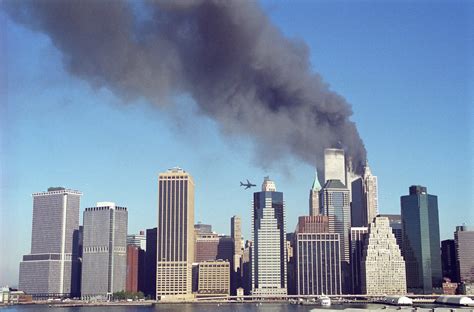
I HAVE A vivid recollection of that day.

My wife came in the room, turned on the TV set and then spoke in shaken tones. 

She said, “They’ve flown a jet-liner into one of the World Trade Center towers in New York…”

For the next several hours I sat transfixed before the television and watched in horror as the events of 911 unfolded.

wtc3

Twentyfour years after that dreadful day, some Americans, like myself, look back on September 11 with intense emotion.

We recall those gaping wounds in the sides of the towers.

We remember those ill-fated flights and how they were intentionally slammed into the very icons of our nation.

We remember those thick plumes of noxious smoke as they bellowed out of the top of those lofty skyscrapers and into our collective conscience.

We remember our own anxiety and ponder what must have raced through the hearts of fellow-citizens as they contemplated the end of their earthly existence and the brevity of human life.

We remember the internal shock of watching the first, and then the second tower plummet to the ground.

We remember those feelings of helplessness and despair as lower Manhattan was engulfed in ash and debris. 

But may I suggest, dear reader, that there is a far more terrible tragedy that warrants our joint remembrance.

Every first day of the week (Acts 20:7), we need to call to memory (1 Cor. 11:23-26) those horrific events which transpired nearly 2,000 years ago:

  • We need to remember the murderous plot against the innocent Son (Mt. 26:3-4; Heb. 4:15; 7:26).
  • We need to remember the Lord’s internal struggle as He pondered His impending death (Mt. 26:37-39).
  • We need to remember His betrayal at the hands of one of His own disciples (Mt. 26:47-50).
  • We need to remember the ill-informed attempt to thwart His crucifixion (Mt. 26:51-54).
  • We need to remember the disciples’ cowardice and how they fled for their lives when He needed them the most (Mt. 26:56).
  • We need to remember the howls of the angry mob as they shouted, “Crucify Him! Crucify Him!” (Mk. 15:13-14).
  • We need to remember the incredible injustice of both the Jewish and Roman courts (Mt. 26:57ff).
  • We need to remember Pilate’s timidity before that blood-thirsty crowd (Mt. 27:24-26; Lk. 23:13-25).
  • We need to remember the brutal flogging (i.e., “little death”) at the hands of the Roman lictors (Jn. 19:1).
  • We need to remember Peter’s lying about his association with Jesus (Mt. 26:69-75).
  • We need to remember the slanderous mockery of the soldiers, priests, and thieves (Mt. 27:27ff; 39-44).
  • We need to remember the Lord’s humiliation as He was stripped of His clothing and numbered with lawless, ungodly men (Isa. 53:12; Mt. 27:28; Heb. 12:2).
  • We need to remember that ruthless blow to His head (Mt. 27:30). We need to remember the heavy burden of the cross that was thrust upon His weary shoulders (Mt. 27:32).
  • We need to remember those cruel nails that pierced His hands and feet and how that He was suspended between holy God and sinful man (Jn. 3:14; 12:34).
  • We need to remember the bitter taste of sour wine mingled with gall (Mt. 27:34).
  • We need to remember His desperate cry to His own Father (Mt. 27:46).
  • We need to remember the frightful earthquake that shook the earth the moment the Savior died (Mt. 27:54).
  • Perhaps most importantly, we need to remember that our own sins made this barbaric occasion necessary (1 Pet. 2:24; Isa. 53). 

“Lest I forget Gethsemane, lest I forget Thine agony, lest I forget Thy love for me, lead me to Calvary.”

“Do this in remembrance of Me…” (1 Cor. 11:24, 25).

How Can We Explain the Paris Olympics Opening Ceremony?

empty_head

THE APOSTLE PAUL spoke of the Gentiles in this fashion… “For although they knew God, they did not honor him as God or give thanks to him, but they became futile in their thinking, and their foolish hearts were darkened” (Romans 1:21 ESV).

Pay attention to the progression in this verse:

  • The Gentiles knew God.
  • The Gentiles did not honor God.
  • The Gentiles did not give thanks to God.
  • The Gentiles became futile in their thinking and their hearts were darkened.

Watch it.

Even though the Gentiles KNEW God existed (because a creation implied a Creator, vv. 19-20), they did not correctly respond to their knowledge of Him.

They refused to recognize, acknowledge, much less, bow down to Him in worship.

They did not accept the fact that He was the singular source of all their blessings.

They decided that blind fortune or human merit afforded the totality of life’s rewards.

And what was the inevitable result of this failure to express honor and gratitude to God?

Paul said their thinking became futile.

The Greek word rendered “futile” means “empty.”

I find it interesting that the same Greek word translated “futile” is the same word in the Septuagint/1 used for idols (e.g., Leviticus 17:7; 2 Chronicles 11:15).

You see, idols are empty; they are nothing.

So instead of building their minds on the reality of God, the ancient Gentiles built them on their own senseless speculation and therefore became futile and idolatrous in their thinking.

There’s a very strong warning in Romans 1:21.

It is possible for a person to know about God and even admit that He exists, but then fail to show love and gratitude towards Him.

The consequences of this perennial ingratitude means that his thinking becomes empty and he eventually loses the ability to make any moral distinctions between right or wrong.

Many are wondering how the 2024 Paris Olympics could open with drag queens and Satan worship.

Romans 1 helps us to understand how that happens.

It began with ingratitude.

Thanklessness.

Folks who chose not to thank God will inevitably pursue “entertainment” that is empty and void of His will.

Think about it.

Pray out it.

1/ The Greek translation of the Old Testament.
“God loves you and I love you and that’s the way it’s gonna be!” – Mike

How Much is the Soup of the Day?

Esau returned home exhausted from his hunting excursion in the field. Driven by hunger, his first thoughts turned to the all-you-can-eat buffet at “the Tent Dweller’s Restaurant” (Gen. 25:27). The Record says, “And Esau said to Jacob, ‘Please feed me with that same red stew, for I am weary’” (v. 30). The Hebrew phrase translated, “feed me”, means let me swallow or let me gulp. Table manners didn’t matter to Esau; he simply wanted his usual /1 hearty meal of red lentil soup. /2


According to the waiter, the “current market price” for the soup of the day was one birthright. “But Jacob said, ‘Sell me your birthright as of this day’” (v. 31). The hunter’s need for sustenance was so intense that he agreed to the exorbitant price (v. 32). Jacob offered his elder sibling a bowl of soup on the condition that Esau would make an oath /3 before God as to his intentions. Esau consented and the two brothers exchanged destinies over a single meal. Call it a Patriarchical “power lunch”.


The birthright referred to the right of the first (born) or “primogeniture”. It was typically /4 bestowed upon a man’s eldest son and included at least three factors: 1) a double-portion of the father’s estate (Deut. 21:17), 2) the responsibility of providing for the families’ physical welfare, and 3) spiritual oversight of the entire clan (Gen. 18:19; cf. 22:926:2535:1).


Sadly, the only aspect of the birthright that absorbed Esau’s thinking was the double-portion (cf. Gen. 27:31). He was a man of “the here and now” and attached no value to the eternal aspects of his inheritance. Note: “And Jacob gave Esau bread and stew of lentils; then he ate and drank, arose, and went his way. Thus Esau despised his birthright” (Gen. 25:34). It is interesting to observe that Scripture judges Esau’s conduct ? not Jacob’s. /5 The word “despise” means to disesteem. It is elsewhere rendered disdain or condemn. Esau underestimated his heritage. It would have not only given him possession of Isaac’s property, but it would have put him in the ancestral line of the Promised Seed (cf. Gen. 12:1-3; 17:1-8; Gal. 3:16)! /6 Commenting on this occasion, the Hebrew writer said, “Lest there be any fornicator or profane person like Esau, who for one morsel of food sold his birthright” (Heb. 12:16) emphasis mine, mb). To “profane” something is to make that which is sacred common or temporal. This is exactly what Esau did; he bartered away his hallowed birthright for a simple bowl of red soup.


“How foolish,” you might say. How foolish, indeed. Brethren, how many of us are guilty of quite the same thing today…?

  • How many of us trade time with our wives and children for our vocation? We exchange our eternal lineage (cf. Prov. 22:6Eph. 6:12 Tim. 1:5) for temporal wealth and prestige.
  • How many of us trade a thorough study of the sacred Word for hours of watching television?
  • How many of us trade Sunday evening communion with the Sovereign God of the universe for a football game (i.e., the Super Bowl) on Sunday night? (Ironically, some shepherds of the local flock even move or cancel worship services for such an event).
  • How many of us trade Lord’s Day morning worship for late-night activities Saturday evening?
  • How many of us exchange entertainment and recreation for the opportunity and privilege of serving needy saints?
  • How many of us trade involvement in secular service organizations (e.g., Kiwanis, Rotary, etc.) for the honor of teaching a Bible class in our home congregation?
  • How many of us trade the blessing of a generous contribution for excessive credit card debt?

Beloved, we like Esau, have a sacred birthright (Rom. 8:16-17Heb. 12:23). And when we fail to live up to its demands and privileges, we forfeit the inheritance our Father wants to bestow upon us (cf. 2 Pet. 3:9).


Esau paid far too much for the soup of the day. What about YOU, dear child of God? Will you cherish your right of the first, or will you despise it (Matt. 16:26)?


/1 Evidently he had eaten Jacob’s soup before. v. 29
/2 Lentils referred to the edible seeds from a plant pod.
/3 An oath was a promise made with a solemn appeal to God to render judgment in the event the promise was not accomplished.
/4 Exception?1 Chron. 5:1,2
/5 Jacob had the right goal, but not the right method. He tried to “help” God (v. 23) along by his own actions.
/6 Note: “Abraham begot Isaac, Isaac begot Jacob…” (not Esau). Matt. 1:2

When Did Jesus Shave His Head?

Nine-year-old Kamryn Renfroe was kicked out of her Colorado elementary school back in 2004. She was told she couldn’t come back to class—at least until she either put on a wig, or her hair grew back.

Kamryn had shaved her head, and so the administration disciplined her.

It was an obvious dress code infraction. She had blatantly broken the rules of Caprock Academy. The school’s dress code requires uniformity and that all students adorn themselves in a non-distracting fashion. And what could be more distracting than a bald-headed little girl in class?

Well, except for another bald-headed class mate.

You see, Kamryn didn’t shave her head to create a scene or contravene the rules. Hers was not an act of violation, but compassion. She shaved her head to become like her friend, Delaney.

Eleven-year-old Deleany Clements suffers from neuroblastoma—a deadly form of childhood cancer. Kamryn saw that her friend had the only bald head at Caprock, so she decided to support and encourage her lonely, hurting friend by essentially becoming just like her.

Delaney loved it! She said, “It made me feel very special and that I’m not alone.”

Isn’t that what our friend (John 15:13-15) Jesus did for us, too?

Man suffered from the deadly form of soul cancer (e.g., sin) with no hope of survival (Romans 3:10, 23). And instead of just watching him suffer in silence, Jesus “shaved his head” metaphorically speaking, by taking on flesh and manifesting himself in human form. He became one of us. He identified himself with us. Scripture says:

”And the Word became flesh and dwelt among us…” (John 1:14a).

“…God was manifested in the flesh…” (1 Timothy 3:16a).

“That which was from the beginning, which we have heard, which we have seen with our eyes, which we have looked upon, and our hands have handled, concerning the Word of life” (1 John 1:1).

“…Jesus Christ has come in the flesh…” (1 John 4:2b).

“Concerning His Son Jesus Christ our Lord, who was born of the seed of David according to the flesh” (Romans 1:3).

“Inasmuch then as the children have partaken of flesh and blood, He Himself likewise shared in the same…” (Hebrews 2:14a).

“Who, being in the form of God, did not consider it robbery to be equal with God, but made Himself of no reputation, taking the form of a bondservant, and coming in the likeness of men. And being found in appearance as a man…” (Philippians 2:6-8a).

Since he came as one of us, Jesus knows exactly what we are going through. He understands when we are tired (Galatians 6:9), or lonely (John 6:66; Matthew 26:56), or sad (John 11:35; 1 Thessalonians 5:16), or tempted (Hebrews 4:15)!

If Deleany felt special when Kamryn became like her, how do you feel as you realize Jesus became like you?

Think about it.