HEART PROMPT – APR 8

Among all of the events recorded in the Bible, the miracles of the Bible stand out conspicuously; among all of the miracles of the Bible, the resurrection of Jesus is the most conspicuous. There are other resurrections in the Bible, but none recorded with as much detail and precision as the resurrection of Jesus. It is an event alluded to in the prophets (Psalm 16:10). Jesus predicted it specifically (Matthew 12:40, 17:23, Luke 24:7). The New Testament writers recorded its facts in their accounts of the gospel, and the apostles made it their central theme in their preaching and teaching. The resurrection of Jesus stands as the single most documented event in ancient history, more so than Caesar’s crossing of the Rubicon, Alexander’s conquering of Persia, or Homer’s account of the Trojan War. It is the central event of history. Even the atheist and skeptic feel compelled to weigh in by challenging its historicity.
That the resurrection of Jesus is a significant event historically is one matter, but it is also an event that holds central significance for the human race. God took human form, lived a mortal existence in poverty, and was crucified and died as a criminal; only as magnificent a work as the resurrection could prove such an outlandish story. So unparalleled in human history is the notion that one could raise himself from the dead, that Isaiah may have had veiled reference to the resurrection when he calls it the Lord’s “strange act” (Isaiah 28:21). Only such a resurrection could prove such a seemingly preposterous claim; only an event of such magnitude would be worthy of pointing humanity to their true God.
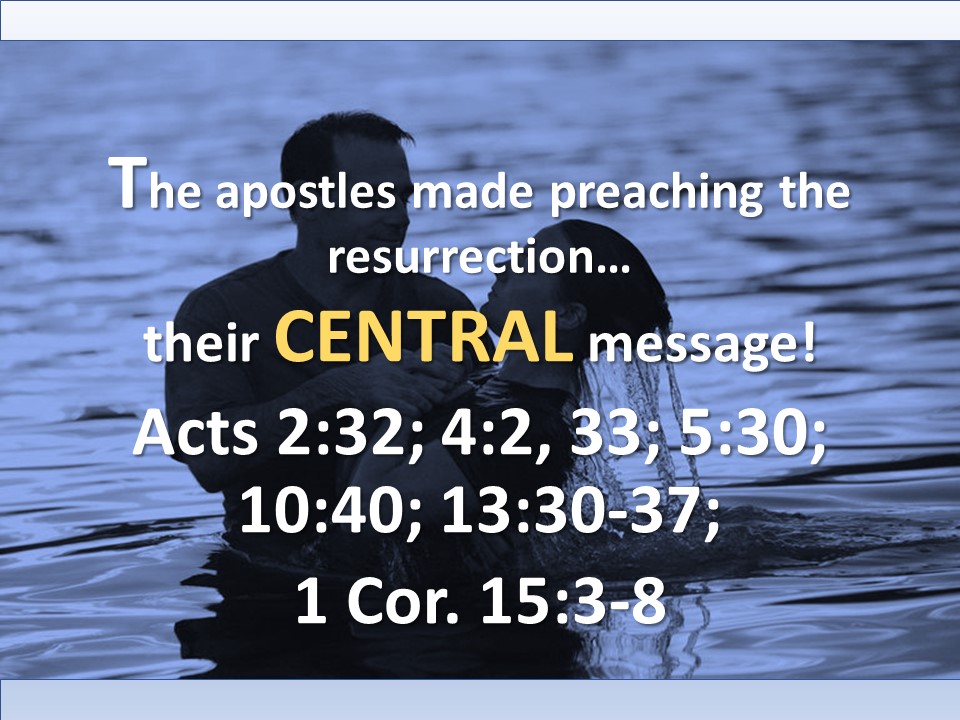
The apostles made preaching the resurrection their central message. Peter’s first recorded sermon in Acts 2 highlights the testimony of the Old Testament prophets and juxtaposes it with the eye witness testimony of the apostles themselves, because Peter, as well as the other eleven, saw Jesus with their own eyes after He had been raised from the dead (Acts 2:32). Acts 4:2 says that the apostles “proclaimed in Jesus the resurrection from the dead.” Acts 4:33 states, “And with great power gave the apostles their witness of the resurrection of the Lord Jesus: and great grace was upon them all.” Acts 5:30, 10:40, 13:30-37, also speak to the apostles’ ubiquity in mentioning the subject. Perhaps the most notable passage of all is found in 1 Corinthians 15:3-8 where the apostle Paul says:
For I delivered unto you first of all that which also I received: that Christ died for our sins according to the scriptures; and that he was buried; and that he hath been raised on the third day according to the scriptures; and that he appeared to Cephas; then to the twelve; then he appeared to above five hundred brethren at once, of whom the greater part remain until now, but some are fallen asleep; then he appeared to James; then to all the apostles; and last of all, as to the child untimely born, he appeared to me also.
They carried this teaching everywhere they went. It was the central evidence to the truthfulness of their message, that Jesus was the Son of God, Immanuel, God with us.
The message of the resurrection is also central to Christian conversion. Both Romans 6:1-11 and Colossians 2:11-13 show that Christian baptism is a portrayal of the death, burial, and resurrection of Christ. The old man of sin dies and is buried in that watery grave; from that same grave rises a new creature (2 Corinthians 5:17). The imitation of the death, burial, and resurrection of Christ is so central to conversion that Peter pronounces remission of sins upon those who submit to it (Acts 2:38), and Ananias tells Paul to do it to “wash away thy sins” (Acts 22:16). Indeed, one cannot be truly converted to Christ without being baptized in the likeness of his death, burial, and resurrection.
Finally, the message of the resurrection is central to Christian living. Colossians 3:1-17 makes this abundantly clear. Because the Christian has been raised with Christ, he is to seek spiritual things and put to death carnal things. He is to be concerned about developing: love, mercy, humility, meekness, forgiveness, and longsuffering. He must put away the lusts of the flesh: fornication, covetousness, anger, malice, blasphemy, and filthy speech. By being baptized, he has committed to a fundamental transformation of life, just as Jesus’ dead body was transformed after His resurrection. The doctrines of Christian living are part and parcel to the New Testament’s teaching on the resurrection.
The resurrection is a subject on which we must teach often, long, and without apology. It is central to the truths contained in the New Testament. One simply cannot be a New Testament Christian and deny the resurrection of Christ. May we ever live to proclaim His resurrection both from the pulpit, and in our public and personal lives, as we daily live for Him. BY KEVIN CAULEY
“GOD LOVES YOU AND I LOVE YOU AND THAT’S THE WAY ITS GONNA BE!” – MIKE

In Luke’s account of Christ crucifixion (Luke 23) he states that two criminals were crucified with Jesus. The one criminal ridicules and tests Jesus by saying “If you are the Christ, save Yourself and us” (vv. 39). In contrast, the Bible records the following interaction concerning the other: “Then he said to Jesus, ‘Lord, remember me when You come into Your kingdom.’ And Jesus said to him, ‘Assuredly, I say to you, today you will be with Me in Paradise’” (vv. 42-43).
This second thief has become the “smoking gun” for those who teach that salvation in Christ is by “faith alone.” To try and prove that someone can be saved without being baptized in water, many will say, “What about the thief on the cross? He was never baptized, and he was saved.” Sadly, based on this view of the thief on the cross, many draw the conclusion that anyone can be saved without being baptized into Christ for the remission of sins… But what does the Bible say?
The Thief May Have Been Baptized…
1. The thief knew a lot about Jesus. The thief on the cross is often portrayed as someone who knew next to nothing about Jesus and just happened to meet Him on the cross and upon believing in Him was granted salvation. Nothing could be further from the truth. Notice what the thief knew about Jesus. He knew that Jesus was innocent, unlike himself and the other robber (Lk. 23:40-41). He knew that Jesus was “Lord” (v. 42). He knew that Jesus would establish a kingdom, and he knew that, even though Jesus was dying on the cross, He would still come into His kingdom (v. 42). He also knew that even with Jesus hanging on the cross, He still had the power to save him (v. 42). Also, it seems this encounter on the cross was not his first introduction to Jesus (cf. Mk. 12:37b).
2. Was the thief baptized? As the one who was sent by God to prepare the Jewish people for the arrival of the Messiah on the scene, John the Baptizer immersed a great many of the Jews in water (Mk. 1:4-5). Is it possible that this thief could have been among those who were baptized by John? The Bible also says that during the earthly ministry of Jesus, His own disciples reached the point where they were baptizing more people than even John was (Jn. 4:1-3). Is it possible that this thief, who knew so much about Jesus, could have been among those who were baptized by Jesus’ disciples? Based on the available evidence, it actually seems more likely that the thief was immersed in water at some point, rather than that he wasn’t.
3. It is impossible to prove that the thief was not baptized. The problem is that many have first assumed that the thief on the cross was not baptized. Based on that, they go on to assume that they can be saved the same way they assume he was saved, that is, without being baptized. The whole idea that one can be saved today like the thief on the cross is nothing more than an assumption on top of another assumption, since no one can prove that the thief was not baptized in water.
… But The Thief Didn’t Need To Be Baptized In Order To Be Saved
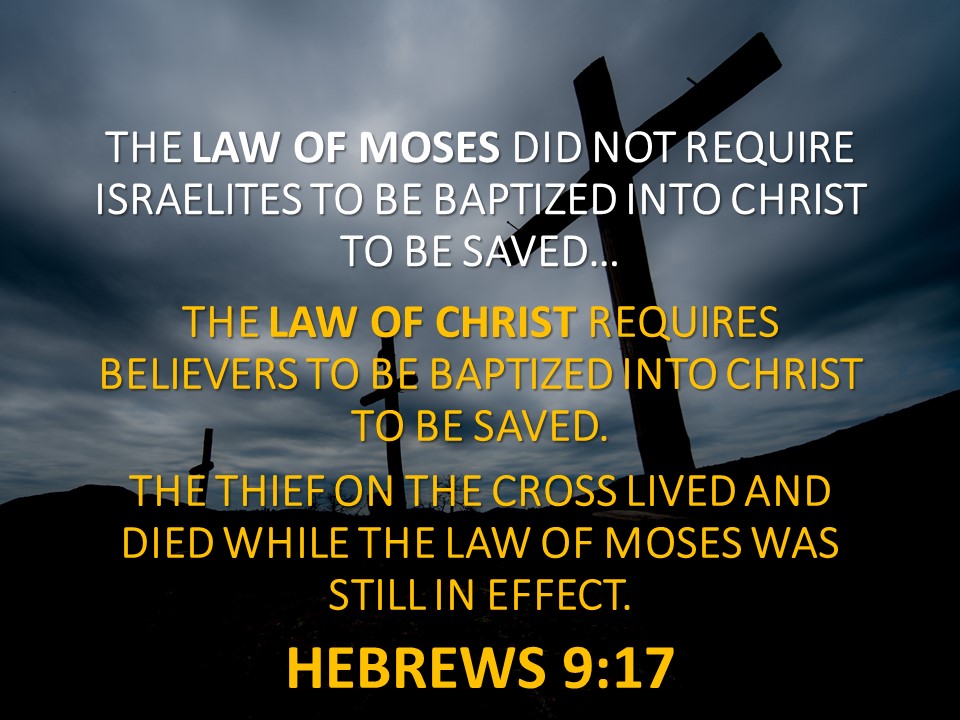
1. The terms for forgiveness and salvation were not the same under the old covenant as they are under the new. The Law of Moses did not require the Israelites to be baptized into Christ to be saved. In fact, the terms the Israelites were required to meet under the Law of Moses were different from the terms of the law of Christ. The Old Law was done way with and replaced with the new covenant, but only after Jesus died on the cross (Eph. 2:15; Col. 2:14-17; Heb. 8:13; 9:16-17). There are numerous examples throughout the book of Acts of people who met the Lord’s terms for forgiveness under the new covenant and were saved. Every detailed case of conversion to Christ recorded in the book of Acts concludes with water baptism (Acts 8:12-13; 8:36-38; 9:18; 10:47-48; 16:15; 16:33; 18:8; 19:4-5). When it comes to what one must do to be saved today, whether the thief was baptized makes as much difference as whether Moses, David, or Elijah were baptized, since, like them, he lived under the Law of Moses.
2. Jesus made baptism into Christ a necessary condition for salvation after His resurrection. It was after the death, burial, and resurrection of Christ that He issued the command for His apostles to make disciples and baptize them in the name of the Father, Son, and Holy Spirit (Matt. 28:18-20). It was after His death, burial, and resurrection, that He stated that one must believe and be baptized to be saved (Mk. 16:15-16). It was after the death, burial, and resurrection of Christ, that the apostles commanded people to repent and be baptized in the name of Jesus Christ for the remission of sins (Acts 2:38). It was after the death, burial, and resurrection of Christ, that the apostle Paul wrote that one is buried with Christ in baptism (Rom. 6:3-4). Even though it is likely that the thief was baptized with John’s baptism at some point during his life, his example is not the pattern for sinners to follow to be saved today. The thief lived and died before the command to be baptized into Christ for the remission of sins was ever issued.
3. No one can be saved like the thief on the cross today. The case of the thief on the cross was a unique circumstance, in which Jesus personally assured a penitent man of salvation under the Old Law before His death. Since no one living today lives in the era before the death, burial, and resurrection of Jesus, no one today can be saved like the thief on the cross. Having been instructed by Jesus, the apostles of Christ made known the terms one must meet for forgiveness of all past sins. When sinners wanted to know what they must do to be saved after the death, burial, and resurrection of Jesus, the Bible says, “Then Peter said to them, ‘Repent, and let every one of you be baptized in the name of Jesus Christ for the remission of sins; and you shall receive the gift of the Holy Spirit’” (Acts 2:38). The teaching of the New Testament makes immersion in water a vital condition that must be met to receive forgiveness of sins and salvation.
Conclusion
While the account of the thief on the cross is a wonderful story that teaches many important things, it is not a story that teaches us how to meet the Lord’s terms for forgiveness of sins today. Only those who obey the gospel of Jesus Christ, which was established through his death, burial and resurrection, have the same assurance of salvation that the thief had (I. Cor. 1:23; Rom. 6:3; Heb. 5:9). Have you been baptized into Christ for the remission of your sins? BY WADE CASEY
“GOD LOVES YOU AND I LOVE YOU AND THAT’S THE WAY IT’S GONNA BE!” – MIKE
 INCARNATE