HEART PROMPT – MAR 5

For God’s people, earthly worship and heavenly thoughts naturally go together. We are pilgrims—strangers on earth. But we are closer, day by day, to the gates that swing outward never.
We sing of the soul’s home. We preach about the city with foundations, and offer prayers reflect our longing for the better country. As often as we eat the bread and drink the cup, we proclaim Christ’s inevitable return, when redeemed body and immortal soul shall forever be with the Lord.
Gratitude fills our hearts as we “abound in this grace also,” thanking God for his unspeakable gift. Through Christ’s poverty, we may become rich. His blood makes the washing of our robes possible. Therefore, we have the right to the tree of life and may enter in by the gates into the city.
To those gates we are closer daily, but seemingly still so far.
Do you think about heaven? Abraham did.
Abraham believed God. He trusted him, even though his knowledge was incomplete. He obeyed God, though he never inherited the land of promise. His tents became weathered representations of the nomadic life of God’s people of all ages.
In time, Abraham saw from afar the better country and welcomed the thought. Neither a tent in Canaan nor an estate in Chaldea could provide a permanent residence to satisfy the longing of the soul. So he looked for a city with foundations whose builder and maker is God.
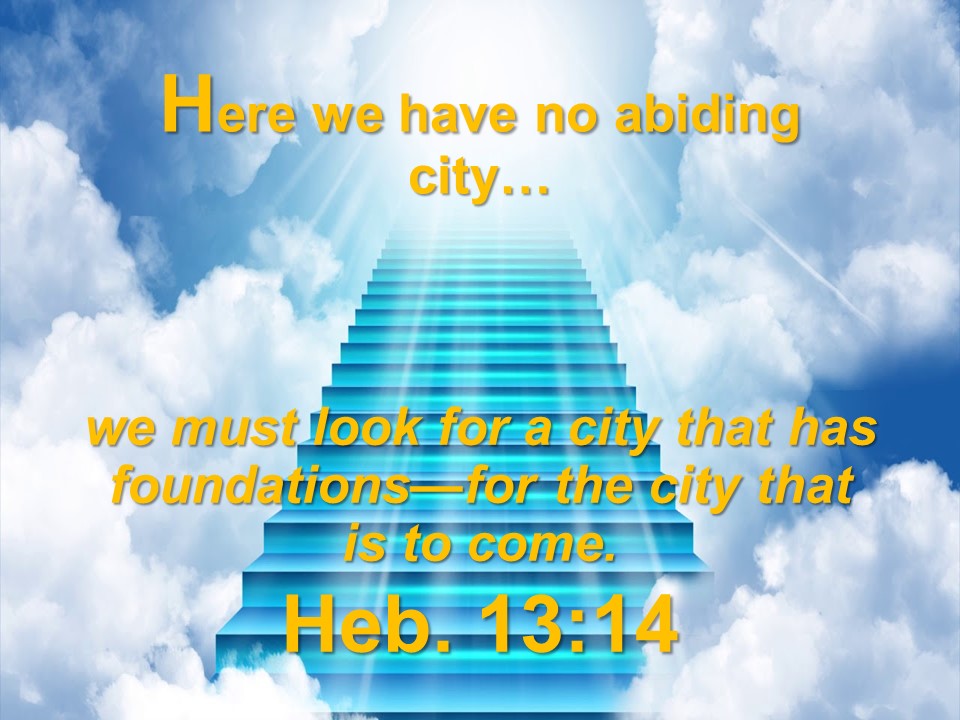
Accordingly, we must realize that here we have no abiding city, but we must look for a city that has foundations—for the city that is to come (Heb. 13:14).
God reveals in Scripture a heavenly city—incomparable in beauty, incredible in size and structural integrity. In that city, the citizens enjoy infinite happiness and inconceivable privileges. If you had to live somewhere forever, there couldn’t be a better place.
Almighty God prepared this city for those who love him. Jesus Christ is preparing mansions for us in his Father’s house (Jn. 14:1-3). As in the case of the patriarchs of old, God has prepared a city for us also (Heb. 11:16). Attention is paid to its preparation, like a bride adorned for her husband (Rev. 21 :2). Everything is going to be perfect—prepared to perfection for those who love him.
Think on what God has revealed about the eternal city of divine design and construction. Why would we not cast a wishful eye? Do you want to go to heaven? Think about heaven—seriously—every day.
In the Apostle John’s grand vision of the soul’s home in Revelation 21-22, the figures of bride and city are employed together.
The symbol of the bride suggests the relationship between the church and the Lamb. The bride is the object of his love. She is holy, without blemish, and has made herself ready to be joined to the Lamb for eternity (Eph. 5:23- 27; Rev. 19:7). She prepared herself by being washed in the Lamb’s blood, by holding firm to the word of her testimony, by not loving her life even unto death, by holding to the commandments of God and the testimony of Jesus Christ (Rev.12:11, 17).
The symbol of the city relates a number of ideas about the place God has prepared for the people who are the bride of the Lamb. Let’s consider a number of these wonderful features about the home of the soul.
John saw the holy city coming down out of heaven—reflecting the glory of God. The vision of incomparable beauty was analogous to a massive diamond descending from heaven was stunning (Rev. 21:11, 18). The jasper (i.e., diamond, perhaps) wall surrounded the holy city, and the foundations were decorated with all kinds of precious stones.
The vision’s focus is on the unparalleled beauty, and this city is built by God for those who love him. Its twelve gates were constructed from solid pearls, and the street was pure gold, like transparent glass (Rev. 21:21).
The city with foundations is one of incredible size and structural integrity. Here we have another aspect of this city introduced to accentuate the point that no city is like God’s city.
The city is square, surrounded by massive walls with twelve gates, three per side. The angel assisting in the vision measures the city, and its immense size is recorded. The city is 12,000 by 12,000 furlongs. The area of the city is 2.25 million square miles, an area roughly equivalent to the United States west of the Mississippi. That’s one big city! And its height is equal to its length and width—1,500 miles high!
When you consider the foundations, remember that there are twelve massive stones on which the walls are constructed. That makes these foundation stones approximately 500 miles long. The city really does have foundations—massive foundations.
The city’s incredible size and structural integrity symbolize that God’s city is without comparison. It could never be besieged, threatened, or compromised in any way. It is a prepared place fit for eternal habitation for all the saved of all the ages, and it is a city built to last forever.
Don’t your want to anticipate living in this city through a life of service to the Eternal Builder? Would you be willing to make any necessary sacrifice to be joined to the Lamb for eternity?
In the city with foundations, the bride of the Lamb enjoys all-inclusive happiness.
Today, the idea of “the big city” brings to mind crime, violence, poverty, gangs, and drugs. Heavily populated urban areas are not usually a place where people feel safe or venture out at night. In earth’s big cities, human life is taken at a whim, and people lock their doors religiously.
But God’s city is one of ideal security. It is a place where people are free from fear and danger, for God decreed that the first things are passed away (Rev. 21:4). Consequently, there will be no mourning, no crying, and no pain ever again, and the valley of the shadow of death is nothing but a distant memory. Death shall be no more.
The infinite happiness deriving from God’s presence is expressed in the beautiful picture of Revelation 22:1-5. Out of the throne of God flows the river of the water of life, both banks of which are shaded by the tree of life. It yields fruit every month. Its leaves are for healing for the nations. As this life-giving, all-satisfying, ever-healing tree is described, emphatically we realize “there shall be no curse any more” (Rev. 22:3).
The river flows directly from God’s throne. He is the source of eternal happiness. The perpetual fruit illustrates the everlasting satisfaction of all needs. The healing properties (i.e., leaves) are available for all (i.e., the nations )—those who have the right to the tree of life by being washed in the blood of the Lamb.
In these symbols we see images of the truth that God will take care of everything we need, every issue we have, every care in our minds, every worrisome thought we may entertain, every memory that may arise. God will take care of us forever.
That means this city is one of absolute, all-inclusive happiness and healing. God himself is the guarantee.
The soul’s home is where the bride of the Lamb enjoys inconceivable privileges. We will be with God himself. We will be his children and inherit exclusive blessings (Rev. 21:3-7). The glory of God will be our sun, and the Lamb our lamp (v. 23). The glory and honor of heaven itself will characterize us as God shines upon us (vv. 24-26).
We will serve him, see his face, and have his name indelibly inscribed upon us (22:3-4). We will have the right to the tree of life and enter into the city by the gates (v. 14)—legitimate citizens whose names are written in the book. With him we shall reign forever (v. 5).
The array of blessings was succinctly declared when John heard the following: “Behold, the tabernacle of God is with men, and he shall dwell with them, and they shall be his peoples, and God himself shall be with them, and be their God” (Rev. 21:3).
That says it all. God himself will be with us. All that we see and hear in Revelation 21-22 illustrates this most wonderful, inconceivable privilege: we will be with him.
The joys of heaven moved Wendell Winkler to appropriately write:
So, whatever burden must be borne now, whatever sacrifice must be made, whatever condition must be met, yea, whatever price must be paid, let us gladly meet the challenge. For, throughout those ceaseless ages encased in the walls of jasper as we walk the street of gold, we will be heard to say, as did the queen of Sheba, “The half has never yet been told” (586).
Noah never saw a flood, but he believed God, built the ark, and was delivered from an evil world.
Abraham never saw heaven, but he longed for a better country. God’s friend never saw a resurrection, but he believed and prepared to offer up Isaac.
You haven’t seen streets of gold or pearly gates. You’ve never quenched your thirst from the river of life. You’ve never eaten of the tree of life, and you’ve never put its healing leaves to work. You’ve never seen God’s face.
But when you die, do you expect to live in the beautiful, heavenly city, incredible size and structural integrity, where God’s people enjoy infinite happiness and inconceivable privileges?
Brother H. A. Dixon wrote: “Heaven is a prepared place for those who have prepared for it” (35). Prepare today for the home of the soul (cf. Matt. 25). BY WAYNE JACKSON, DECEASED https://www.christiancourier.com/articles/1517-heaven-the-home-of-our-soul
“GOD LOVES YOU AND I LOVE YOU AND THAT’S THE WAY IT’S GONNA BE!” – MIKE

From the book of Genesis to the Bible’s last book, the book of Revelation, we read about people having faith. In some cases, Jesus said people had little faith (Matthew 8:26; 14:31). Yes, people can be weak in faith, but it also is possible to have a strong faith (Romans 4:19,20).
The expression “live by faith” is used at least four times in the Bible, once in the Old Testament and three in the New. It first appears in Habakkuk 2:4, where it is written, “Behold the proud, his soul is not upright in him; but the just shall live by his faith.”
In a context in which he wrote about God making man righteous through the gospel, Paul reminded the early Christians that “The just shall live by faith” (Romans 1:16,17). In contrast to the impossible task of being justified by the law of Moses, Paul told Christians that “The just shall live by faith” (Galatians 3:11). The final time we read the words “The just shall live by faith” is found in Hebrews 10:38. After that statement, the writer speaks about believing to the saving of the soul (10:39), then he shows us example after example of Old Testament characters whose lives exemplified a living faith (Hebrews 11).
In every era of mankind’s history, those who have pleased the Lord God have been those who chose to live by faith. The reality is, “The just shall live by faith.” Yes, it is a choice. Faith is not something that can be injected with a needle, transplanted from one person’s heart to another’s, or purchased with money. Having faith is an individual response.
When the Bible says, “The just shall live by faith,” what does the word “just” mean? It comes from the Greek word “δ καιος/dikaios,” which means “righteous, observing divine laws; in a wide sense, upright, righteous, virtuous, keeping the commands of God” [Thayer, word no. 1342]. So, being righteous means to comply with God’s instructions. That same Greek word is translated frequently into our English Bible as “just,” but more often it is translated as “righteous.” If you want to think in terms of, “The righteous shall live by faith,” that is not a mistake.
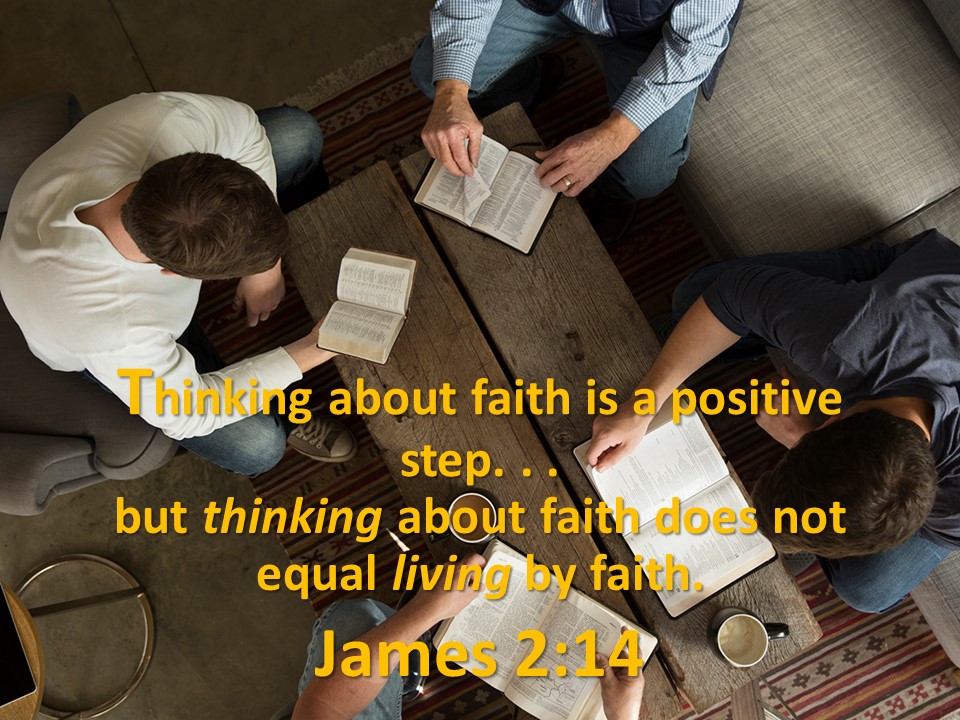
The one who is blessed is the one who lives by faith. Thinking about faith is a positive step, but thinking about faith does not equal living by faith.
Asking about faith, if the inquiry is from a sincere heart, is good. However, asking about faith and living by faith are not the same.
Putting in the effort to learn about faith has the potential to bring great benefits, but learning about faith and living by faith are different. Multitudes receive instruction about faith, but in the end many do not choose to live by faith.
Some pray about faith. Jesus’ disciples appealed to Him to increase their faith (Luke 17:5). Requesting faith and living by faith are different.
Many Christians know and sing the spiritual hymn entitled “Living by Faith.” It is one thing to sing about faith; it is another thing entirely to live by faith.
Talking about faith is not wrong, but do not confuse talking about faith with living by faith. From James 2:14-26, we learn that the kind of faith which pleases God is faith that manifests itself in action. And, it is not only faith in action, but it is action which is in harmony with the revealed will of God. In that context, James referred to the possibility of talking about faith: “What does it profit, my brethren, if someone says he has faith but does not have works? Can faith save him?” (James 2:14). The point: that kind of faith, a faith that is lifeless and non-active, cannot save anyone. One can talk about his faith from the rising of the sun until he goes to bed at night, but if he is not living by faith, his talk is just hot air.
Recently I tried to reason with an atheist about the human body showing design, which would indicate it came from an intelligent Designer. His response was, “You believe what you want to believe and I will believe what I want to believe.” While believing is a choice, you and I do not believe in God, the Bible, Jesus, and heaven because that is our personal whim or feeling, something that we just desire to believe. Biblical faith is always based on evidence (Hebrews 11:1), and like the example of Abel reminds us, faith is man’s response to God’s revelation/instruction (Hebrews 11:4; Romans 10:17).
If one has a faith which pleases God, what does he do? First, he accepts the facts/truthfulness of the Lord’s message, just as Paul exclaimed, “. . . I believe God that it will be just as it was told me” (Acts 27:25). Second, such a person trusts in the Lord, having a sense of dependence on Him (Proverbs 3:5). Third, biblical faith includes submitting to the Lord. When God said Moses did not believe Him (Numbers 20:12), the context shows that meant Moses failed to obey the Lord. Real, God-pleasing faith is demonstrated by submitting to the Lord’s will.
“Living by faith” is an ongoing process. It is what God wants us to do each day: trust in Him and have a heart that is ready to obey Him at all times. When the devil sends his fiery darts our way, a strong faith can serve as a shield to protect us (Ephesians 6:16). Whether it feels like matters are going smoothly in our lives or we are facing disappointment, turmoil, and opposition, let us keep on choosing to live by faith. BY ROGER CAMPBELL
“GOD LOVES YOU AND I LOVE YOU AND THAT’S THE WAY IT’S GONNA BE!” – MIKE
 INCARNATE