
Take Heed to WHOM?

There are several reasons for elders taking heed to themselves.  One reason is because elders have a soul to save, viz., their own…

reflection

PAUL’S ADMONITION TO the elders of the church of Christ at Ephesus is a pertinent challenge to all elders. An analysis of this inspired advice to the Ephesian bishops shows the importance of elders taking heed to themselves…

Paul urged, “Take heed to thyself…”  The word translated “heed” literally means: “to hold to, . . .turn one’s attention to . . .”  There are several reasons for elders taking heed to themselves.  One reason is because elders have a soul to save, viz., their own (Mat. 16:26).  Elders, like preachers, may become preoccupied with the spiritual needs of others to the degree that they lose sight of their own spiritual liabilities and personal needs.

As surely as elders must be men of great spiritual stature they must “take time to be holy.”  Spiritual development and maturity is a process which involves prayer, devotional Bible reading, and meditation on things of God (Psa. 1; 119; 2 Tim. 2:15; Phil. 4:8).

Elders are not immune to temptation.  They may give in to sin, succumb to subtle solicitations to violate or neglect the will of God, and they may become discouraged with their own efforts to live the Christian life and/or the efforts of others.

There is another reason elders must “turn attention” to themselves: elders lead in spiritual matters by example.  They must be diligent in developing and maintaining a godly character.  Can a spiritual pygmy successfully lead the saints of God?  Elders must spiritually “stand head and shoulders” over the crowd.  The concept of church edification means that God’s people grow and develop spiritually.  They develop Christlike characters.  But Christlike leaders must show the spirituality and demonstrate the possibility of accomplishment in this vital area of Christian living.  (Tom Holland, “ELDERS – THEIR DUTY OF SELF-EXAMINATION,” The Spiritual Sword, Vol. 9, Ap., 1978, Num. 3, 8).

“Therefore take heed to yourselves and to all the flock, among which the Holy Spirit has made you overseers, to shepherd the church of God which He purchased with His own blood” (Acts 20:28).

“God loves you and I love you and that’s the way it’s gonna be!” – Mike
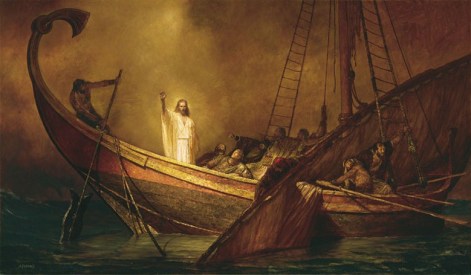
 

Teacher, Do You Not Care?

The Lord purposely steered this little band of future church leaders into the tempest and then went to the back of the boat to lay down on a cushion for a power nap…

storm

Matthew and Luke don’t bear this out in their records, but they do tell us about the disciple’s fear: “Then His disciples came to Him and awoke Him, saying, ‘Lord, save us! We are perishing!’” (Mat. 8:25). “And they came to Him and awoke Him, saying, ‘Master, Master, we are perishing…!’” (Luke 8:24).

But Mark uniquely communicates their aggregate anxiety in the form of a question: “But He was in the stern, asleep on a pillow. And they awoke Him and said to Him, ‘Teacher, do You not care that we are perishing?’” (Mark 4:38). The NET version translates it, “Teacher, don’t you care that we are about to die?”

What strikes me about this entire episode is that—put your seat belt on—JESUS INTENTIONALLY LED THE GROUP INTO THE STORM. You might need to read that again because it’s not a misprint.

Yes, the Lord purposely steered this little band of future church leaders into the tempest and then went to the back of the boat to lay down on a cushion for a power nap: “Now when He got into a boat, His disciples FOLLOWED Him” (Mat. 8:23). “On the same day, when evening had come, He said to them, “Let us cross over to the other side.” (Mark 4:35). “Now it happened, on a certain day, that He got into a boat with His disciples. And He said to them, ‘Let us cross over to the other side of the lake.’ (Luke 8:22). That’s right—it was Jesus who led the group on this frightening excursion.

And that’s because He was eventually going to leave the early church in the hands of this weak rabble of Jewish devotees. And one of the ways THEY would learn to trust in Him and lead with such courage was by riding it out on the whitecaps and watching His deliverance. “Teacher, don’t you care that we are about to die?”

Did Jesus care?! Of course He cared—and that’s why He took them out on the boat trip across Galilee in the first place!

The disciples obviously knew that He had miraculous ability or they never would have awakened Him. They had witnessed His mighty works and knew something of His identity. If they believed that He was impotent to affect change on the circumstances they would have never roused Him from His slumber. You see, they knew that He had power; they just didn’t recognize that He had ALL power—over sickness and disease, over sin, over the grave, over demonic forces, and even over the elements themselves.

Jesus cared so much that He let them learn that important lesson out on the troubled waters of the sea.

Want a mustard seed for today?

If your boat is filling up with water from the monsoon, if the wind looks to collapse your sails and shatter your mast, IT COULD BE that’s exactly where the Lord wants you to be. You see, SOMETIMES Jesus takes you out on the lake and let’s you watch the squall (to the point where you think you’re going to die! Mark 4:38) so that you can learn to lean on and trust in Him!

If you never get scared, how will you ever learn to place your whole-hearted faith in Him (Job 13:15)?! How else can you learn that He really cares (1 Pet. 5:7)?

What really makes me chuckle about his storm story is that one minute the disciples are afraid of the wind and waves, and then the next minute, they’re really afraid of the Man who stopped it all with a sentence. “And they feared exceedingly, and said to one another, ‘Who can this be, that even the wind and the sea obey Him!” (Mark 4:41). What a way to learn and build faith!

Are you afraid? Is your craft about to capsize?

I have a recommendation. Don’t ask Jesus if He cares, because He does. Ask Him and trust Him…to calm the storm…in your heart (Phil. 4:6-7).

“God loves you and I love you and that’s the way it’s gonna be!” – Mike

WHAT is the Most Deadly Virus?

The virus of relativism was blowing in the wind, along with a virulent secularism determined to propel any remnants of biblical Christianity out of the public square.

virusB

When I originally wrote this book more than twenty-five years ago, the winds of the “me generation” were blowing a strong and deadly virus through the culture.

The cultural revolution that had taken root in the 1960s was beginning to reach full flower, as seen in the abandonment of traditional values and moral standards in almost every sector.

“Do your own thing” became the slogan that guided choices and behaviors, closely aligned with “I gotta be me!” and “I owe it to myself.”

The virus of relativism was blowing in the wind, along with a virulent secularism determined to propel any remnants of biblical Christianity out of the public square.

It was period of time marvelously captured in a biblical statement that serves as a description slogan for a period in Israel’s history known as the time of the judges: “Everyone did what was right in his (or her) own eyes.”

Even at my most pessimistic moments back then, I would not have imaged that things could or would unravel as quickly or as drastically as they have.

We have experienced a cultural “perfect storm,” due to the convergence of forces such as moral relativism, aggressive pluralism, determined secularism, “do it yourself” spirituality, and libertarian individualism, aided by the technological realities of the information age.

The implications for followers of Jesus Christ are obvious.

We cannot hermetically seal ourselves from the spirit of the age so that we live in splendid isolation from it.

In fact, we must not.

First, our sovereign Lord calls us to live in the world for His glory, and monasticism and isolationism are not biblical options.

Our mandate from the risen Christ prohibits retreat.

Besides, the attempt is futile. There is no place to hide. Virtually every segment of modern culture has become a carrier of values alien to those of the kingdom of Christ.

We confront the open expression of these anti-Christian values in academia, the media or the entertainment industry; commonly in the operations of our daily life that bring us into constant contact with lifestyles we are expected not merely to tolerate or accept, but to celebrate; and less directly in spheres of commerce and technology.

Sadly, the spirit of the age often takes its most deadly form when it is absorbed into the professing Christian community.

Much more than I want to admit, many Christians live, act, and choose as if God’s Word had never been written.

How do we live in a society without fixed standards, a society daily becoming more secular and pagan?

God’s call is clear: “Prove yourselves to be blameless and innocent, children of God above reproach in the midst of a crooked and perverse generation, among whom you appear as lights in the world, holding fast the word of life” (Phil. 2:15-17 NASB).

These are important verses.

They remind us that we are not simply to survive the moral confusion and spiritual anarchy that surrounds us, somehow staying unpolluted by the world.

We are also to shine, reflecting the glory of the Lord Jesus to a world that desperately need to see Him.

In other words, we are not just to be good in the midst of evil.

We are not even just to be good for something, serving others.

We are to be agents of our King, pressing His kingdom and its values into our culture and forming communities that are outposts of his kingdom, demonstrating to the world another, and a better, way to live life.  (Gary Inrig, “Hearts of Iron, Feet of Clay,” 7-8)

“God loves you and I love you and that’s the way it’s gonna be!” – Mike
What About those Mutations?

We all ‘read’ messages through our past hurt, our present circumstances and our prejudged expectations…

dna-structure-562597795-5ae77532c06471003681d684

When I preach I am often shocked at the disconnection that occurs between the words and that I speak and the words that are heard.

I have often had a discussion with a member of a congregation after church service who is convinced that I said something that I didn’t say.

When the video, tape or other people are consulted and it becomes clear what was actually said, the individual sometimes becomes intransigent: ‘Well, I know what I heard, and it’s not what you say that you said!’

What we are seeing here is a problem of decoding.

The same communication problem operates in the field of genetics.  Information is passed from one generation to another via a genetic code.  Sometimes, however, in the process of exchange some sort of mutation or change takes place that causes the process to go awry.  The information received is not the same as that passed down.

The principle that we must be aware of if we are to receive the exact messages that are sent is that we all ‘read’ messages through our past hurt, our present circumstances and our prejudged expectations.  In other words, we screen or decode messages through a filter, and occasionally that filter is not always clean (emphasis mine–mb).

For instance, when I teach on the subject of relationships, occasionally I have read out a list of common words and asked the audience to write down their immediate feelings when I mentioned them.  I then compare answers.  If I use the word ‘father’, for example, the feelings swing from ‘love’ and ‘security’ to ‘hatred’ and ‘pain.’  Their recorded emotions reflect their past.

What I am attempting to illustrate to them is the difference between denotation and connotation.  If we look up the word ‘father’ in the dictionary, it has a literal meaning or denotation, yet it may, as we have seen, have a completely different specific meaning or connotation to each of us. So if I use the phrase ‘God is our Father’ without explanation from the pulpit, I am in danger of being misinterpreted since everyone will decode the phrase differently.  On top of the problem of connotation, people tend to add their feelings of rejection, their poisoned perceptions and their ill-informed expectations (Robert Fergusson, “A Plank Across a Stream,” Making Connections That Work, 166-167).

“Therefore do not be unwise, but understand what the will of the Lord is (Eph. 5:17).

“God loves you and I love you and that’s the way it’s gonna be!” – Mike