Do You Remember the Tragedy?

Tribute in Light

I HAVE A vivid recollection of that day.

My wife came in the room, turned on the TV set and then spoke in shaken tones. 

She said, “They’ve flown a jet-liner into one of the World Trade Center towers in New York…”

For the next several hours I sat transfixed before the television and watched in horror as the events of 911 unfolded.

wtc3

Twentyfour years after that dreadful day, some Americans, like myself, look back on September 11 with intense emotion.

We recall those gaping wounds in the sides of the towers.

We remember those ill-fated flights and how they were intentionally slammed into the very icons of our nation.

We remember those thick plumes of noxious smoke as they bellowed out of the top of those lofty skyscrapers and into our collective conscience.

We remember our own anxiety and ponder what must have raced through the hearts of fellow-citizens as they contemplated the end of their earthly existence and the brevity of human life.

We remember the internal shock of watching the first, and then the second tower plummet to the ground.

We remember those feelings of helplessness and despair as lower Manhattan was engulfed in ash and debris. 

But may I suggest, dear reader, that there is a far more terrible tragedy that warrants our joint remembrance.

Every first day of the week (Acts 20:7), we need to call to memory (1 Cor. 11:23-26) those horrific events which transpired nearly 2,000 years ago:

  • We need to remember the murderous plot against the innocent Son (Mt. 26:3-4; Heb. 4:15; 7:26).
  • We need to remember the Lord’s internal struggle as He pondered His impending death (Mt. 26:37-39).
  • We need to remember His betrayal at the hands of one of His own disciples (Mt. 26:47-50).
  • We need to remember the ill-informed attempt to thwart His crucifixion (Mt. 26:51-54).
  • We need to remember the disciples’ cowardice and how they fled for their lives when He needed them the most (Mt. 26:56).
  • We need to remember the howls of the angry mob as they shouted, “Crucify Him! Crucify Him!” (Mk. 15:13-14).
  • We need to remember the incredible injustice of both the Jewish and Roman courts (Mt. 26:57ff).
  • We need to remember Pilate’s timidity before that blood-thirsty crowd (Mt. 27:24-26; Lk. 23:13-25).
  • We need to remember the brutal flogging (i.e., “little death”) at the hands of the Roman lictors (Jn. 19:1).
  • We need to remember Peter’s lying about his association with Jesus (Mt. 26:69-75).
  • We need to remember the slanderous mockery of the soldiers, priests, and thieves (Mt. 27:27ff; 39-44).
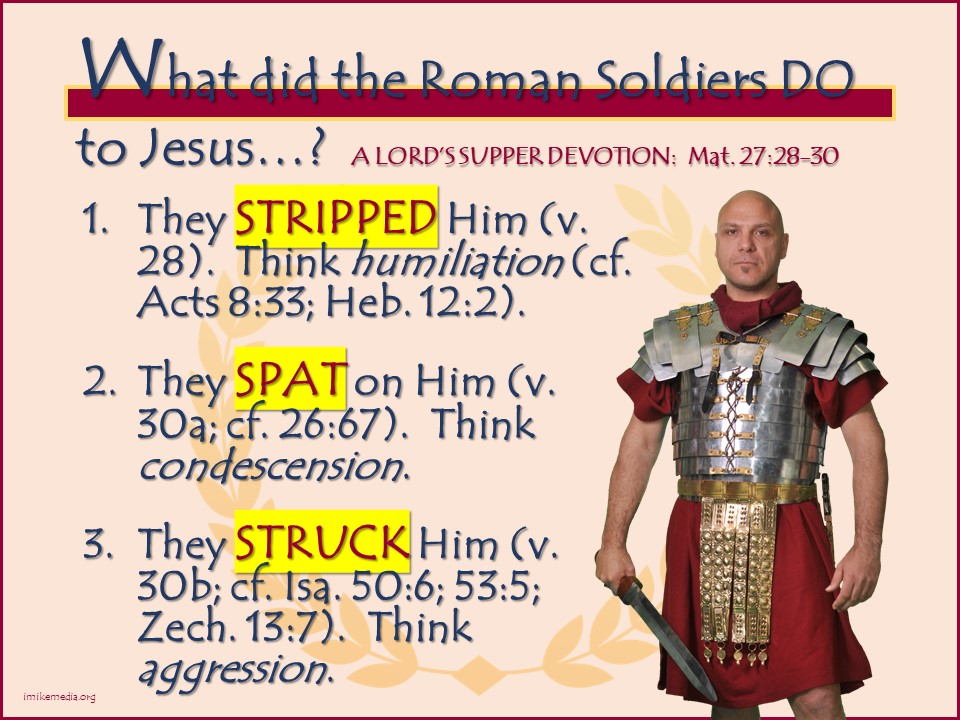
  • We need to remember the Lord’s humiliation as He was stripped of His clothing and numbered with lawless, ungodly men (Isa. 53:12; Mt. 27:28; Heb. 12:2).
  • We need to remember that ruthless blow to His head (Mt. 27:30). We need to remember the heavy burden of the cross that was thrust upon His weary shoulders (Mt. 27:32).
  • We need to remember those cruel nails that pierced His hands and feet and how that He was suspended between holy God and sinful man (Jn. 3:14; 12:34).
  • We need to remember the bitter taste of sour wine mingled with gall (Mt. 27:34).
  • We need to remember His desperate cry to His own Father (Mt. 27:46).
  • We need to remember the frightful earthquake that shook the earth the moment the Savior died (Mt. 27:54).
  • Perhaps most importantly, we need to remember that our own sins made this barbaric occasion necessary (1 Pet. 2:24; Isa. 53). 

“Lest I forget Gethsemane, lest I forget Thine agony, lest I forget Thy love for me, lead me to Calvary.”

“Do this in remembrance of Me…” (1 Cor. 11:24, 25).
Have You Ever Slept Through the Lord’s Supper?

Were the infirmities of 1 Cor. 11:30 figurative or literal?

I CAN’T SAY that I’ve given a great deal of thought to this particular passage until a recent Lord’s Day.

The brother presiding at the table brought it to my attention.

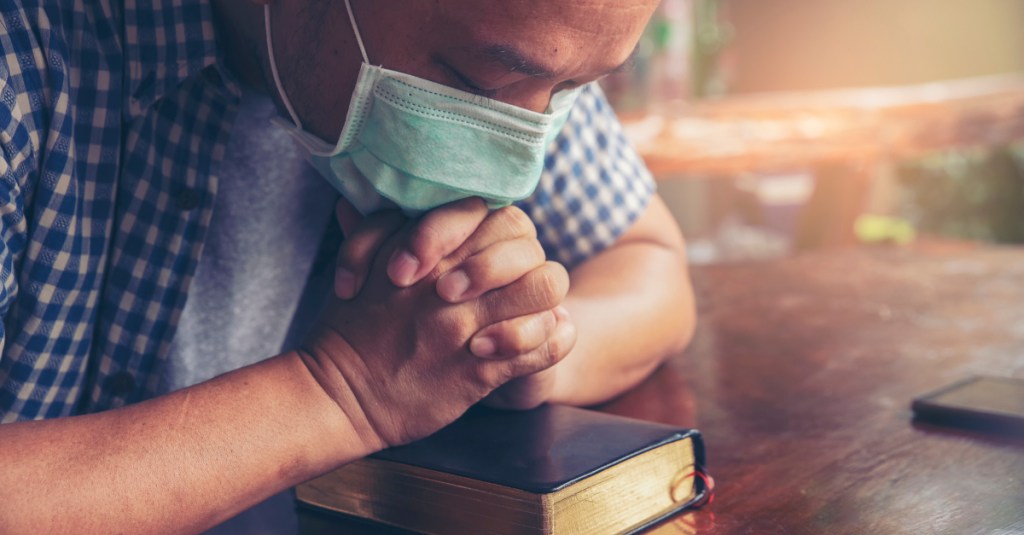
Paul wrote, “Many are weak and sick among you, AND MANY SLEEP” (1 Cor. 11:30 – emphasis mine, mb).

What exactly did the apostle mean when he said, “and many sleep?”

It is possible that he was speaking figuratively.

The brethren at Corinth had merged a common “love feast” covered-dish fellowship meal with the communion (cf. 2 Pet. 2:13).

Yes, their eyes were open, but their hearts were dull and closed – in essence, asleep.

It was a sort of congregational epidemic, kind of like what I heard about years ago in the Knoxville, Tennessee area with the flu more than a half a decade before Covid struck the U.S..

Brethren couldn’t shake hands or hug lest they spread the rampant, life-threatening virus.

Well, members at Corinth could shake hands and hug, physically and metaphorically speaking, but evidently they didn’t.

On the contrary, they divided and separated (vv. 17-19; cf. 1:10-12) and failed to exhibit brotherly love, care and affection.

What the Lord had initially intended as a feast for the soul had been incrementally warped and twisted into a gluttonous feast for the belly (1 Cor. 11:21).

What made it even worse was the fact that some were eating while others were actually going hungry.

The church body was “coming together” (vv. 17-18, 20, 33-34) at the same location (v. 20), but they certainly weren’t coming together in the highest sense of the phrase.

“Many are weak (i.e., feeble and infirm) and sick (i.e., powerless, without strength) and many SLEEP” (are dead).

A number of commentators think this refers to a kind of divine judgment (cf. v. 32) against various members of the congregation – akin to what had happened to Ananias and Sapphira (Acts 5:1-11; cf. Rev. 2:21-23).

They believe Paul was speaking literally.

In essence, they are convinced God actually made some members physically ill because of their divisive and unlovingly hypocrisy (v. 34).

That is a plausible interpretation and merits further study.

One brother thinks they were the former:

“They were languishing with spiritual infirmities (cf. lukewarm, Rev. 3:15-16, and those who had left their first love, Rev. 2:4). Because they had failed to discern the body (to properly remember the sacrificial death of Christ and its necessity of their salvation) they had grown negligent and lost interest in the higher values of life and eternity” (Winters, 159 – emphasis mine, mb).

IF these afflictions were in fact figurative, it’s scary to realize that this spiritual virus can still infect precious hearts today.

Brethren can be deer-in-the-headlights awake as they consume the loaf and swallow the fruit of the vine and yet simultaneously be in a spiritual stupor – physically awake, but spiritually asleep as Winters suggests.

Beloved, may I lovingly probe our hearts with the scalpel of the Word (Ps. 139:23; Heb. 4:12)?

Can we really partake of the communion and then intentionally avoid our own brethren following the assembly?

Can we, in God’s eyes, feast one minute on a minute piece of unleavened bread and drink the contents of the cup and then bad-mouth a fellow child of God the very same hour?

Can we sup and then later serve roast preacher and poached shepherd?

Can we close our eyes in silent meditation as we allegedly commune with the Lord Jesus, and then refuse to do the same with other members of His precious blood-bought body after the very same assembly?

Obviously these are rhetorical questions.

Of course we can’t.

Period.

Dot.

End of sentence.

Sure, we can consume crackers and juice and then salve our conscious’ by saying, “Look Lord, we took the emblems!”, but the reality is, doing so may actually indicate our inner weakness, sickness, or perhaps worst of all, spiritual slumber or death (cf. Mat. 9:12).

I have an exhortation.

Let’s observe, partake, worship, and evaluate our hearts – and then let’s really show one another, as well as the world, that we are one in Christ.

“For we, being many, are one bread and one body; for we all partake of that one bread” (1 Cor. 10:17).

“God loves you and I love you and that’s the way it’s gonna be!” – Mike