QUESTION: “Did Jesus immediately forgive those who were crucifying Him when He said, ‘Father, forgive them, for they do not know what they do” (Lk. 23:34)?”
Let’s carefully study your Bible question together. NOTE:
Luke 23:34 was a PETITION–not a DECLARATION, but when Jesus forgave people during His earthly ministry, He did not petition, rather He declared:
. The Paralytic man–“Son, be of good cheer; your sins are forgiven you.” Mat. 9:2
. The woman in the Pharisee’s house–“Your sins are forgiven.” Lk. 7:48
When the Lord said, “Father, forgive them…” He was asking God to give His executioners the time and opportunity to learn the truth and repent. Instead of calling for their immediate punishment, which they obviously deserved, Jesus sought mercy because a) they didn’t recognize Him as the Messiah, b) they misunderstood the prophecies about Him, and c) they acted in ignorance rather than full knowledge. Watch:
. “Yet now, brethren, I know that you did it in ignorance, as did also your rulers.” Acts 3:17; see also 13:27; 17:30
. “Which none of the rulers of this age knew; for had they known, thy would not have crucified the Lord of glory.” 1 Cor. 2:8
. NOTE: Jesus told Pilate: “He who delivered Me to you has the greater sin.” (Jn. 19:11). Judas had greater sin because He betrayed and delivered the Lord to the authorities knowing full well that He was the Son of God (see Mat. 26:14-16; 47-48; 27:3).
If the Jews who killed Jesus were immediately forgive at the cross then:
. They didn’t know it–because fifty days later when Peter preached at Pentecost and reminded them that they had, in fact, crucified the Lord (Acts 2:23, 36), their hearts were pricked and they asked, “Men and brethren, what shall we do?” (v. 37). There was no reason to ask that question if they had already been forgiven by Jesus several weeks earlier.
. Peter didn’t know it–because he told them, “Repent and let everyone of you be baptized in the name of Jesus Christ for the “remission” (Greek–aphesis, “pardon”) of sins…” (v. 38). If they had been immediately forgive back at the cross, why didn’t Peter correct their misunderstanding and say, “There’s nothing for you to do my friends because Jesus declared you forgiven before His death at Calvary?”
Jesus’ petition at the cross was answered in the affirmative by the Father when those who had crucified Him were given the opportunity to have their sins washed away on the Day of Pentecost in Acts 2 when they obeyed the gospel (Acts 22:16; see also 1 Cor. 15:1-4; 2 Thes. 1:8; 1 Pet. 4:17).
SEVENTEEN verses. Seventeen long verses of genealogy with hard-to-pronounce names like Zerah, Hezron, Amminadab, Nahshon, Rehoboam, Jehoshaphat, Uzziah, and Jeconiah—just to name a few.
From a modern vantage point, this might not have been the most effective way to start a New Testament book—much less the first book of the New Testament. I mean, let’s face it, genealogies can be, dare I say it, bland at best, and yet that’s exactly how the Holy Spirit in His infinite wisdom chose to initiate this particular gospel account. This tells us that Jesus’ genealogy is here for a reason—and as we incrementally read our way through these seventeen verses of Scripture, we begin to uncover the Divine method behind this literary madness.
Note first part of verse 1: “The book of the genealogy of Jesus Christ, the Son of David…” This esteemed personality would have immediately caught the eyes and hearts of every dedicated Jewish reader who was looking for the Messiah because “The Son of David” not only rooted Jesus Christ in David’s lineage, but it also demonstrated that God had kept His promise and “establish(ed) the throne of (his descendant’s) kingdom forever (cf. Ps. 89:29; 132:11; Lk. 1:32; Acts 2:30-36). It therefore it comes as no surprise then that Matthew often employs the phrase “Son of David” as a messianic title for Jesus, reminding His readers that Jesus was not some usurper to the throne, but that He was the legitimate heir and ruler of that eternal kingdom (9:27; 12:23; 15:22; 20:30-31; 21:9, 15; 22:42).
But notice also the latter part of verse 1: “The book of the genealogy of Jesus, the Son of David, the Son of Abraham.” This description not only placed Jesus in the lineage of Israel going all of the way back to father Abraham, but it also vividly demonstrated that He was/is the fulfillment of God’s promises, not only through David, but through Abraham as well. Back in Genesis, God told Abraham, “And in you all the families of the earth shall be blessed” (Gen. 12:3b), “In your seed all the nations of the earth shall be blessed…” (22:18b). Paul later explains that Jesus was/is that “seed” of Abraham (Gal. 3:16).
But there is another fascinating detail about the Jesus’ genealogy that commands our attention. Matthew not only connects notable women as well. Ironically, Old Testament genealogies were concerned with male, as opposed to female, lineage—and yet, here they are in this inspired account: 1) Tamar (v. 3) who disguised herself as a prostitute and committed fornication with her father-in-law Judah (cf. Gen. 38), 2) Rahab (v. 5) the notorious Canaanite prostitute of Jericho (cf. Josh. 2), 3) Ruth (v. 5) the Moabite of whom God had said, a “Moabite shall not enter the assembly of the Lord” (cf. Ruth 1-4; cf. Deut. 23:3), and finally, 4) Bathsheba (v. 6) not mentioned by name, but is referred to as “her who had been the wife of Uriah,” who committed adultery with a king (cf. 2 Sam. 11).
All four of these women would have certainly been shunned by the elite Jewish society of Matthew’s day, and yet the Bible lets us know why they, like David and Abraham, were also included in Jesus’ lineage. You see, while Christ is the Son and Seed of the likes of as David and Abraham, He also is the descendant of broken, imperfect, weak, and sinful people, which is exactly why you and I cannot and must not pass over His genealogy. Jesus the Anointed One/Messiah, the Son of David, the Son of Abraham, and the offspring of sinners—is uniquely qualified to serve and save sinners Himself (Heb. 4:15; Lk. 19:10) because He Had sinners in His own family tree!
Good brethren, please don’t pass over this genealogy in Matthew. What might initially seem like a poor way of starting a book, is actually a storehouse of faith-building, soul-strengthening truth.
FOR DEEPER UNDERSTANDING:
1. Give some reasons as to why the Jews were so interested in genealogies.
2. How is Matthew’s genealogy of the Christ different from Luke’s?
3. How could Jews know to refer to Jesus as “Son of David?” Be specific
4. What is the relationship between Old Testament genealogies and the promises of God?
If the resurrected Christ couldn’t be found in the tomb, WHY would a child of God want to linger there today?
WALK with the little band of heartbroken women early Sunday morning as they make their way to the place of interment (Mk.16:1-2). In their final act of tender homage, the ladies hope to anoint the deceased body of Jesus with spices and fragrant oils (Lk. 23:55-56; cf. Jn. 11:39).1
WORRY with the women as they grapple with who might maneuver the heavy stone and grant them inner access to the tomb (Mk. 16:3). Surprisingly, when they reach their destination, they discover that the stone has already been rolled aside (Lk. 24:2).2
WATCH with the women as they enter the sepulcher and begin their astonishing survey. There are linen burial garments, but there is no crucified Savior (Lk. 24:3; Jn. 20:7). There are two angelic pallbearers arrayed in shining apparel (cf. Mat. 17:2; Acts 1:10),3 but the sinless One who briefly lodged there is conspicuously absent (Jn. 20:12; Mat.12:40). Had His body been stolen by enemies (Jn. 20:2, 13; cf. Mat. 27:64)?
WONDER lastly—and listen as the angels speak to the frightened women. “Why do you seek the living among the dead? He is not here, but is risen!” (Mk. 16:5-6; Lk. 24:5b-6a).4 It is irrational for the women to be looking for the Resurrection and the Life in a place reserved for a corpse (Jn. 11:25; Rev. 1:18).
Good Christian, you’ve no doubt retraced this wondrous journey many times in your mind in the context of the Lord’s Supper (Lk. 22:19; 1 Cor. 11:24-25), and/or the death of Christ. You too have walked, worried, watched, and wondered with these very same women, but have you considered the personal and practical side of his inspired narrative—especially as it pertains to the empty tomb and your own life in Christ?
Think about it. Why were the women in these gospel accounts searching for the living Lord in a grave…? Jesus had predicted His resurrection on multiple occasions (Mat. 16:21; 17:22-23; 20:17-19; 26:2; 27:63), so the women should have been expecting it, right (Mat. 12:20; cf. 27:63; Mk. 8:31; 9:31; 10:33-34)? For that matter, knowing that truth, why did they even bring spices to anoint Him in the first place?
But revisit the question posed by the angels, “Why do you seek the living (Jesus) among the dead (in a tomb)?” Since the women knew that Jesus would be raised, and since the tomb was vacant, it made no sense for them to be looking for Him there.
Here’s the point. If the resurrected Christ couldn’t be found in the tomb, WHY would a child of God want to linger there today? To borrow from Paul, “How can [a Christian—mb] who DIED to sin STILL LIVE IN [sin]?” (Rom. 6:2b ESV; cf. Rom. 13:14; Eph. 2:3). The obvious answer is, “He can’t” (1 Jn. 3:9). When a person dies to self, is buried in the watery grave, and then RAISED to walk in newness of life (Rom. 6:3-4; 17-18), wouldn’t you agree that it’s incongruous for him to later be found lingering back in the old grave of sin and death (1 Jn. 2:15-17; cf. Col. 3:5-10)? “Why seek the living among the dead…?”
A raised person simply doesn’t dwell in, live or abide in, or make his home in the tomb. “He is not here!”
A raised person won’t be found in the tomb of addiction. “He is not here!”
A raised person refuses to lie down in the dark sepulcher of fornication. “He is not here!”
He doesn’t wander around in the cemetery of deceit, lies, or dishonesty. “He is not here!”
He doesn’t lodge in the spiritual death-sphere of gossip and backbiting. “He is not here!”
A raised person refuses to settle near the cadaverous realm of anger, wrath, and hatred. “He is not here!”
He doesn’t dwell in tomb-gutter of filthy language and blasphemy. He is not here!”
He won’t sit in the putrefying seat of the scornful. “He is not here!”
He refuses to tarry in black hallows of worldliness. The angels proclaimed, “HE IS NOT HERE!”
That was all in the past, back at the grave—but the grave is empty now (Col. 3:1; Rom. 6:4), and the sinner has conquered the black abyss of sin through obedient faith and the resurrection power of Jesus Christ (1 Pet. 1:3-4).
Lovingly but firmly, may I ask, dear brother, “Where is your habitation at this moment? Are you walking with the risen Christ, or are you still lingering back at the tomb?” Think about it.
1 Joseph and Nicodemus had initiated the preparation of Jesus’ body on Friday by wrapping it in linen (Lk. 23:50-53), and now Mary Magdalene, Mary the mother of James, Salome, Joanna, and other women seek to finish this ministry on Sunday (Lk. 24:1, 10).
2 The woman may not have known about the Roman detachment assigned on the Sabbath by Pilate to watch the tomb (Mat. 27:62-66). The guards, terrified by the great earthquake and the appearance of angels, fled their post, returned to the city, and then reported their experiences to the Jewish leaders (Mat. 28:2-4, 11).
3 Reminiscent of the winged cherubim separated by the mercy seat on the Ark of the Covenant (Mat. 28:2; Mk. 16:5; Lk. 24:4; Jn. 20:12; cf. Exo. 25:10-22).
Is it necessary for one who is baptizing to say a certain verbal formula just prior tothe baptism itself?
IS IT NECESSARY, i.e., Scripture required, for one who is baptizing another to say a certain verbal formula just prior to the baptism itself?
Must he actually utter the words, “I now baptize you in the name of the Father, the Son and the Holy Spirit” in order to certify the immersion?
Let’s consider these questions together in the light of Scripture (2 Tim. 3:16-17; 2 Pet. 1:3):
1. QUESTIONS
. What if the immerser says nothing just prior to the candidate’s immersion? Is the immerser guilty of sin? How might he go about repenting of this omission? Would a second immersion be necessary because he was silent just before the baptism took place?
. When a candidate is immersed for the remission of sins is he still in sin because the one doing the immersing did not articulate a specific verbal formula?
. Is any candidate’s salvation in any way dependent upon the verbiage of the individual performing the baptism?
. Is there a specific passage of Scripture which instructs the one doing the baptizing to say a certain verbal formula?
. Is there an approved example in the New Testament which illustrates where the individual doing the baptizing actually said, “I now baptize you in the name of…?”
2. It is essential that we differentiate between what the candidate MUST DO (Acts 16:30), and what the one doing the baptizing COULD SAY.
Every candidate MUST believe on the Lord Jesus and be baptized (Mk. 16:16; Acts 2:38; 22:16; Rom. 6:3-4; 17-18; Col. 2:12; Tit. 3:5), but every individual doing the immersing is free to speak or remain silent at the event.
3. The emphasis in Scripture has to do with the AUTHORITY for baptism and not the exact terminology employed at the time.
As Wayne Jackson states, “No passage in the New Testament, which mentions baptizing ‘into” the ‘name’ of the Father, the Son and the Holy Spirit (or ‘into’ Christ, or ‘in’ His name), has reference to what is being said at the time of the immersion. …There is no allusion whatsoever to a formalized ‘language code’ that is required in order to validate the immersion.”1
Watch:
. “Baptizing them IN (Greek – eis, into) THE NAME OF the Father and of the Son and of the Holy Spirit” (Mat. 28:19b).
. “Baptized IN (Greek – eis, into) THE NAME OF the Lord Jesus” (Acts 8:16).
. “Be baptized IN (Greek – epi, upon) THE NAME OF Jesus Christ” (Acts 2:38).
. “Baptized IN (Greek – en, in) THE NAME OF the Lord” (Acts 10:48).
. “Baptized IN (Greek – eis, into) THE NAME OF the Lord Jesus” (Acts 19:5).
“To be baptized ‘upon the name’ or ‘in the name’ of Jesus suggests the ground or occasion for the baptism. ‘The name’ in the Sacred Writing often denotes the sum of the divine attributes of the Person named; all that is involved in the Being whose name is thus designated. ‘Into the name’ denotes union or communion with. Thayer says that ‘be a usage chiefly Hebraistic the name is used for everything a name covers. . .to do a thing in the name of another, i.e., by one’s command and authority, acting on his behalf, promoting his cause.’ Thus acting by the authority of Christ from the relationship we sustain to him our Redeemer and Lord, we are baptized into a state of union and communion with God the Father, Christ the Son, and the Holy Spirit”‘ (emphasis mine – mb).2
Sometimes one performing a baptism will hold his free hand high in the air as we says, “I now baptize you in the name of…”
Hopefully we all recognize and agree that having his hand in the air is neither required nor commanded.
It is simply a customary activity employed to add (it is argued) solemnity to the occasion.
The person who is being baptized is not in any way impacted by this token gesture.
Well, the same is true of what is said at immersion.
Both hand gestures and verbal statements are merely customs which preachers and other have employed down through the years as they carry out their work.
The key word in that sentence is customs and customs are not commands (cf. Mat. 15:8).
Brethren, let’s be very cautious about speaking where the Bible does not speak and legislating where the Bible has not bound (1 Pet. 4:11; Col. 3:17).
The Word of God does not specify what one doing the immersing must say;3 it does mandate what he must do – immerse!
2 Guy N. Woods, “Questions and Answers – Open Forum,” 165-66.
3 “To be baptized upon the name is to be baptized on the confession of that which the name implies: on the gound of the name; so that the name Jesus, as the contents of the faith and confession, is the ground upon which the becoming baptized rests. In the name (en) has reference to the sphere within which alone true baptism is accomplished. The name is no the mere designation, a sense which would give to the baptismal formula merely the force of a charm. The name, as in the Lord’s Prayer (“Hallowed be thy name”), is the expression of the sum total of the divine Being: not his designation as God or Lord, but the formula in which all his attributes and characteristics are summed up. It is equivalent to his person. The finite mind can deal with him only through his name; but his name is of no avail detached from his nature. When one is baptized into the name of the Trinity, he professes to acknowledge and appropriate God in all that he is and in all that he does for man. He recognizes and depends upon God the Father as his Creator and Preserver; receives Jesus Christ as his only Mediator and Redeemer, and his pattern of life; and confesses the Holy Spirit as his Sanctifier and Comforter. Marvin Richardson Vincent, Matthew 28:19, Word Studies in the New Testament, Vol. 1, 150.
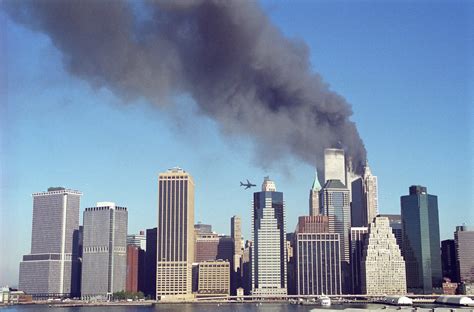
My wife came in the room, turned on the TV set and then spoke in shaken tones.
She said, “They’ve flown a jet-liner into one of the World Trade Center towers in New York…”
For the next several hours I sat transfixed before the television and watched in horror as the events of 911 unfolded.
Twenty–four years after that dreadful day, some Americans, like myself, look back on September 11 with intense emotion.
We recall those gaping wounds in the sides of the towers.
We remember those ill-fated flights and how they were intentionally slammed into the very icons of our nation.
We remember those thick plumes of noxious smoke as they bellowed out of the top of those lofty skyscrapers and into our collective conscience.
We remember our own anxiety and ponder what must have raced through the hearts of fellow-citizens as they contemplated the end of their earthly existence and the brevity of human life.
We remember the internal shock of watching the first, and then the second tower plummet to the ground.
We remember those feelings of helplessness and despair as lower Manhattan was engulfed in ash and debris.
But may I suggest, dear reader, that there is a far more terrible tragedy that warrants our joint remembrance.
Every first day of the week (Acts 20:7), we need to call to memory (1 Cor. 11:23-26) those horrific events which transpired nearly 2,000 years ago:
We need to remember the murderous plot against the innocent Son (Mt. 26:3-4; Heb. 4:15; 7:26).
We need to remember the Lord’s internal struggle as He pondered His impending death (Mt. 26:37-39).
We need to remember His betrayal at the hands of one of His own disciples (Mt. 26:47-50).
We need to remember the ill-informed attempt to thwart His crucifixion (Mt. 26:51-54).
We need to remember the disciples’ cowardice and how they fled for their lives when He needed them the most (Mt. 26:56).
We need to remember the howls of the angry mob as they shouted, “Crucify Him! Crucify Him!” (Mk. 15:13-14).
We need to remember the incredible injustice of both the Jewish and Roman courts (Mt. 26:57ff).
We need to remember Pilate’s timidity before that blood-thirsty crowd (Mt. 27:24-26; Lk. 23:13-25).
We need to remember the brutal flogging (i.e., “little death”) at the hands of the Roman lictors (Jn. 19:1).
We need to remember Peter’s lying about his association with Jesus (Mt. 26:69-75).
We need to remember the slanderous mockery of the soldiers, priests, and thieves (Mt. 27:27ff; 39-44).
We need to remember the Lord’s humiliation as He was stripped of His clothing and numbered with lawless, ungodly men (Isa. 53:12; Mt. 27:28; Heb. 12:2).
We need to remember that ruthless blow to His head (Mt. 27:30). We need to remember the heavy burden of the cross that was thrust upon His weary shoulders (Mt. 27:32).
We need to remember those cruel nails that pierced His hands and feet and how that He was suspended between holy God and sinful man (Jn. 3:14; 12:34).
We need to remember the bitter taste of sour wine mingled with gall (Mt. 27:34).
We need to remember His desperate cry to His own Father (Mt. 27:46).
We need to remember the frightful earthquake that shook the earth the moment the Savior died (Mt. 27:54).
Perhaps most importantly, we need to remember that our own sins made this barbaric occasion necessary (1 Pet. 2:24; Isa. 53).
“Lest I forget Gethsemane, lest I forget Thine agony, lest I forget Thy love for me, lead me to Calvary.”
“Do this in remembrance of Me…” (1 Cor. 11:24, 25).



 INCARNATE